
Smoke Odor Removal: A Practical Guide That Works
People typically start smoke odor removal by buying an air purifier. That's understandable, but it's usually the wrong first move. A purifier can reduce what's suspended in the air, while the strongest odor source may be sitting in curtains, carpet, drywall, upholstery, dust, or the HVAC system, releasing compounds back into the room.
Smoke odor behaves less like a temporary smell and more like contamination distributed through a building. Effective remediation therefore starts with source removal and surface cleaning, then uses filtration or other equipment to capture what remains. Air treatment has a role, but it shouldn't be asked to solve a material problem by itself.
Table of Contents
- Why Smoke Odor Stays After the Smoke Is Gone
- How Smoke Odor Actually Behaves in a Space
- The Cleaning Sequence That Comes Before Any Machine
- Matching the Right Air Purifier to the Job
- Tackling Cars, Fabrics, and the HVAC System
- Knowing When to Call a Smoke Damage Pro
Why Smoke Odor Stays After the Smoke Is Gone
Smoke doesn't disappear when visible haze clears. Combustion creates particles and volatile and semi-volatile organic compounds that travel through a room, settle on cooler surfaces, and remain in porous materials. Research from CIRES and Science Advances describes how these compounds condense on walls, furniture, curtains, and other indoor materials, then slowly off-gas over time. The same research indicates that surface cleaning can provide more persistent odor reduction than ventilation, window opening, or portable air cleaners alone. CIRES explains post-fire smoke impacts and mitigation.
That's why an air purifier often seems effective at first and disappointing later. It removes part of the airborne load, but the room can replenish the odor whenever air moves across a contaminated curtain, carpet, wall, or duct. A purifier is treating the symptom in the air while the reservoir remains untouched.
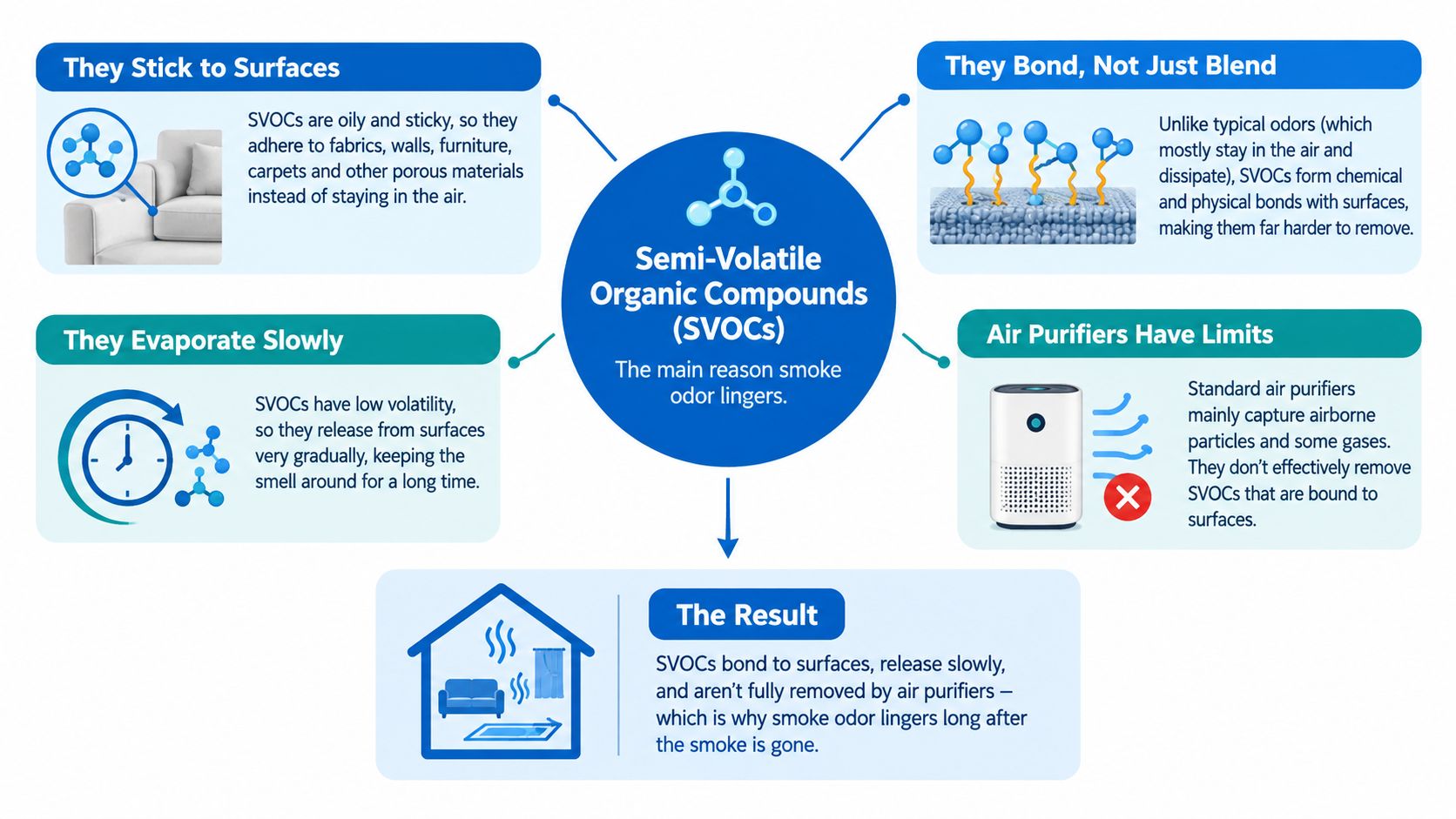
Four places that hold smoke odor
Porous soft goods include carpet, cushions, mattresses, drapes, clothing, and fabric wall coverings. Fibers provide extensive surface area for residue, and dust trapped inside the material can act as a continuing odor source. Laundering, extraction, or replacement may be necessary depending on the severity.
Hard painted surfaces can look clean while holding a thin film of residue. Ceilings, walls, doors, trim, and cabinets collect smoke deposits, especially where warm air rises. Painting over residue without cleaning can trap some odor, but it can also lock contamination into a surface that wasn't prepared properly.
Ductwork and insulation spread the problem beyond the room where smoking occurred. The blower can move contaminated dust through the system, while coils, filter housings, and nearby insulation can retain odor. HVAC contamination deserves separate inspection rather than blind deodorizing.
Trapped air pockets occur behind furniture, inside wall cavities, under flooring, and in closed cabinets. These spaces may exchange air slowly, so they can release odor long after the main room smells better.
Practical rule: If the smell returns when the heat starts, a textile moves, or humidity rises, look for a contaminated reservoir instead of simply increasing purifier runtime.
The practical sequence is straightforward. Identify the reservoirs, remove loose residue, clean hard and soft materials, inspect HVAC pathways, and only then use machines to capture residual particles or gases. A home air quality monitor can help you observe changes in indoor conditions, but it won't replace a material inspection. Explore an indoor air quality monitor as one part of that assessment.
How Smoke Odor Actually Behaves in a Space
Smoke odor follows a recognizable cycle. Understanding that cycle makes the cleaning order easier to choose.
First comes airborne penetration
During smoking or a smoke event, particles and gases move with room air. They enter upholstery, carpet, clothing, curtains, wall pores, cracks, and HVAC returns. Fine contamination can reach areas that aren't directly visible, particularly when the system fan or forced-air heating circulates the room.
Cooling creates deposition
As smoke cools, compounds leave the air and attach to available surfaces. Cooler walls, windows, metal fixtures, and floors can collect residue, while fibers and dust hold it in less visible locations. Common smoke-related compounds include acrolein, formaldehyde, benzene, and polycyclic aromatic hydrocarbons, but the practical point isn't memorizing chemical names. It's recognizing that the odor is carried by a mixture that can settle on materials rather than remaining suspended.
Many textiles don't “soak up” smoke like a sponge. Odor compounds can adsorb onto fibers and dust, meaning they remain on surfaces within the material and can be released when the fabric is warmed, disturbed, or exposed to moisture. That's why vacuuming alone rarely finishes the job, while washing, steam cleaning, or hot-water extraction can remove more of the residue.
Finally, off-gassing returns odor to the room
Temperature and humidity changes encourage re-emission. A carpet can smell tolerable in a cool, dry morning and noticeably smoky after heating, sunlight, or increased moisture. Residue can also rehydrate and release odor compounds, which explains why a room may seem clean until weather changes.
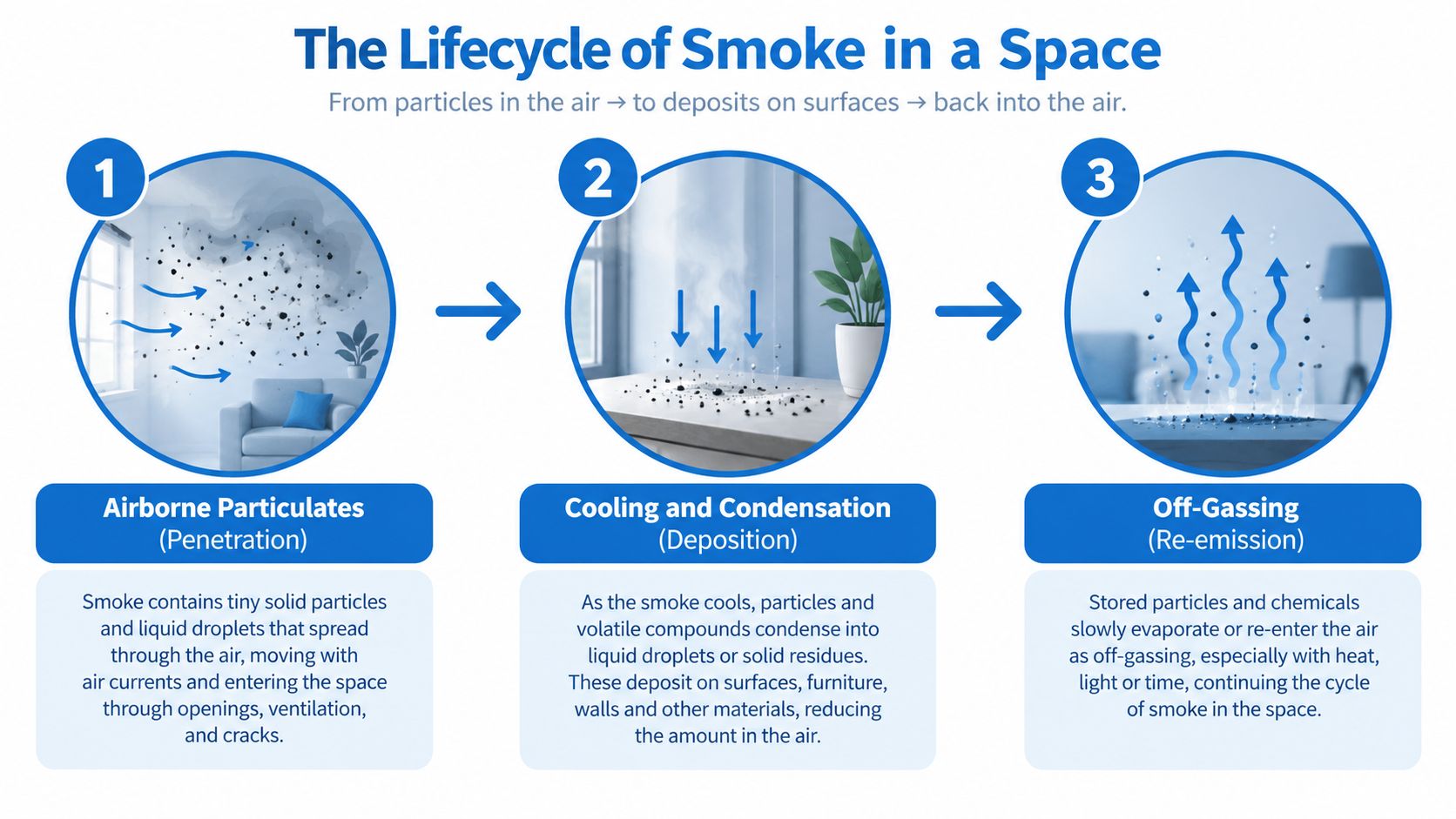
This lifecycle also explains why masking products disappoint. Air fresheners add a competing fragrance, but they don't remove the deposit that keeps releasing smoke odor. Ventilation helps exchange air, yet it can't extract residue from painted surfaces or fabric interiors.
The same principle applies to an air cleaner such as the EcoRoom Plug-In Air Purifier for Small Rooms. Its compact wall-plug design suits small rooms, bedrooms, bathrooms, and offices, but an air cleaner should be treated as a way to improve room air, not as a substitute for cleaning contaminated materials.
The video below provides additional visual context for how indoor air treatment fits into a broader cleanup strategy.
The Cleaning Sequence That Comes Before Any Machine
A professional doesn't begin by filling a smoke-damaged room with fragrance or ozone. The first task is controlling exposure and preventing the HVAC system from redistributing residue.
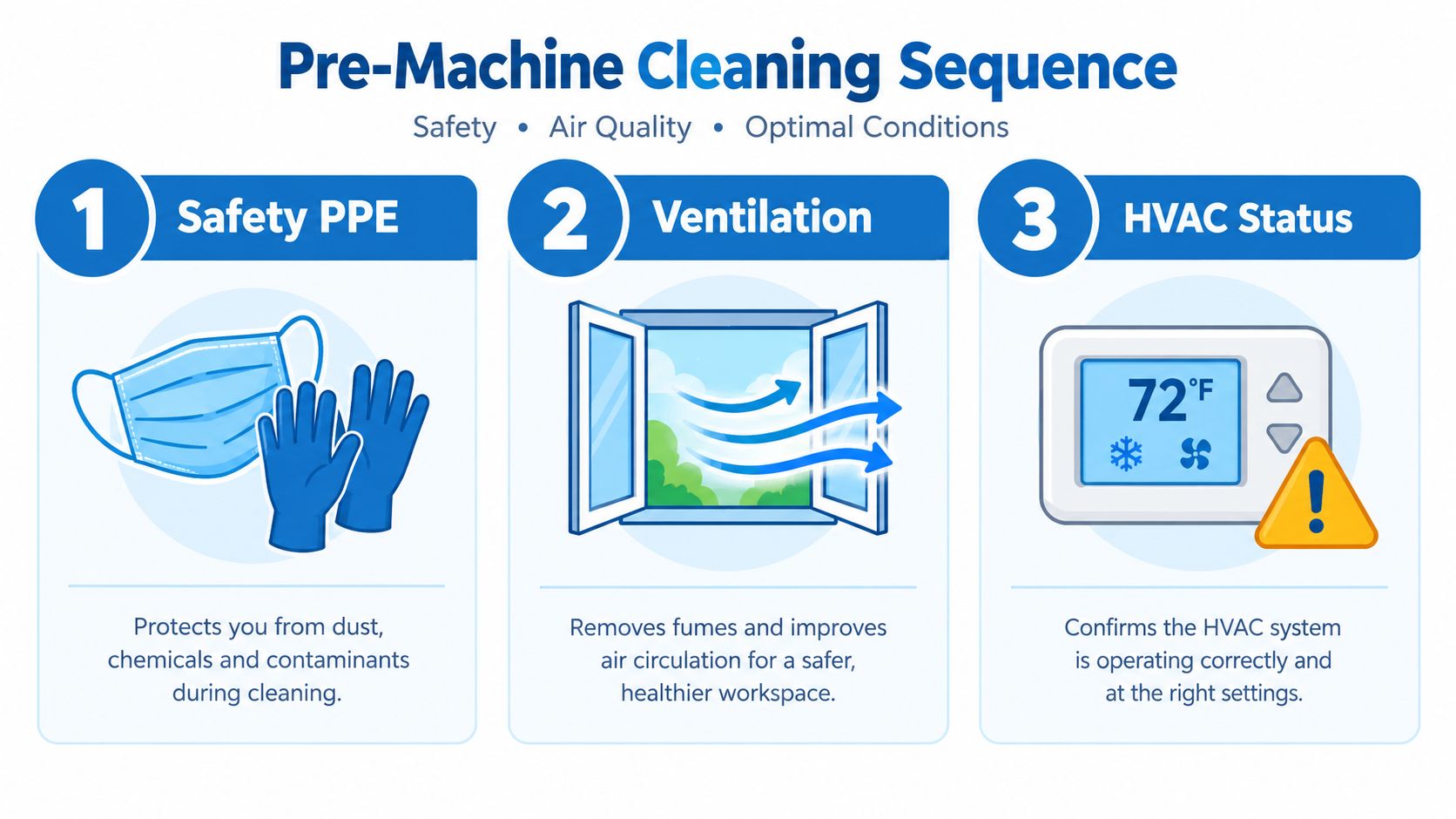
Start safely
Wear gloves, eye protection, and respiratory protection appropriate to the contamination. Open windows when outdoor conditions allow, isolate unaffected rooms, and avoid spreading soot through unnecessary foot traffic. If the HVAC system is visibly contaminated, turn it off until the filter, return path, and air handler have been assessed. If the system is clean and needed for controlled ventilation, follow the equipment manufacturer's guidance and monitor where air is moving.
Loose soot should come off before liquid touches the surface. Wet cleaning too early can smear soot into paint, wood grain, grout, and fabric pores, making the odor harder to remove. Restoration Intel outlines the chemistry and sequence of smoke odor elimination.
Remove dry residue from the top down
Use a HEPA vacuum for loose soot and dust, keeping the nozzle close without grinding residue into the surface. On walls and ceilings, follow with dry-cleaning sponges designed for soot. Work from the ceiling downward, then walls, trim, doors, floors, and fixtures. Replace or turn the sponge surface as it loads, because a dirty sponge can redeposit contamination.
Do not scrub aggressively at the beginning. The aim is to lift loose material before washing, not spread it across a larger area.
Wash, rinse, and evaluate
After dry removal, wash suitable hard surfaces with a degreaser or an alkaline cleaner. Industry guidance commonly places alkaline cleaning in the pH 9 to 11 range for remaining soot and residue. The restoration sequence and pH guidance are described by Restoration Intel. Test an inconspicuous area first, protect flooring, and rinse where the surface and product instructions require it.
Raw wood and drywall may continue to release odor after cleaning. If the material is structurally sound but remains contaminated, a shellac-based or other stain-blocking primer can seal residual odor before repainting. Sealing is a finishing step, not permission to skip source removal.
Treat fabrics as materials, not accessories
Washable items should be laundered with an odor-neutralizing detergent and rinsed thoroughly. Upholstery and carpet often need hot-water extraction, but heavily contaminated or damaged materials may be beyond economical recovery. Mattresses, foam, insulation, and multilayer furnishings can retain odor deep inside, so replacement may be more reliable than repeated surface spraying.
Finish with the HVAC system. Replace the filter, inspect the return and supply pathways, and have the coil, blower wheel, and air handler cleaned when residue is present. A purifier performs better after the source load has been reduced, because it isn't forced to process fresh contamination continuously.
Matching the Right Air Purifier to the Job
Smoke contains two different problems, and one filter technology rarely handles both equally well. Particles call for mechanical filtration. Gaseous odor compounds call for adsorption or chemical treatment, while residue on surfaces still requires cleaning.
A useful technical comparison looks like this:
| Technology | VOC / Odor Removal | Particulate Removal | Notes |
|---|---|---|---|
| HEPA filtration | Limited for gases unless paired with another media | Strong for airborne particles | Important for particle control, but not a complete odor solution |
| Activated carbon | Useful for gaseous compounds, capacity depends on carbon quantity and contact time | Limited by itself | Carbon becomes less effective as its adsorption sites fill |
| Ionization | Variable and dependent on design and operating conditions | Can affect airborne particles | Some systems can generate ozone, so check emissions and safety information |
| Ozone generation | Can react with some odor compounds, but is not a safe occupied-space first choice | Doesn't replace particle filtration | EPA warns that safe public-health concentrations aren't effective for many odor-causing chemicals |
| Photocatalytic treatment | May break down some VOCs under suitable conditions | Not a substitute for particle filtration | Performance depends on catalyst, airflow, contact time, and contaminant |
The EPA specifically warns that ozone at concentrations not exceeding public health standards isn't effective for many odor-causing chemicals. It also states that ozone use belongs only in unoccupied spaces, while concentrations associated with smoke odor reduction can exceed levels generally considered safe for people. Read the EPA guidance on ozone generators.
What the smoke-removal evidence shows
In one study, a nonwoven fabric-supported TiO2 photocatalyst reduced total volatile organic compounds from 0.91 μg/m3 to 0.25 μg/m3 over 24 hours, a 73% removal ratio. The same review described a chamber test in which ozone removed 13% of smoke odor after 30 minutes, while a tabletop filtration device removed 67% under the contaminated-room conditions. Review the smoke and tar odor research in Catalysts.
Those results don't mean every carbon or filtration unit will perform identically in a home. Room volume, airflow, carbon mass, filter condition, temperature, humidity, and source strength all matter. They do show why short-duration ozone treatment shouldn't automatically outrank physical capture or adsorption.
For broader indoor air quality fundamentals, Bear Valley Plumbing & Heating advice offers useful context on filtration, ventilation, and household air concerns. For smoke odor specifically, choose a unit with meaningful activated carbon when gases are the target, and use HEPA when airborne particles are also present. Review smoke-focused air purification options without confusing air cleaning with surface remediation.
Tackling Cars, Fabrics, and the HVAC System
Cars concentrate smoke contamination in a small enclosure. The headliner, seats, carpet, door panels, seat belts, and cabin filter can all carry odor, while the HVAC system repeatedly cycles air across those materials.
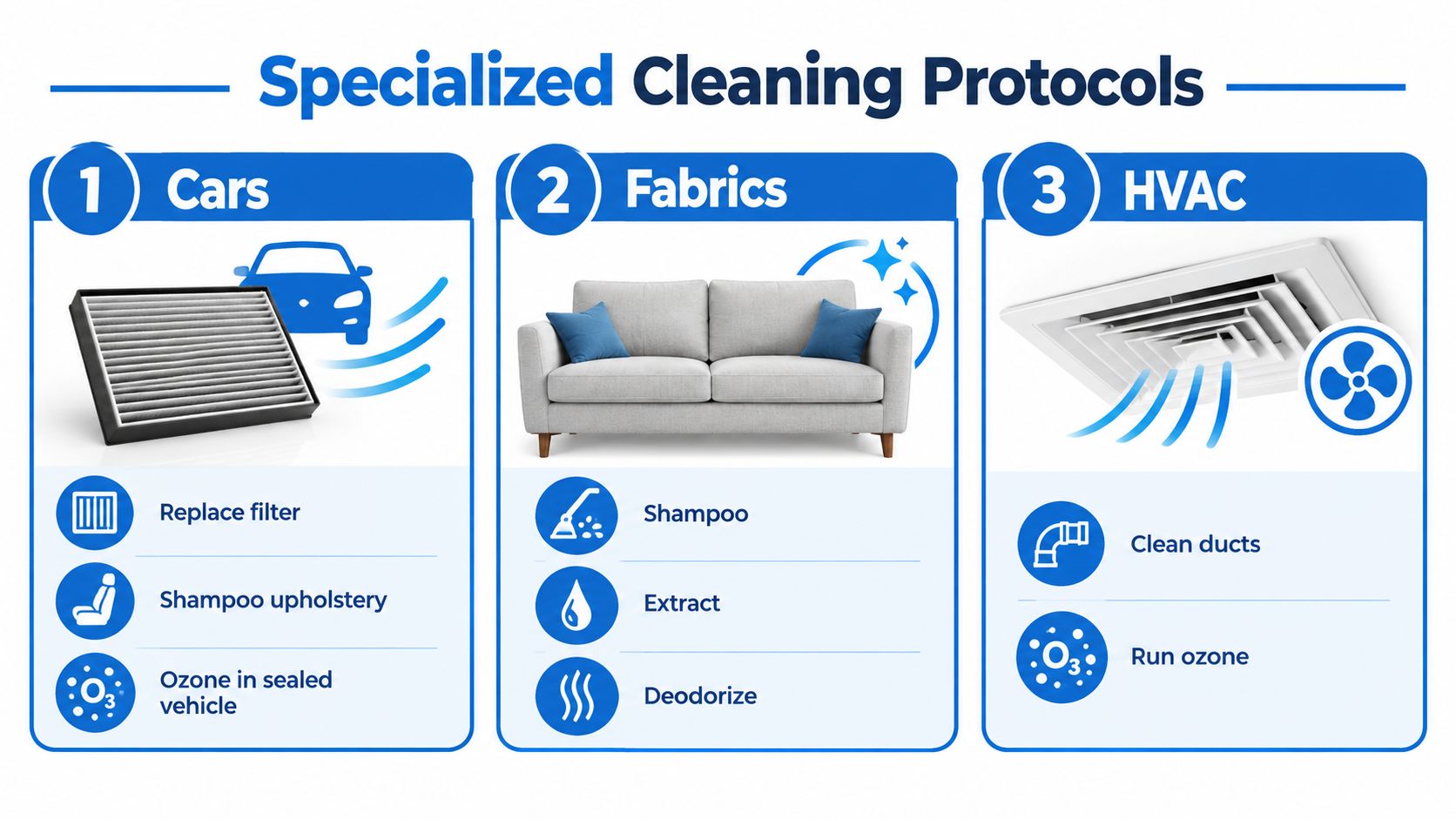
Cars need a cabin-first approach
Replace the cabin air filter before deodorizing. A loaded filter can continue releasing odor and can restrict the effectiveness of later air treatment. Vacuum the interior with a HEPA-equipped machine, shampoo fabric upholstery and carpet, clean hard trim, and treat the headliner gently so adhesive and backing aren't damaged.
After physical cleaning, a professional may use ozone in an empty, sealed vehicle with the HVAC on recirculate. Nobody should occupy the vehicle during treatment. The car must be opened and ventilated thoroughly before use, and the treatment shouldn't be treated as a replacement for cleaning. A practical car-specific reference is this guide on how to remove smoke smell from car.
Fabrics require the correct route
Washable textiles benefit from hot-water laundering, an odor-neutralizing detergent, and repeated rinsing. Test dyes and finishes first. Vinegar may be used as part of some household laundry routines, but never mix cleaning chemicals casually, and don't assume a soak can rescue foam, batting, or heavily smoke-saturated material.
Dry-clean-only items should go to a qualified cleaner rather than into a washing machine. For items that must be isolated temporarily, sealed storage with an odor absorber can prevent further spread, but it won't guarantee permanent removal. If the odor remains embedded after proper cleaning, replacement is often the honest answer.
HVAC contamination can hide in the air handler
Inspect the return grille, filter cabinet, blower wheel, evaporator coil, drain pan, and accessible duct interiors. Dust and residue on the blower can be redistributed every time the fan runs. A high-MERV or media filter may improve particle capture, but it won't clean contamination already attached inside the system.
Professional duct cleaning, coil cleaning, and blower service may be needed. Thermal fogging can reach duct interiors, but it should follow physical cleaning and may require an appropriate professional-grade sealer afterward. A charcoal air-purifying bag, such as the large multipurpose charcoal air-purifying bag, can be considered for localized odor adsorption, but passive media won't solve a heavily contaminated vehicle, room, or duct system.
The same rule applies in every setting: if a seat cushion, curtain, carpet pad, wall cavity, or filter remains a source, any machine treatment will have only a temporary effect.
Knowing When to Call a Smoke Damage Pro
DIY smoke odor removal makes sense when the contamination is limited, visible surfaces are cleanable, fabrics are recoverable, and the HVAC system hasn't carried residue through the building. It becomes risky when the work involves hidden contamination, structural materials, or exposure that household cleaning cannot control.
Call a fire restoration specialist when you find:
- Visible soot on walls or ceilings: Soot can spread during casual wiping and may require controlled dry removal and specialized cleaning.
- Porous materials with heavy soiling: Carpet, drywall, insulation, foam, and unfinished wood may keep releasing odor after repeated cleaning.
- Persistent odor after sustained cleaning: If the smell remains after two to four weeks of serious source-removal work, the remaining reservoir may be hidden or too extensive for household tools. Paul Davis describes assessment, cleaning, deodorization, and sealing in smoke remediation.
- HVAC contamination behind the air handler: Odor inside the blower compartment, coil area, insulation, or inaccessible ducts needs trained handling.
- Structural or electrical fire damage: Stop DIY work and obtain a professional assessment before occupying or disturbing affected areas.
Professionals may use thermal fogging, hydroxyl generators, dry-ice blasting, specialty extraction, and sealants. Those tools are useful only after the technician identifies and removes the source. A fogger can distribute treatment into difficult areas, but it shouldn't become a shortcut around cleaning. Hydroxyl methods may be more suitable in some occupied or partially occupied situations, while ozone requires an unoccupied space and strict re-entry controls.
The honest standard: The job is finished when the source is removed or properly sealed, not when the room smells like fragrance for a day.
A professional assessment also helps separate odor from damage that requires rebuilding or replacement. Surface cleaning comes first, air cleaning follows, and specialist intervention becomes the sensible choice when the material problem is larger than a household job.
EcoQuest Purifiers offers indoor air quality products, replacement parts, and repair support for single-room, whole-house, vehicle, and HVAC-related applications. If you've cleaned the smoke sources and need equipment to manage remaining airborne particles or odors, visit EcoQuest Purifiers to review options for your space.