
Ionizer Air Purifier for Smoke: Does It Really Work?
An ionizer air purifier for smoke handles one of three jobs. It can pull charged particles out of the air column. It does not remove smoke gases, it does not lift odor from upholstery, and it leaves a film on walls and curtains that keeps releasing smell. Ozone output is a printed specification on these units, and it belongs beside the coverage claim rather than in a footnote, because regulators cap it for occupied rooms.
The popular shortcut still holds: plug in an ionizer and the smoke is gone. That advice collapses three separate problems into one. Fine particles, odor gases, and the residue that clings to surfaces each need a different tool, and charging the air touches only the first. A lower particle reading does not mean the air is safe to breathe or that the sofa is clean. A device can pass the meter test and fail the nose test.
Table of Contents
- Does an Ionizer Clear Smoke? Verdict by Smoke Type
- How Ionizers Charge and Trap Smoke Particles
- Where Ionizers Fall Short on Smoke Odor and Residue
- Ozone Risk and How Maintenance Changes It
- Ionizers Compared with HEPA, Carbon and RCI for Smoke
- Choosing a Safer Ionizer for Your Space
- Confirm Your Smoke Plan Before You Buy
Does an Ionizer Clear Smoke? Verdict by Smoke Type
The U.S. EPA indoor air filtration fact sheet does not recommend electronic air cleaners, including ionizers and electrostatic precipitators, as the primary smoke-removal technology, because their effect on smoke particles is uncertain and they may generate ozone. Charged particles land on walls, floors, furniture, and curtains instead of entering a sealed filter. They are not destroyed. Walking, cleaning, or a draft can put them back in the air, so a falling particle reading can sit next to a room that still smells.
| Smoke source | Main problem | Ionizer's realistic role | What else you need |
|---|---|---|---|
| Cigarette smoke indoors | Fine particles plus strong gas-phase odor | Lowers some airborne particles; little effect on odor | Activated carbon, ventilation, no indoor smoking |
| Wildfire smoke | Fine particles plus gases | Can lower some fine particles; not a substitute for filtration | True HEPA filter sized to the room, closed windows |
| Cooking or grease smoke | Oily particles and cooking odors | Limited; oily particles stick to surfaces | Range hood with exhaust venting, carbon filter |
| Burnt food or fire soot | Soot particles and lingering smell | Reduces airborne soot; deposits stay on surfaces | Surface cleaning, HEPA filtration, activated carbon |
| Stale smoke in a car or upholstery | Odor embedded in fabric and foam | Little direct effect on embedded odor | Deep cleaning, carbon media, ventilation |
Wildfire smoke is mostly fine particles, so an ionizer has more to work with there than it does against a heavy tobacco smell. Even then, a properly sized mechanical filter is the stronger particle tool, and clean outdoor air only helps when the outdoor air is clean. If the complaint is the smell, the ionizer row never finishes the job.
How to read the rows
Match the complaint to the last column, not the device label. Particle haze, grease film, and stale fabric odor do not share one fix.
Practical rule: If you can still smell it, the particle step is not the missing piece.
Open flames add their own smoke before any purifier starts. Wick and burn habits matter, and Ask Jade candle care advice is a useful check when a candle, not a cigarette, is the source.
How Ionizers Charge and Trap Smoke Particles
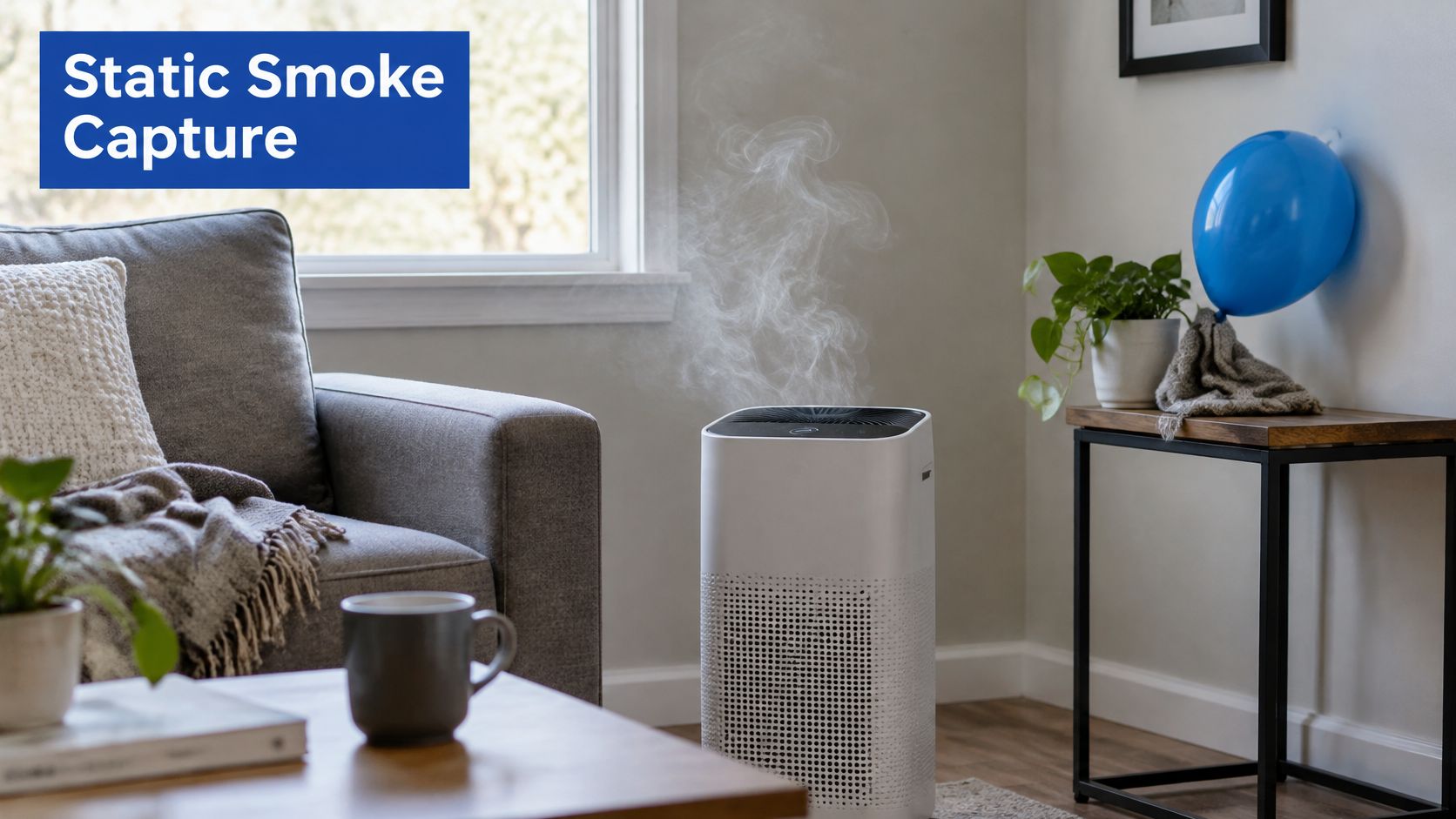
Rub a balloon on wool and it clings to a wall. An ionizer does a version of that to smoke. It does not sieve the air. It gives particles a charge so nearby surfaces become the collector.
The four-step sequence
Say someone lights a cigarette in a closed living room and switches on a plug-in ionizer.
- The unit releases ions. Charged molecules leave the device and mix into the room air.
- Ions stick to smoke particles. Fine tobacco particles pick up that charge while they are still floating.
- Charged particles move toward surfaces. The U.S. EPA's explanation of ionizers says ion generators charge particles so they are attracted to walls, floors, furniture, curtains, and occupants. That path can take small particles, including those in tobacco smoke, out of the air.
- They settle there. Nothing holds them inside a disposable filter. The wall, the curtain, and the person's clothing become the landing zone.
Very small smoke particles respond best. Larger pollen and ordinary household dust respond less, so a unit that looks busy during a smoke event can look weak against dust.
What a fiber filter does instead
A HEPA filter pulls air through a dense fiber mesh and keeps what it catches inside the media you later throw away. Ionization never makes that handoff. Airborne counts can fall while the same material sits on trim, blinds, and upholstery, ready to lift again when someone vacuums or opens a door.
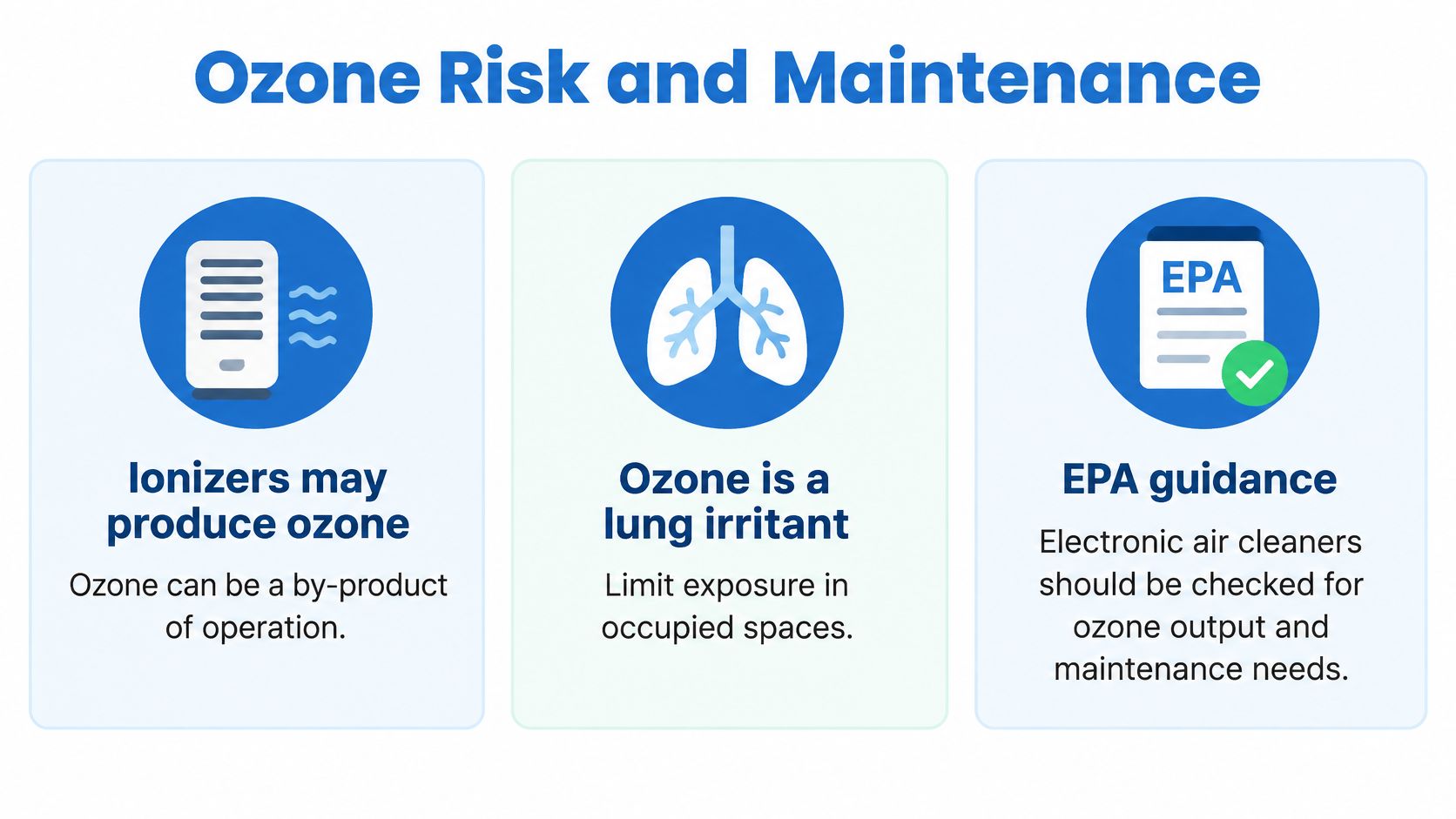
The same EPA account is clear that this process does not remove gaseous pollutants or odors. Ion generators can also produce ozone indirectly, and ozone is a lung irritant. Some operating conditions can push concentrations above levels considered harmful to health. Treat ionization as particle control, and ask the spec sheet to separate that from gas treatment and ozone performance. Homes, offices, vehicles, and care settings all need that split in writing.
A short walk-through of the charge-and-stick idea is easier to see than to describe.
Where Ionizers Fall Short on Smoke Odor and Residue
A room can look clear and still fail a smoke test. The haze drops, the ashtray smell stays in curtains, and the next morning a car smells like the cigarette from the night before. Those odors are gases. Ionization gives particles a charge; it gives gas molecules no comparable route into a filter.
The EPA's account of ionizers and ozone-generating cleaners says ion generators may remove some small particles, including tobacco-smoke particles, yet they do not remove gases or odors. Without special media such as activated carbon, an air cleaner cannot be expected to remove gaseous pollutants. The particle result and the odor result come from different mechanisms, and a product page that reports only one leaves the smoke job half described.
Three outcomes behind a smoke claim
- Lowering airborne concentration: fewer particles in the air you are sampling right now.
- Capturing particles for disposal: material trapped in media you can bag and throw out.
- Removing odor-forming gases: molecules that create the smell, which need sorbent media, not a charge.
A lower particle count proves only that fewer particles are airborne at that moment. Odor fading after you open a window proves even less. Hazardous particles and gases can remain when the nose has adapted.
Residue is the leftover problem
What lands on walls, carpets, curtains, and ceilings is the film people later call thirdhand smoke. It yellows paint and keeps off-gassing. Smoking lounges, restaurants, vehicles, and homes after tobacco or wildfire exposure often need washing and surface work, not another hour of ions. Fabric holds odor the way foam does. The same logic appears in fabric-safe fixes for damp storage for clothes that have absorbed a smell no plug-in can reach. For a passive carbon option in a closet or car, bamboo charcoal bags adsorb odor molecules until the carbon is spent.
Visible clearing lowers the count in the air. It leaves most of the smoke mass on walls, carpets, and fabric, and it leaves the smell in the gas phase until sorbent media or surface cleaning removes it.
Ozone Risk and How Maintenance Changes It
Ozone output is a spec. Product pages often give room size more space than ozone output, a poor ratio for smoke because smoke exposure often means long runtimes.
What the certification counts show
California's Air Resources Board fact sheet on the air cleaner regulation sets the 0.050 ppm limit for portable indoor air cleaners sold in the state, effective for products sold after October 18, 2010, following Board approval on September 27, 2007, and reports that at the time 94 certified air cleaners existed, 81 using mechanical filtration only and 13 using ionizers, electrostatic precipitators, or other electronic technologies; the same document describes a separate CARB review of consumer products that found six products emitting increased ozone and five at levels that could produce health effects. The tested group included personal air purifiers and other ionizing or electrically active devices. An electronic or ionizing label says nothing about ozone output; check the certification and test conditions for each model.
Who feels it first, and what UL 2998 is for
EPA wildfire filtration guidance does not recommend electronic air cleaners for smoke removal, because effectiveness is uncertain and they may produce ozone. The same guidance warns that bipolar ionization can generate ozone and other by-products unless design and maintenance safeguards are built in, and it points buyers toward UL 2998 zero-ozone certification for that technology. California guidance notes that ozone exposure can be particularly harmful to children, older adults, and people with asthma or other respiratory disease. Intentional ozone generators are a different product class. They should not run in occupied spaces, and ozone levels strong enough for heavy odor work can exceed generally safe concentrations.
Why the spec sheet drifts
Dirty collector plates, a higher setting than the one that was tested, off-brand replacement parts, and modes that stack an ozone function on ionization can all change what the unit emits in a real room. The number on the box comes from a defined test. It does not describe year three. Dose over time matters: a unit run eight hours a night at a tested setting is a different exposure from the same unit run on high while you are in the room.
- Clean collector plates on the schedule in the manual.
- Stay on the tested setting if that is the setting behind the ozone claim.
- Use the manufacturer's replacement parts, including any ozone plate or cell the unit ships with.
Ask for the test on the exact model, in the mode you will leave on overnight.
Ionizers Compared with HEPA, Carbon and RCI for Smoke
| Technology | Particles captured | Odors and gases removed | Ozone risk | Typical upkeep |
|---|---|---|---|---|
| Ionizer | Partly, by charging and depositing on surfaces | No | Yes, varies by design | Clean collector plates; replace ozone parts if fitted |
| HEPA filter | Yes, held inside the filter media | No | None | Replace filter on the manufacturer schedule |
| Activated carbon | Poor for fine particles | Yes, adsorbs many odor gases until saturated | None | Replace carbon when saturated; interval tracks smoke load |
| RCI photocatalysis | Limited | Partial; breaks down some odor compounds with a UV-activated catalyst | Possible by-products by design | Replace UV lamp or cell on the schedule in the manual |
HEPA is the particle specialist. Air is forced through fiber media, and what the filter catches stays in the filter until you replace it. It does nothing meaningful for the gases that make smoke smell.
Activated carbon is the odor specialist. It adsorbs many odor gases until the pores fill. A thin carbon sheet in a light smoke load lasts longer than the same sheet in a household where people smoke indoors. Heavy use means a shorter replacement interval, not a thicker claim on the box.
RCI, a photocatalysis stage that uses UV and a catalyst, can break down some odor compounds. By-products depend on how the cell is built and maintained, so a published test matters more than the acronym.
An ionizer remains optional, and only when ozone data for that exact model is published. Ventilation and stopping the source still come first. Many cabinets stack these stages, so read each stage on its own. A HEPA air purifier handles the particle column. Carbon has to be in the same machine, or in a second stage, if odor is part of the complaint.
Drivers hit the same split in a smaller box. A smoke odor guide for car owners is worth reading before you buy a hanging freshener, because a scent on top of embedded tobacco odor hides the problem the carbon and a deep clean are supposed to solve.
Pair particle capture with carbon when the smell is the reason you shopped, and treat ions as an add-on with a published ozone number.
Choosing a Safer Ionizer for Your Space
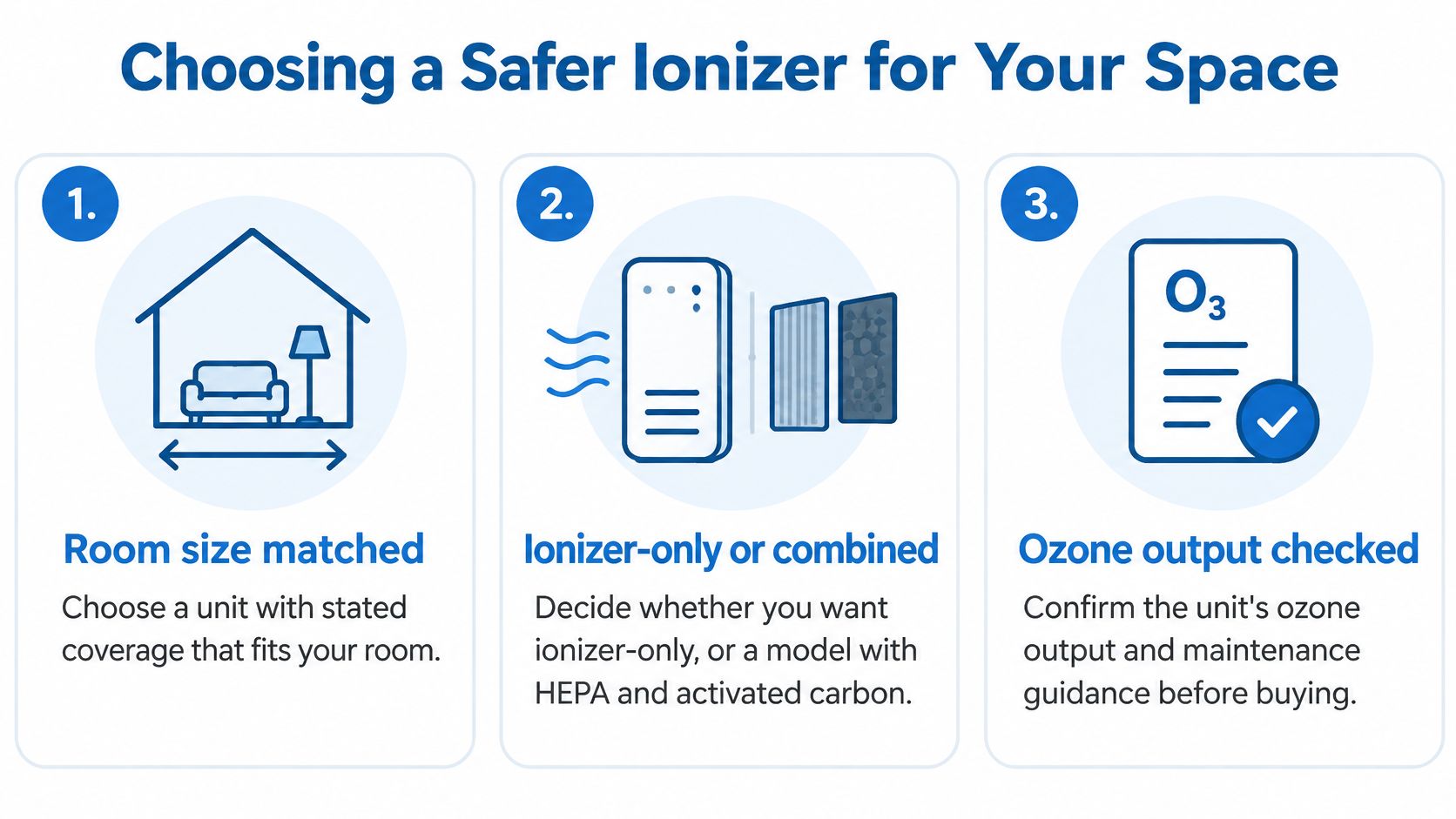
Coverage ratings are the first filter, not the last. A model can match the square footage and still be the wrong choice for smoke if it has no carbon stage or no published ozone number. Use the checklist to rule out those mismatches before price enters the decision.
- Room size matched to stated coverage. A unit sized for a bathroom will not move enough air for an open living room.
- Ionizer-only or combined. Smoke complaints that include odor need HEPA plus activated carbon in the same plan. Ionizer-only hardware only addresses floating particles.
- Published ozone data for the exact model. Look for a test of the unit you will buy, not a sibling in the line.
- Zero-ozone certification where bipolar ionization is used. UL 2998 is the label to ask for on that technology.
- How much activated carbon is in the box. A sprayed sheet is not a deep bed.
- Replacement cost and schedule. Plates, cells, carbon, and HEPA media all have a date on them.
- Whether people stay in the room while it runs. Occupied rooms need the low-ozone operating mode, not an unoccupied shock treatment.
Fit by space
The Air Ionizer Purifier EcoSpace is a $159.99 plug-in rated for up to 500 ft² with ions and ozone. The desktop unit is $79.99 for one room up to 300 ft², with ions, ozone and charcoal. A second plug-in model is $279.99 for one room up to 500 ft², using ActiveOx and plasma ionization. Whole-house units combine ionization, UV, ozone generation and photocatalysis, with optional HEPA filters. The portable car unit is $199.99 and uses ozone, ions, UV and photocatalysis.
Coverage is a sizing number, not a smoke-clearance guarantee. It tells you how much room the manufacturer expects the unit to treat. It does not tell you how fast particles settle, how much carbon is in the box, or what ozone concentration the unit produces at its tested setting. Treat a missing ozone number as a missing spec, the same way you would treat a missing filter size.
Every option here uses ionization or ozone, so the ozone check applies to each one. A combined unit with carbon and HEPA covers smoke more completely. An ionizer-only model is simpler and stays partial.
Confirm Your Smoke Plan Before You Buy
A smoke plan has an order. Identify the source, decide whether the complaint is particles, odor, or both, stop new smoke from entering, then choose filtration that covers both the particles and the gases. Skip a step and the equipment runs against a problem it was never sized to solve.
- Name the source. Tobacco, wildfire, cooking, soot, or fabric that already smells. Each source produces a different mix of particles and gases, so the fix changes with it.
- Split the complaint. Track particle load separately from gas and odor. A particle filter that clears haze can leave the smoke smell embedded in soft furnishings.
- Stop the source and move air first. No indoor smoking, a vented hood, and windows only when outdoor air is clean. Filtration handles what remains.
- Choose HEPA plus activated carbon when you need both particles and odor. That pairing addresses capture and gas removal. A single electronic stage does neither job completely.
Before checkout, apply the earlier checklist to the exact model instead of the product family. An air quality monitor gives before-and-after particle readings, so you can see whether the change lowered airborne load. Change one variable at a time.
Use the room-size shortlist to check fit, then confirm the ozone sheet before you buy.
EcoQuest Purifiers lists room, whole-house, car, and portable units that combine ionization or ozone with HEPA, charcoal, UV, and photocatalysis for smoke particles and lingering odor. To match coverage and ozone data to a real room, start with the listings at EcoQuest Purifiers and check the spec for the exact model before it runs in an occupied space.