
Indoor Air Quality Products: The Complete Buyer Guide
You've noticed the stale smell in the basement, the dust returning shortly after cleaning, or the way cooking fumes linger long after dinner. Then you search for indoor air quality products and find HEPA filters, activated carbon, UV-C lamps, ionizers, oxidation systems, monitors, and ventilation equipment, all promising cleaner air in different ways.
The right choice doesn't start with a brand or a feature list. It starts with identifying the pollutant, understanding how a technology acts on it, and deciding whether your space needs filtration, source control, ventilation, monitoring, or a combination of these measures.
Table of Contents
- Why Indoor Air Quality Matters More Than Ever
- How Air Purification Technologies Actually Work
- Matching Technology to Your Specific Environment
- Essential Buying Criteria for Smart Shoppers
- The Hidden Costs of Maintenance and Ownership
- Addressing Safety Concerns and Common Myths
- Building a Lasting Indoor Air Strategy
Why Indoor Air Quality Matters More Than Ever
A family can spend an ordinary evening indoors while several air-quality problems occur at once. Cooking releases smoke and fine particles. A dog brings pollen and outdoor dust inside. Upholstery and new furniture can release chemical compounds, while a damp basement may contribute musty odors. Opening a window might help, but outdoor conditions, weather, security, and building design can limit that option.

Indoor air quality is therefore more than a comfort issue. Household air pollution caused about 2.9 million premature deaths in 2021, including more than 309,000 deaths among children under age five, according to the World Health Organization's household air pollution fact sheet. The same source estimates that around 2.1 billion people still cook with open fires or inefficient stoves fueled by kerosene, biomass, or coal.
Those figures describe a global health burden, including environments very different from a modern home or office. They also clarify why indoor air quality products exist. Air cleaning can't replace safe cooking systems, moisture control, repairs, or adequate ventilation, but it can form part of a broader strategy for reducing airborne particles and odors.
The pollutant determines the solution
Dust, pollen, pet dander, and smoke are particles. Odors and many chemical vapors are gases. Excess carbon dioxide usually indicates that people and activities are generating more indoor air than the room is effectively exchanging with outdoors. These problems require different responses.
A purifier may capture airborne particles while leaving the source untouched. A carbon filter may reduce odors while becoming saturated. A ventilation system may dilute indoor pollutants but won't necessarily remove every particle before occupants breathe it. Property managers dealing with moisture, mold, and invisible building risks can also consult this practical indoor air quality guide for property managers.
Practical rule: Treat a purifier as one part of an indoor air plan, not as permission to ignore a leaking pipe, blocked exhaust fan, smoky appliance, or contaminated material.
The WHO also associates combined ambient and household air pollution with about 6.7 million premature deaths annually, reinforcing the scale of the wider problem in its fact sheet. Indoor air quality products address only selected parts of that challenge, but the need for thoughtful control is far from niche.
How Air Purification Technologies Actually Work
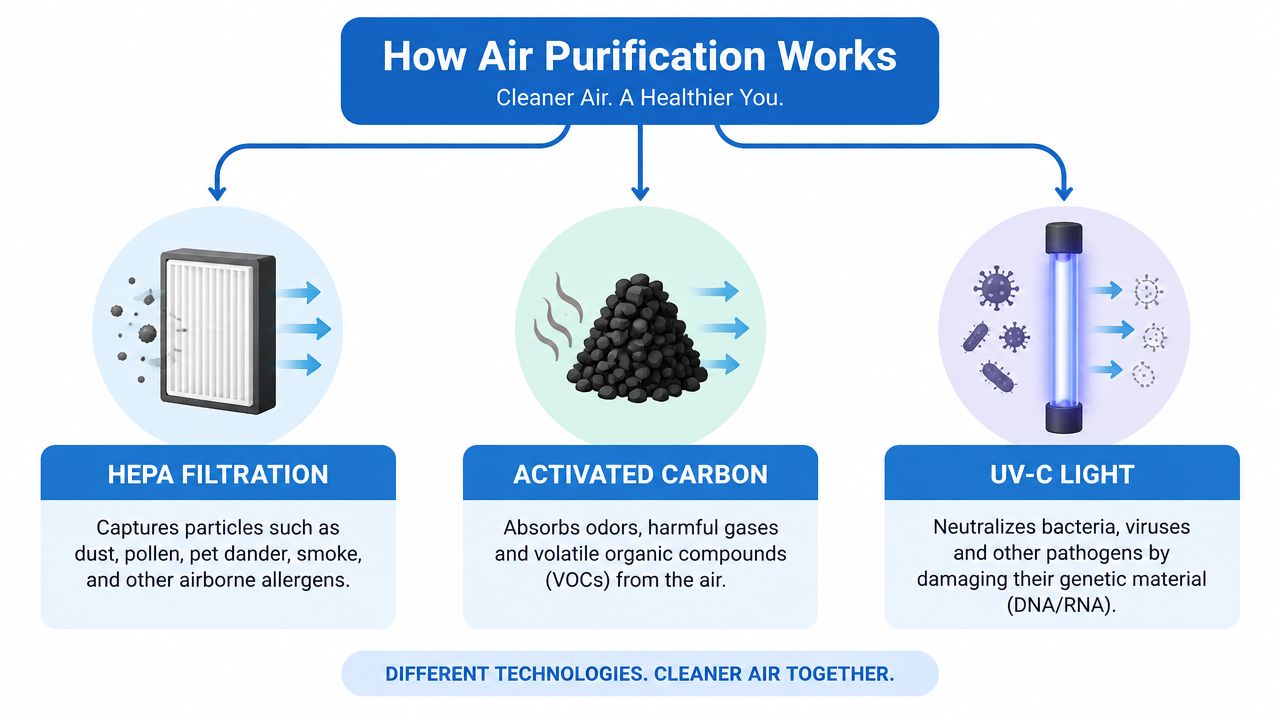
Air purification technologies don't all “clean” air through the same mechanism. Some physically trap particles, some adsorb gases onto a material, some expose microorganisms to ultraviolet light, and some electrically charge airborne particles. The name on the box matters less than the mechanism, airflow, operating conditions, and maintenance.
Mechanical and adsorption methods
HEPA filtration is the clearest benchmark for particle removal. According to ASHRAE's filtration and disinfection guidance, HEPA-based cleaners are defined by removal efficiency of at least 99.97% for particles at 0.3 micrometers, the most penetrating particle size in standard testing. Performance is typically stronger for particles larger and smaller than that size, provided the cleaner maintains adequate airflow.
HEPA works well for dust, pollen, mold particles, and many combustion aerosols. It doesn't remove gases by itself, and a clogged filter can restrict airflow and reduce practical performance.
Activated carbon, or charcoal, addresses a different category. Its porous surface adsorbs some odors and gaseous compounds. Carbon is useful for cooking smells, tobacco odors, and selected chemical vapors, but its capacity is finite. A thin carbon sheet may have limited usefulness compared with a larger carbon bed, and no carbon filter removes every gas.
UV-C uses ultraviolet energy to damage microorganisms that receive a sufficient dose. The result depends on lamp intensity, exposure time, airflow, cleanliness, and chamber design. A fast-moving air stream may pass through a lamp too quickly for the intended effect, so a UV label alone doesn't establish real-world performance.
Electrical and oxidation approaches
Ionization gives particles an electrical charge. Charged particles may attach to surfaces or be collected by an oppositely charged plate, depending on the design. This can reduce airborne particle concentration, but systems that primarily cause particles to settle still require surface cleaning. Some electrical designs can also produce ozone, so emissions information matters.
RCI photocatalysis combines light, catalysts, and reactive processes intended to alter certain airborne contaminants. Its usefulness depends heavily on engineering, pollutant type, airflow, and byproduct control. Marketing language shouldn't substitute for clear operating specifications.
Activated oxygen and ozone are not interchangeable with ordinary particle filtration. Oxidation may be used for odor treatment in controlled settings, but ozone-generating equipment presents a serious occupied-space concern. The EPA's guidance on ozone generators sold as air cleaners says ozone has little potential to remove indoor contaminants at concentrations below public-health standards, while some generators can exceed occupational exposure limits.
For a broader introduction to filtration terminology, you can also browse air filtration guides. EcoQuest's air purifier collection includes products built around different approaches, so compare the mechanism with your use case rather than assuming every unit performs the same task. The Living Air Classic XL-15 Air Purifier is described as a filterless unit using ionization and activated oxygen technology to help reduce airborne particles, odors, and stale indoor air.
Matching Technology to Your Specific Environment
A dusty bedroom, a restaurant kitchen, a musty basement, and a stuffy office each present a different air-quality problem. Begin with the contaminant you can identify, then check for an underlying issue such as poor ventilation, moisture, or weak source capture.
A practical decision matrix
| Environment or concern | First response | Supporting technology |
|---|---|---|
| Bedroom with dust, pollen, or pet dander | Reduce sources and filter particles | HEPA cleaner sized for the room |
| Kitchen with cooking particles | Use the exhaust hood and capture emissions at the source | Particle filtration, with carbon for selected odors |
| Room with persistent odors | Locate and remove the odor source | Activated carbon or a controlled odor-treatment system |
| Basement with damp or musty conditions | Repair moisture intrusion and control humidity | Filtration after the source is addressed |
| Busy office with stuffy air | Assess ventilation and occupancy patterns | CO2 monitoring and ventilation improvements |
| Area with microbial concerns | Correct moisture and follow professional hygiene procedures | Carefully specified filtration or UV-C where appropriate |
The matrix helps prevent a common mismatch: using a purifier to solve a ventilation problem. If a conference room feels stale because outdoor-air exchange is inadequate, a particle filter can reduce dust but cannot remove the underlying buildup of exhaled air. Ventilation systems are identified as the fastest-growing indoor air quality category through 2034, with a projected 7.2% CAGR, while air purifiers held the largest market share at 38.4% in 2025, according to this indoor air quality market coverage. These figures describe market direction, not the right product for your room. The practical distinction is simple: filtration cleans some pollutants already in the space, while ventilation replaces indoor air with outdoor air.
Room by room, not home by slogan
An allergy-focused bedroom may benefit from a sealed HEPA unit with airflow suited to the room. Place it where air can circulate, and continue reducing dust, pollen, or pet dander at the source. For cooking odors, use the stove's exhaust hood first. Activated carbon can address residual odors, but its usefulness depends on the pollutant and the amount of carbon in the device.
Commercial spaces add operating constraints. Noise, service access, occupancy, and compliance documentation can matter as much as the purification method. A unit that cannot run during occupied hours offers limited practical value.
Ozone-generating equipment does not belong in an occupied room because an odor is difficult to remove. If a technology requires evacuation, controlled timing, or professional handling, classify it as a specialized treatment rather than a normal continuous purifier.
Essential Buying Criteria for Smart Shoppers
A product's technology label is only the beginning. A capable filter that moves too little air, a monitor with no response plan, or a unit that's difficult to service may disappoint even when its underlying mechanism is sound.
Start with the room and the pollutant
Measure the room's approximate dimensions and note whether doors remain open. A purifier rated for a single closed bedroom may not clean an entire open-plan floor effectively. Ask four questions before comparing models:
- What must be reduced? Separate particles, odors, chemical vapors, and ventilation concerns.
- Where is the source? A purifier near a smoker, stove, litter area, or workshop may face a concentrated load that changes filter life.
- How many people use the space? Occupancy affects ventilation needs and the value of monitoring.
- Can the device run at a tolerable sound level? A unit that gets switched off isn't providing continuous treatment.
Look for a published Clean Air Delivery Rate, or CADR, where applicable. CADR helps compare how quickly a device delivers filtered air for particular particle categories, but it isn't a universal score for odor removal, microbial treatment, or whole-building performance. Room coverage claims also depend on assumptions about ceiling height, doors, fan speed, and air mixing.
Calculate ownership before buying
A low-maintenance design may suit a room where regular filter changes are inconvenient. A replaceable-filter model may be preferable when you want visible, straightforward particle capture. Permanent HVAC equipment can distribute treatment more broadly, but installation and service are more involved than placing a portable unit in a bedroom.
| Technology | Best for | Primary action |
|---|---|---|
| HEPA | Dust, pollen, dander, and many fine particles | Mechanically captures particles |
| Activated carbon | Selected odors and gaseous compounds | Adsorbs gases onto porous media |
| UV-C | Carefully designed microbial-control applications | Uses ultraviolet exposure |
| Ionization | Particle charging and collection or settling | Electrically charges particles |
| RCI photocatalysis | Selected oxidation-based applications | Uses light, catalysts, and reactive processes |
| Ventilation | Stale air and dilution of indoor emissions | Replaces or dilutes indoor air |
Monitor placement matters too. A sensor near a stove, window, supply vent, or purifier outlet may not represent the room as a whole. EcoQuest's air quality monitor options can be evaluated as part of a measurement plan, but a reading is useful only when it leads to an action, such as increasing ventilation, reducing a source, or checking a filter.
The Hidden Costs of Maintenance and Ownership
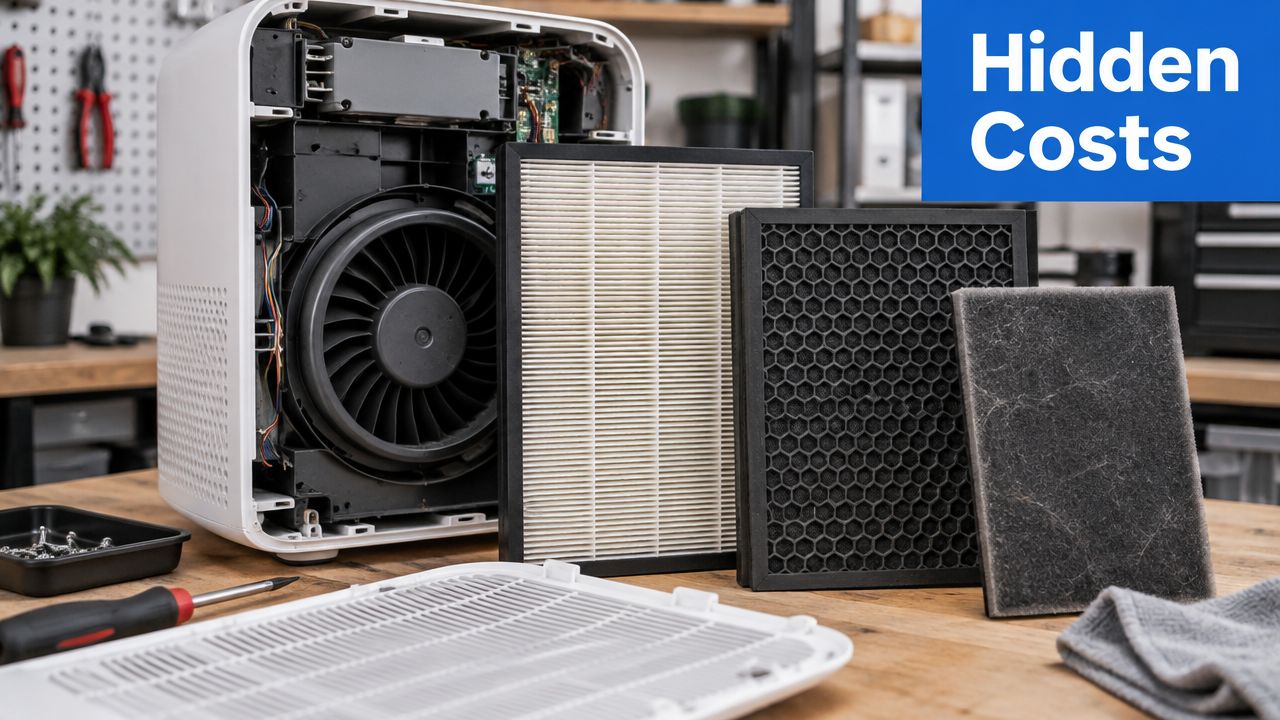
The purchase decision becomes clearer when you examine the work after installation. Filters load with dust, carbon loses adsorption capacity, UV components age, plates collect residue, and sensors can drift or become dirty. A neglected device may deliver less airflow, create noise, or encourage users to run it at an ineffective setting.
Compare the maintenance burden
Carbon often needs attention sooner than HEPA because adsorption capacity depends on the amount and type of carbon exposed to the air. Independent coverage cited in the brief notes that carbon filters may be replaced around 3 months, while HEPA filters may last 6 to 12 months, though actual intervals depend on pollution load, runtime, airflow, and manufacturer instructions. Treat those intervals as planning references, not guarantees.
A filterless unit avoids routine filter purchases but doesn't mean it requires no care. Ionization plates, cells, vents, fans, and sensors may still need cleaning or replacement. UV systems need lamp and sleeve checks, while integrated HVAC equipment may require scheduled service access.
Count energy, access, and downtime
Running a purifier continuously affects energy use, so compare power settings and decide whether the device must operate while the room is empty. A quiet lower setting may be practical overnight, while a higher setting may be useful after cooking or cleaning. Do not remove a filter and keep using the device just to avoid replacement. Restricted airflow and overloaded media can undermine the purpose of the equipment.
Maintenance complexity and installation expense are significant barriers for buyers. Market coverage cited in the brief reports that 39% of end users identified maintenance complexity and 46% cited high installation expenses as barriers in 2025, as reported by BCC Research's indoor air quality coverage. The practical lesson is simple: ask who will service the unit, how often, with which parts, and whether the access point is realistic for your home or facility.
HEPA filtration has a long development history. It originated in the 1940s through wartime work by the United States Atomic Energy Commission and moved into commercial and residential applications by the 1960s, as described in this historical overview of HEPA technology. That history doesn't eliminate maintenance, but it shows why mechanical filtration remains a familiar reference point.
Addressing Safety Concerns and Common Myths
Safety questions deserve more than a reassuring label. Ionizers, UV-C devices, oxidation systems, and ozone generators can behave differently depending on their construction, operating mode, enclosure, and emissions. “Natural,” “active,” or “advanced” doesn't tell you whether a device is suitable for continuous use around people.
Ozone isn't a harmless shortcut
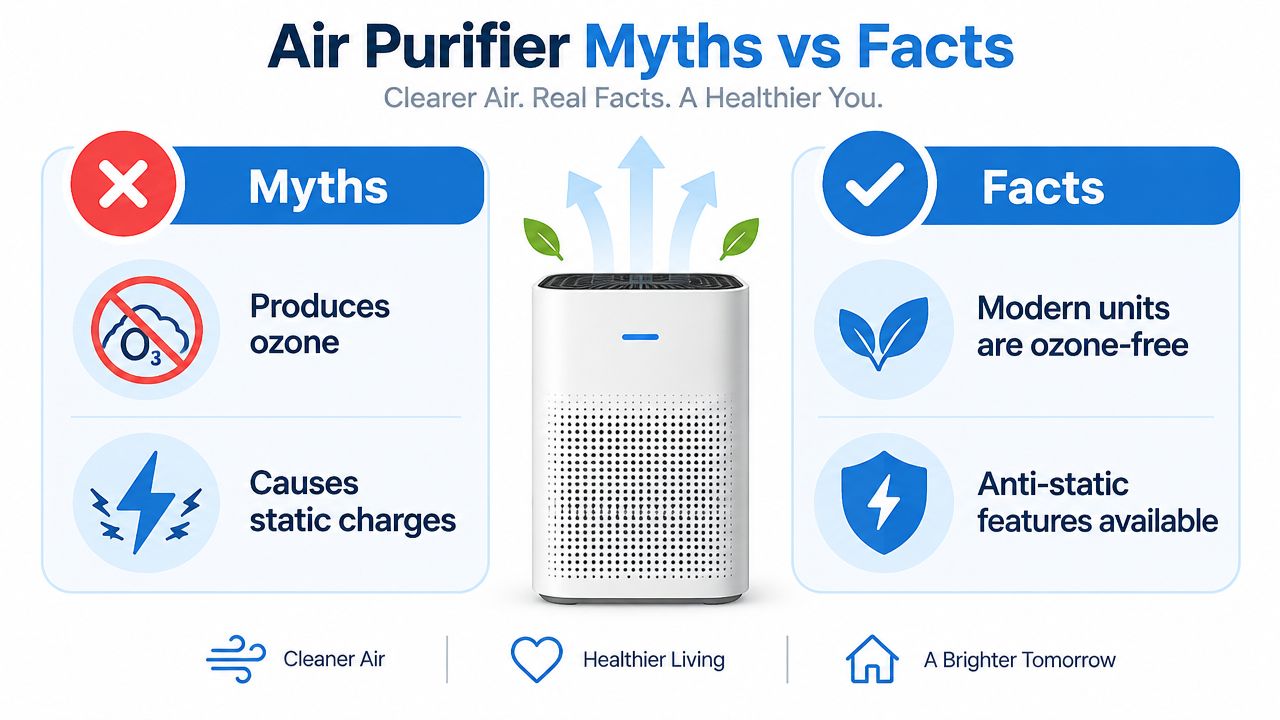
The EPA's position is particularly important for occupied spaces. At concentrations below public-health standards, ozone has little potential to remove indoor contaminants. Independent testing has also found that some ozone generators can exceed occupational exposure limits, making ozone a lung irritant rather than a dependable cleaning benefit.
That means you shouldn't use an ozone generator as an ordinary bedroom, classroom, office, or living-room purifier. Specialized ozone treatment may require an unoccupied space, controlled access, ventilation afterward, and procedures that follow applicable safety requirements. If you're comparing ozone generator products, read the operating instructions and determine whether the intended application is occupied or unoccupied before purchase.
Ionization requires careful evaluation
Ionization isn't automatically equivalent to ozone generation, but electrical air cleaners should be assessed for emissions, collection method, and cleaning requirements. If charged particles settle on walls and furniture, you'll still need a cleaning routine. Ask the manufacturer for clear information about ozone output, replacement components, and safe operating modes.
UV-C also needs safeguards. Direct exposure can injure skin and eyes, so enclosed air-path designs and interlocks matter. A device should explain where the lamp sits, how exposure is controlled, and what maintenance keeps the chamber working properly.
Safety check: If the manufacturer doesn't clearly explain emissions, occupancy rules, maintenance, and failure modes, treat that lack of information as a buying concern.
Building a Lasting Indoor Air Strategy
Better indoor air begins with matching controls to actual pollution sources, then checking whether those controls continue to work. Start with prevention: use kitchen exhaust, repair moisture problems, maintain combustion appliances, reduce tracked-in dust, and avoid products that release unnecessary fumes. These actions lower the workload for any purifier.
Choose the smallest system that addresses the identified problem, rather than the most elaborate specification sheet. A room with airborne particles may need HEPA filtration. A persistent odor may call for activated carbon. A stuffy office may need ventilation improvements and CO2 monitoring before another portable cleaner. UV-C or oxidation equipment belongs in a setting with a defined purpose, operating procedure, and person responsible for maintenance.
Review performance as conditions change
Keep a simple record of filter changes, cleaning, unusual odors, visible dust, and operating settings. If occupants experience irritation, headaches, or breathing difficulty after equipment is installed, stop using it and investigate. Check for ozone emissions, cleaning chemicals, moisture, combustion sources, and inadequate ventilation.
Smart monitoring is becoming more common, but that does not make a sensor necessary in every home. Measurement is most useful in shared or compliance-sensitive spaces, where operators may need to document conditions as well as maintain equipment. A reading can also prevent guesswork: it may show that ventilation, rather than additional filtration, is the main issue.
Select products that occupants can operate safely, maintain consistently, and evaluate over time. Cleaner air usually comes from several modest controls working together, with each one addressing a different source.
EcoQuest Purifiers offers indoor air quality products, replacement parts, repair services, and systems using technologies such as HEPA, charcoal, UV, ionization, and RCI photocatalysis for homes and professional spaces. Review the available options and support resources at EcoQuest Purifiers, then choose according to the pollutant, room, safety requirements, and maintenance capacity.