
How to Get Musty Basement Smell Out of Clothes: What Works
You pull a jacket from a basement storage bin, give it a quick rinse, and discover that it still smells like a damp cellar. The fabric looks clean, but you wouldn't want to wear it into a meeting or put it beside freshly washed clothes.
The practical answer to how to get musty basement smell out of clothes is to treat the garment and its storage environment together. Wash according to the fabric's care instructions, dry completely, and investigate the basement before putting anything back. Stronger fragrance won't solve a damp storage room.
Table of Contents
- Sort Clothes by Odor Level and Fabric
- Wash Musty Clothes and Choose Odor Products
- Drying Methods That Stop the Smell Coming Back
- Fix the Basement Before You Store Clothes Again
- Decide Whether an Air Purifier Helps
Sort Clothes by Odor Level and Fabric
Start by taking the affected clothes out of the basement. Keep them apart from clean laundry while you check their condition, including linings, cuffs, folded areas, and the bottom of the storage container.
A musty odor isn't proof that every garment has visible mold. However, the U.S. Environmental Protection Agency explains that microbial volatile organic compounds can produce mold's unpleasant smell, and that a moldy odor warrants investigating possible growth in the building. The garment may be carrying the smell of its surroundings, not just needing a more heavily scented detergent.
Match the treatment to the garment
Use the closest match below. Fabric restrictions take priority over a general odor-removal method, especially for lined jackets, structured clothing, and garments with decorative trim.
| Case | Fabric or condition | Action | Escalate when |
|---|---|---|---|
| Light musty smell, no visible spots | Washable cotton or synthetic | Wash at the label-approved temperature and dry completely using an approved method | Odor survives careful washing and complete drying |
| Light musty smell | Wool, silk, or another delicate fabric | Hand-wash cool with suitable mild detergent only if permitted; reshape and dry as directed | Smell remains, or the label requires professional cleaning |
| Visible mold spots | Washable fabric | Remove loose contamination carefully outdoors; wash separately and check bleach restrictions | Spots or odor remain after treatment |
| Visible mold spots | Dry-clean-only garment | Contain for transport and contact a professional cleaner promptly; disclose the mold | Arrange professional assessment immediately rather than attempting home washing |
| Left damp for an extended period | Any fabric | Treat as potentially contaminated and arrange appropriate cleaning and complete drying | Mold odor returns after drying |
| Smell returns after storage | Any fabric | Investigate the basement and container before storing again | Dampness persists or neighboring items develop odor |
Don't assume that washable means suitable for high heat. A cotton garment may have a lining, coating, or trim that changes the treatment route.
First decision: Read the care label before choosing a cleaner, not after filling the washing machine.
Finish your assessment with a smell check after the item is fully dry, without holding visibly moldy fabric close to your face. Damp fabric and detergent fragrance can make the result difficult to judge. If the earthy smell survives drying, change the treatment route instead of returning the garment to storage.
Wash Musty Clothes and Choose Odor Products
Detergent, adequate rinsing, and complete drying do the heavy lifting. Reach for additives only as a finishing step once those basics are in place.
The CDC's mold cleanup guide recommends keeping cleanup clothing separate from uncontaminated laundry and washing with detergent in the warmest water the care label permits. If two full wash-and-dry cycles leave the odor, I stop treating the garment at home and send it to a professional cleaner.
Use this workflow to keep affected garments separate while you prepare them for washing.
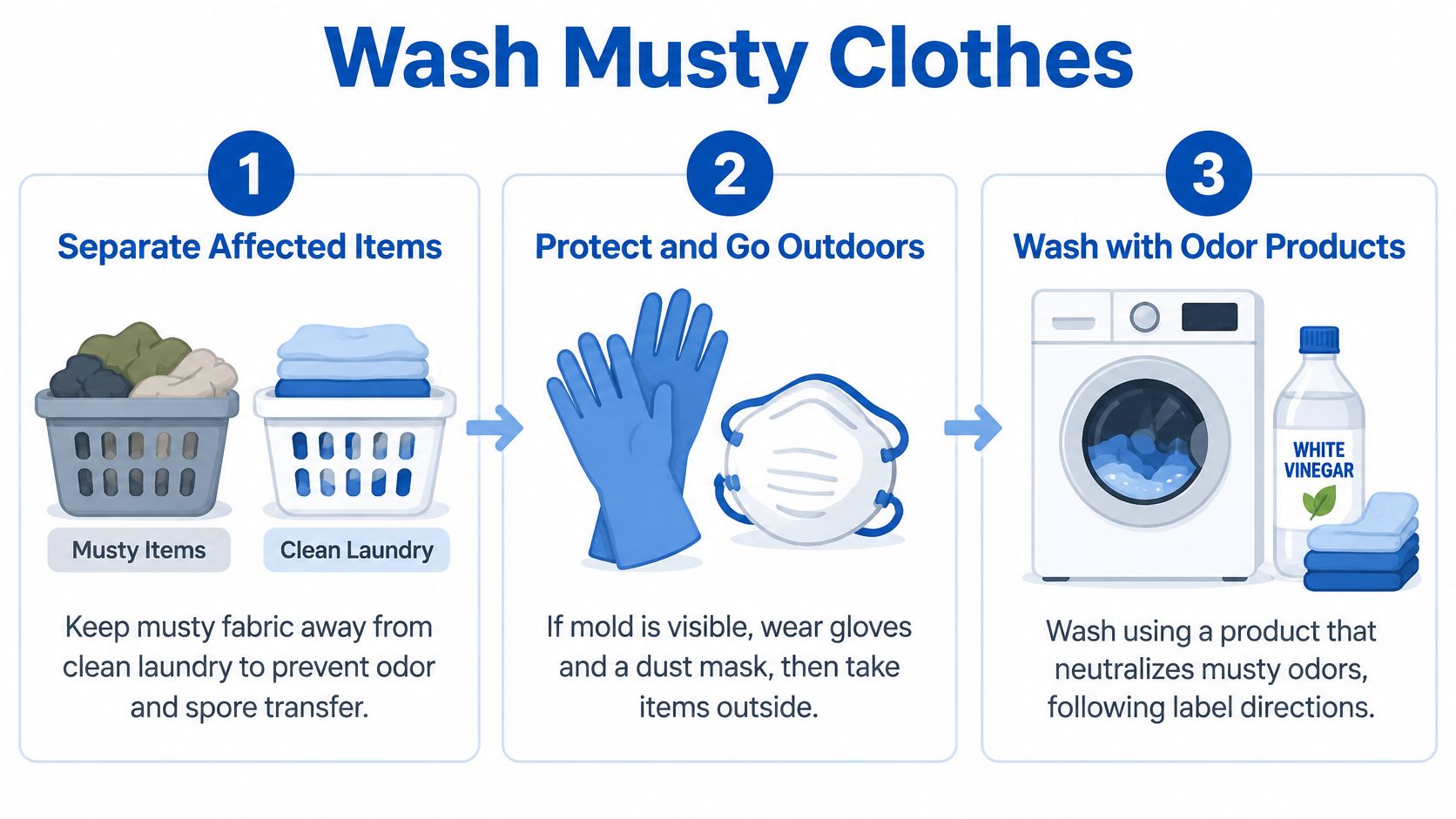
A controlled wash sequence
Separate the affected items. Keep them away from bedding, towels, and clothes that don't smell. Check whether the basket or hamper is damp or musty before using it to carry clean laundry.
Handle visible mold outdoors. Wear gloves and a well-fitting particulate respirator rather than a loose dust mask. Remove loose, dried contamination outside with slow, deliberate movements; vigorous shaking or aggressive brushing spreads it.
Match settings to construction. Use the warmest label-approved water and a cycle appropriate for the fabric. Durable cotton and delicate knitwear call for different treatment even when they smell alike.
Leave room for movement. Choose a load size that lets garments circulate rather than packing the drum tight. Measure detergent for the load and the product's concentration; more detergent than directed does little for odor removal.
Rinse thoroughly. Add an extra rinse if the garment stays slippery or visibly sudsy. When every load in the house smells musty, inspect and clean the washer's gasket, dispenser, and accessible filter according to its manual.
Move directly to drying. Assess the final result only after the load is fully dry, then decide whether another treatment is warranted.
Choose additives conservatively
Household remedies have limits. Vinegar and baking soda can lighten some residual odors, yet neither is a dependable treatment for heavily mold-contaminated fabric. Stick to one product at a time and follow its directions; improvised chemical mixtures are how fumes and ruined fabric happen.
| Product | How to use | Works best on | Avoid when |
|---|---|---|---|
| White vinegar | Use only where garment and appliance instructions allow; keep separate from other cleaners | Optional treatment for light residual odor on compatible washable fabric | Chlorine bleach is present, or the manufacturer prohibits acidic additives |
| Baking soda | Follow compatible laundry-product or appliance guidance rather than guessing a dose | Residual odor in sturdy washable cottons | Treating heavy visible mold or expecting it to disinfect fabric |
| Oxygen bleach | Follow package dilution, temperature, and soaking instructions | Compatible colored and white washable fabrics | Wool, silk, or trim isn't explicitly approved |
| Chlorine bleach | Dilute exactly as directed and use only when the garment label permits | Bleach-safe white cotton and linen with mildew | Colored items, wool, silk, or any mixture with ammonia, vinegar, or other cleaners |
| Fragrance or dryer sheets | Use only as an optional finishing product | Scenting a garment that already smells neutral | You still need to judge whether mustiness has gone |
Read both labels before reaching for any bleach. The care label decides what the fabric can take, and the product label sets dilution, temperature, and restrictions on prints, elastic, and finishes. That check applies to oxygen bleach on colored garments exactly as it does to chlorine bleach on whites.
If you prefer a sheet-format detergent, apply the same dosing and fabric checks when reviewing laundry detergent sheets. The format alone tells you nothing about mold-removal performance.
A clean result smells neutral after drying. Strong perfume over an earthy undertone means the treatment hasn't finished.
When the first attempt disappoints, resist raising the chemical concentration. Recheck the fabric, the washer, the drying conditions, and the storage environment before committing to another cycle. If clean clothes pick the smell back up within days of storage, the wash routine has done its part and the problem sits where the garments live.
Drying Methods That Stop the Smell Coming Back
Press the back of your hand against a waistband straight off the line or out of the dryer. Cool, slightly clammy fabric against your skin means the seam still holds moisture, even when the outer surface feels dry. Let the garment sit at room temperature for a while and press again before folding, since cold fabric can mimic dampness. That ten-second check catches most loads that would otherwise carry the smell back.
Drying is part of treatment, not a finishing step. Wet fabric needs heat, moving air, and somewhere for the moist air to go. Remove any one of the three and drying slows enough for odor to return.
The rack below shows the spacing and airflow that work indoors, provided the room itself is dry.
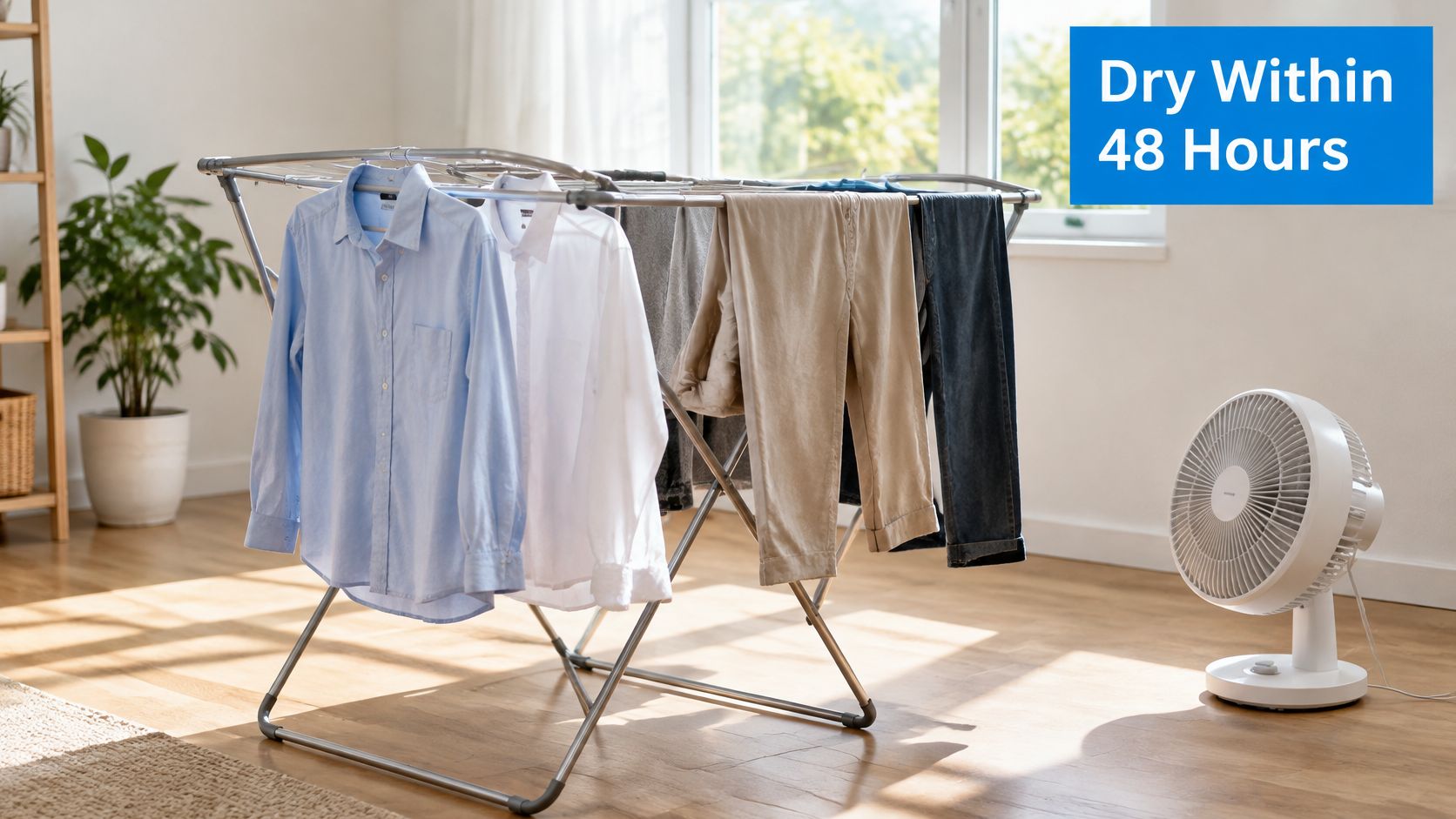
Match the method to the load
A preset cycle can't guarantee dryness across different loads. Fabric weight, washer extraction, room humidity, and dryer airflow all shift the result, so treat the garment's condition as the endpoint rather than the timer.
| Method | Typical time | Best for | Risk of odor return |
|---|---|---|---|
| Outdoor line-drying in sun | Until seams and layered areas are fully dry; weather controls duration | Colorfast cottons and linens approved for outdoor drying | Lower in dry, breezy conditions; higher when air is humid |
| Tumble dry, high heat | Approved cycle, extended only if necessary | Heat-tolerant cottons and towels labeled tumble-safe | Lower when the entire load dries completely |
| Tumble dry, low or delicate | Label-approved cycle with a seam check afterward | Compatible synthetics and blends | Moderate; damp cuffs or waistbands can go unnoticed |
| Indoor line-drying in a basement | Unreliable in humid conditions | Not recommended in a damp storage area | High |
| Hanging in a closed basement room | Often prolonged without moisture removal | Not recommended | High |
Skip the basement for drying altogether. A fan in a closed basement only circulates the water the clothes release, so the moisture stays in the room and the load dries slowly. Move the rack to a dry, ventilated room or wait for suitable outdoor conditions.
On the line, turn colorfast garments inside out where appropriate, leave space between items, and open pockets so air reaches folded fabric. Before folding, check waistbands, underarms, thick seams, and jacket linings, since these dense areas release water last.
The video below walks through the drying process visually.
For tumble-safe garments that remain damp after outdoor drying, finish on an approved low setting and inspect the seams again. High heat on a delicate item to meet a deadline risks shrinkage and damage that cost more than the extra drying time.
Fix the Basement Before You Store Clothes Again
Washing won't provide a durable result if you return clothing to wet shelving, contaminated boxes, or a persistently damp room. The CDC's mold guidance emphasizes that cleanup requires both removing mold and correcting the moisture problem, with wet materials dried within 24–48 hours when possible.
Start with a hygrometer near the clothing storage area. Check its readings under ordinary conditions, including after laundry use and wet weather, rather than judging the basement from a single dry afternoon.
A dehumidifier can help remove airborne moisture, but it can't repair a leaking pipe or stop water entering through the building.
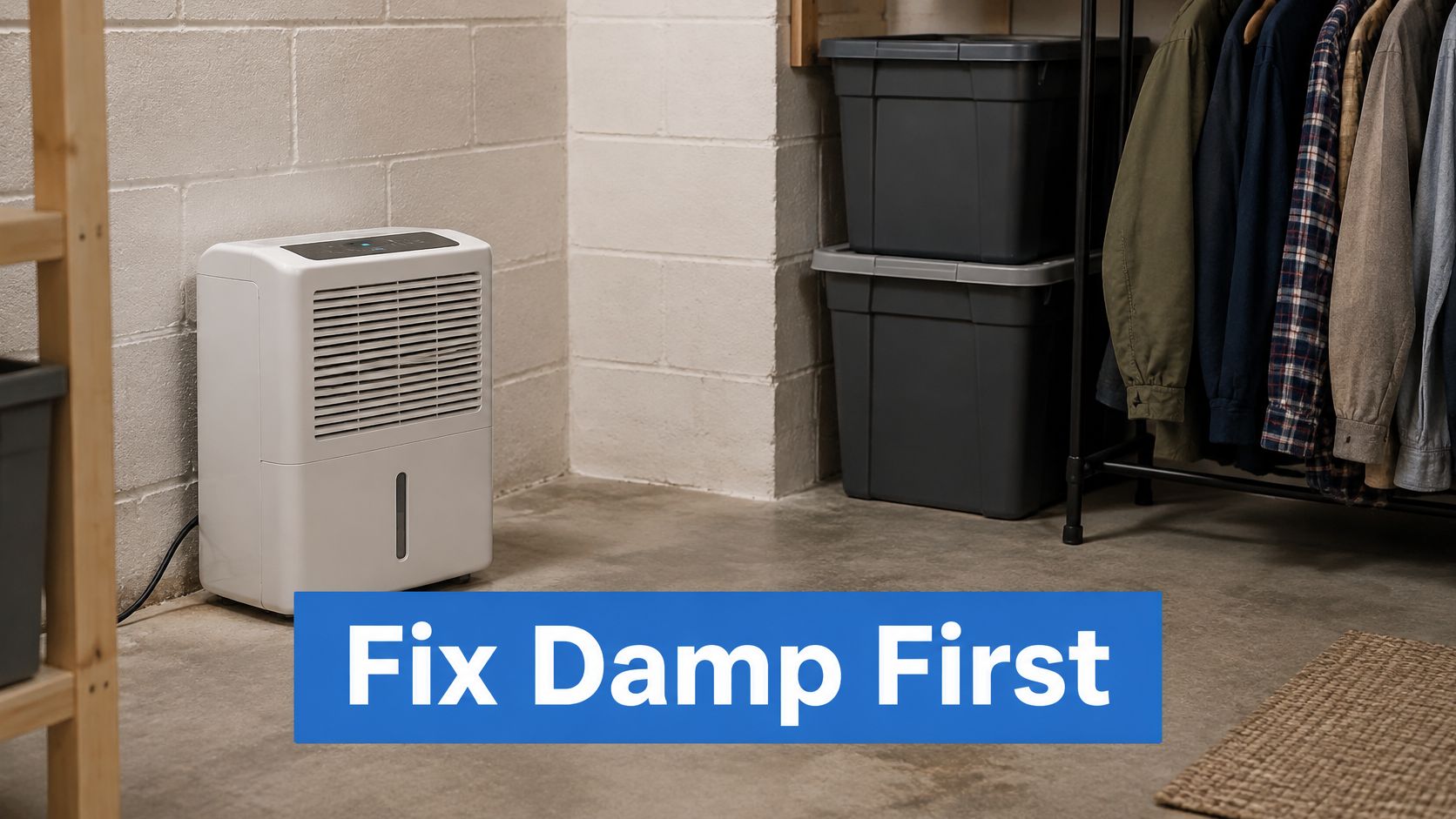
Read humidity alongside physical evidence
The EPA's guide to mold, moisture, and your home supports aiming for roughly 30–50% relative humidity and keeping indoor humidity below 60%; the table translates that guidance into storage decisions.
| Reading | Meaning | Action |
|---|---|---|
| Target humidity range | More suitable conditions for clothing storage | Maintain conditions and record readings through changing weather |
| Above the upper humidity limit | Conditions favor moisture-related biological growth | Address leaks, condensation, and damp materials before restoring storage |
A humidity reading doesn't rule out a localized leak. Inspect the room directly:
- Pipes and walls: Look for condensation, staining, active drips, and damp masonry.
- Porous materials: Check cardboard, carpet, drywall, and shelving around affected containers.
- Laundry equipment: Inspect hose connections, the washer area, and the dryer's exhaust route.
- Storage containers: Check lids, undersides, and interior corners for moisture or odor.
For a building-focused explanation of persistent dampness, Trademaster Construction's guide to why your basement never dries out provides useful inspection context. If you're comparing monitoring equipment, confirm that an air-quality monitor measures relative humidity rather than assuming every monitor does.
Restore storage only after checking the result
Clean compatible hard surfaces with detergent and water, and dry them. Remove or isolate damaged porous materials; don't keep using a moldy cardboard box because the clothing inside has been washed.
Use clean, hard-sided lidded bins for completely dry garments, raise them off the floor, and avoid tight packing. Leave access around containers so you can inspect the wall and floor behind them.
Storage test: Keep a cleaned, fully dried garment in a clean, dry room before returning it to the basement. Returning odor calls for reassessment, not more perfume.
Record humidity and odor observations over several days. If the garment remains musty outside the basement, consult a cleaner; heavily damaged material that can't be cleaned may need disposal.
Decide Whether an Air Purifier Helps
Use a purifier only after the moisture is fixed and the contaminated items are out. Air cleaning can reduce a lingering airborne odor in the storage space, yet it cannot wash residue out of fabric, drain water from a wall, or make a damp storage bin suitable for clean garments.
The useful question is narrow: once you control moisture and remove contaminated materials, does a faint odor still hang in the room? That leftover airborne smell is the one problem supplemental air cleaning can address.
Match the technology to the remaining problem
Different technologies handle different airborne contaminants. Particle filtration and odor adsorption are not interchangeable, and neither proves that hidden mold has been removed. Check the device's documented filtration method, maintenance requirements, and operating restrictions rather than choosing on the word purification alone.
Use these decision criteria:
- Persistent visible growth: Prioritize material cleanup and moisture investigation; a larger purifier changes nothing here.
- Odor confined to clothing: Reassess the textile treatment or consult a professional cleaner.
- Faint room odor after drying and cleanup: Consider supplemental air cleaning while continuing to inspect the space.
- Odor returning during wet weather: Investigate water entry and humidity changes before adjusting equipment settings.
When comparing air purifiers for mold-related concerns, distinguish airborne particle management from claims about treating mold inside walls or garments. If the room smells better while humidity readings stay high, the odor was masked and the moisture problem remains.
Check ozone and placement before operating
Avoid ozone-generating devices in occupied rooms. Ozone can irritate the lungs, and introducing it into room air does nothing for wet fabric or concealed moisture. A lower output setting does not make an ozone-generating device safe around people or pets.
Our EcoZone is a compact purifier suited to storage rooms, laundry rooms, and basements, and it combines ozone and UV technology. Run it under the same occupancy rules as any ozone unit: only in unoccupied space, with the manual's restrictions followed exactly, especially near shelves, textiles, or vents.
For placement, position any suitable unit as close to the ceiling as practical, or at least five feet from the floor, and next to an incoming air vent so natural airflow distributes the output. Keep inlets and outlets clear, and never hide the unit behind tightly packed bins. Maintain filters and other components on the manual's schedule so you are not judging equipment with obstructed airflow.
Compare odor under similar conditions while continuing to record humidity. If the smell returns, inspect the room again rather than raising the output automatically.
Air cleaning supports a dry storage environment; it doesn't create one.
EcoQuest Purifiers offers indoor air-quality equipment, replacement parts, and repair services for homeowners managing lingering indoor odors. Once your clothing is clean and your basement moisture problem is controlled, visit EcoQuest Purifiers to compare supplemental air-cleaning options and review operating guidance before choosing a unit.