
Commercial Air Purifier Smoke: A Practical Buyer Guide
Friday night, a restaurant's dining room is full, the patio door keeps opening, and smoke drifts past the bar before the HVAC system can pull it away. Across town, a boutique gym is dealing with a different version of the same problem, a member vapes near reception and the odor spreads through an open, occupied floor. In both buildings, the owner is tempted to buy a purifier, place it wherever there's an outlet, and hope the complaints stop.
That approach usually disappoints. Commercial smoke control is a building-management decision, not a shopping-cart decision. You need to account for smoke CADR, room volume, source location, HVAC filtration, outdoor-air intake, carbon dioxide, maintenance, and how long the event will last. The commercial air purification options are only useful when the equipment matches the building and the operating plan.
Table of Contents
- Why Commercial Smoke Control Is a Real Operational Problem
- The Two Numbers That Actually Matter, Smoke CADR and ACH
- Matching Filtration Technology to Commercial Smoke
- Placement, Runtime, and HVAC Coordination
- Real Venues, Real Setups
- Mistakes Buyers Make and Ozone Safety Warnings
- Maintenance Schedules and Compliance Basics
- A Decision Framework for Your Space
Why Commercial Smoke Control Is a Real Operational Problem
Smoke creates several problems at once. Staff notice headaches, odors, haze, and stale air before a facility manager sees a sensor reading. Customers leave sooner, employees complain about working conditions, and neighboring tenants may challenge the building's air quality. Lease language, local smoking restrictions, and workplace obligations can turn an air problem into an operational dispute.
The first mistake is treating every smoke source as the same. Patio tobacco smoke, cigar smoke, cooking aerosols, wildfire infiltration, and vaping emissions behave differently in the building. Some sources are concentrated near a door or workstation. Others enter through outdoor-air intakes, envelope leaks, or shared corridors.
Why residential units fall short
Residential purifiers often fail in venues because the room is larger, ceilings are higher, occupancy is continuous, and the HVAC system may keep bringing contaminated outdoor air inside. A unit can produce clean air at its outlet while the occupied zone remains smoky. That's a distribution failure, not necessarily a filter failure.
Smoke also contains both particles and gases. Fine particles can remain airborne and travel through the room, while odor-causing gases can pass through particle filters. The EPA identifies portable air cleaners, high-efficiency HVAC filters, and DIY air cleaners as practical tools for reducing indoor smoke levels, but each tool has a defined capacity and role. EPA indoor air filtration guidance also gives a tobacco-smoke CADR rule that helps buyers avoid guessing.
Site-visit rule: Don't ask, “Which purifier is strongest?” Ask, “How much contaminated air enters this zone, where does it travel, and how much clean air can I deliver continuously?”
Commercial smoke control starts with a survey. Measure the room, identify the source, inspect return and supply paths, check whether outdoor-air dampers are open, and decide whether source capture or general air cleaning should carry the primary load. A purifier can support the building, but it can't compensate for an open door, a badly balanced exhaust system, or a missing source-control measure.
The Two Numbers That Actually Matter, Smoke CADR and ACH
Smoke CADR tells you how quickly a purifier delivers cleaned air against smoke-sized particles. Think of it as the unit's effective clean-air output, measured in cubic feet per minute after the fan works against the filter. Air changes per hour, or ACH, translates that output into room turnover. It answers a practical question, how many room volumes pass through the cleaning system each hour?
Use this formula:
ACH = (CADR × 60) ÷ room volume
For a 2,000-square-foot venue with 9-foot ceilings, the room volume is 18,000 cubic feet. A 4 ACH target requires 1,200 CFM, 6 ACH requires 1,800 CFM, and 8 ACH requires 2,400 CFM. Those are total smoke CADR requirements, so you can meet them with one large unit, several smaller units, or a combination of portable and HVAC filtration.
EPA guidance recommends a portable cleaner with a tobacco-smoke CADR of at least two-thirds of the room area in square feet. For the same 2,000-square-foot venue, that produces a guideline of 1,334 CFM, calculated as 2,000 × ⅔. This rule is an area-based starting point, while ACH accounts for ceiling height and makes the airflow requirement easier to test against the actual room volume. The EPA and ASHRAE material on air-cleaner sizing and smoke CADR explains why smoke CADR is more useful than raw fan airflow.
Sizing reference for a 2,000-square-foot venue
| Room Volume (ft³) | CADR for 4 ACH (CFM) | CADR for 6 ACH (CFM) | CADR for 8 ACH (CFM) | EPA Tobacco CADR Guideline (CFM) |
|---|---|---|---|---|
| 18,000 | 1,200 | 1,800 | 2,400 | 1,334 |
Manufacturers' room-size labels often assume a relatively clean residential environment and a particular operating speed. They don't necessarily reflect continuous smoke generation, open doors, high ceilings, or outdoor-air contamination. Buy against the required CADR, not the marketing room-size badge.
For a building manager comparing HVAC-integrated options, the Induct 5000 air purification selection may be relevant as part of an in-duct evaluation, but it still has to be assessed against the system's airflow, pressure drop, and filtration design. The Living Air Classic XL-15 Air Purifier is described as a filterless unit for homeowners and other indoor environments, using ionization and activated oxygen technology to help reduce airborne particles, odors, and stale indoor air. That positioning makes it a different category from a smoke-control system sized for a heavily occupied commercial venue.
Matching Filtration Technology to Commercial Smoke
Commercial smoke is a two-part problem. Mechanical filtration handles particles, while gas-phase media handles odors and chemical vapors. No single technology should get automatic approval because its brochure uses the word “smoke.”
What each technology contributes
True HEPA, including H13 or H14 configurations, is the baseline for fine-particle removal in portable or ceiling-mounted units. EPA guidance identifies HEPA or smoke-rated units as suitable for particles in the fine range, and its air-cleaner guidance describes HEPA filters as having 99.97% minimum efficiency at 0.3 micrometers in the relevant test condition. That figure applies to particle filtration, not odor removal.
Activated carbon addresses gases and odor-causing compounds that a particle filter won't capture. Commercial smoke control needs substantial carbon mass and adequate contact time. A thin carbon sheet may help with light odor, but it shouldn't be treated as equivalent to a deep carbon bed.
RCI photocatalysis with UV can be considered where odor reduction and air treatment are part of a broader system, but it isn't a substitute for smoke CADR. Treat it as a secondary technology, not the main particle-control device.
Bipolar ionization is usually installed in an HVAC airstream or air handler. It can integrate with central circulation, but facility managers should verify emissions performance and certification. The relevant safety checks include UL 867 or UL 2998, depending on the product and claims.
Intentional ozone generators are the wrong choice for occupied commercial interiors. EPA guidance notes that some filters can reduce tobacco smoke particles without removing gaseous smoke components, which is why carbon is needed for odor control. Ozone adds a respiratory irritant instead of removing the source, and facilities in California must also consider CARB requirements.
| Technology | Targets | Best Installation | Maintenance Burden | Compliance Notes |
|---|---|---|---|---|
| True HEPA | Fine smoke particles | Portable or ceiling-mounted unit | Filter loading and replacement | Verify performance claims and pressure-drop limits |
| Activated carbon | Odors and gaseous compounds | Portable, recirculating, or makeup-air unit | Carbon inspection and replacement | Don't confuse a thin carbon layer with substantial gas-phase media |
| RCI with UV | Secondary odor and air-treatment support | Portable or integrated module | Cell and lamp service | Use as a complement, not as the primary smoke-CADR source |
| Bipolar ionization | HVAC-integrated particle-treatment support | In-duct or air-handler installation | Emitter inspection and testing | Verify UL 867 or UL 2998 status and emissions data |
| Ozone generation | Oxidation claims, not safe occupied-air cleaning | Not suitable for occupied indoor use | High operational and safety burden | Avoid intentional ozone generation indoors |
The practical recommendation is simple: start with high smoke CADR, HEPA-class particle filtration, and meaningful activated carbon. Add HVAC-integrated technologies only after the basic airflow, source control, and ventilation plan works.
Placement, Runtime, and HVAC Coordination
A purifier works where it can intercept contaminated air, not where it looks tidy. Keep portable units out of corners and away from furniture that blocks the intake. In a restaurant, place a unit near the bar or patio-door path when smoke enters there, while preserving a clear route for intake and discharge air. In an open gym, use multiple points of circulation instead of expecting one floor unit to clean a high ceiling.
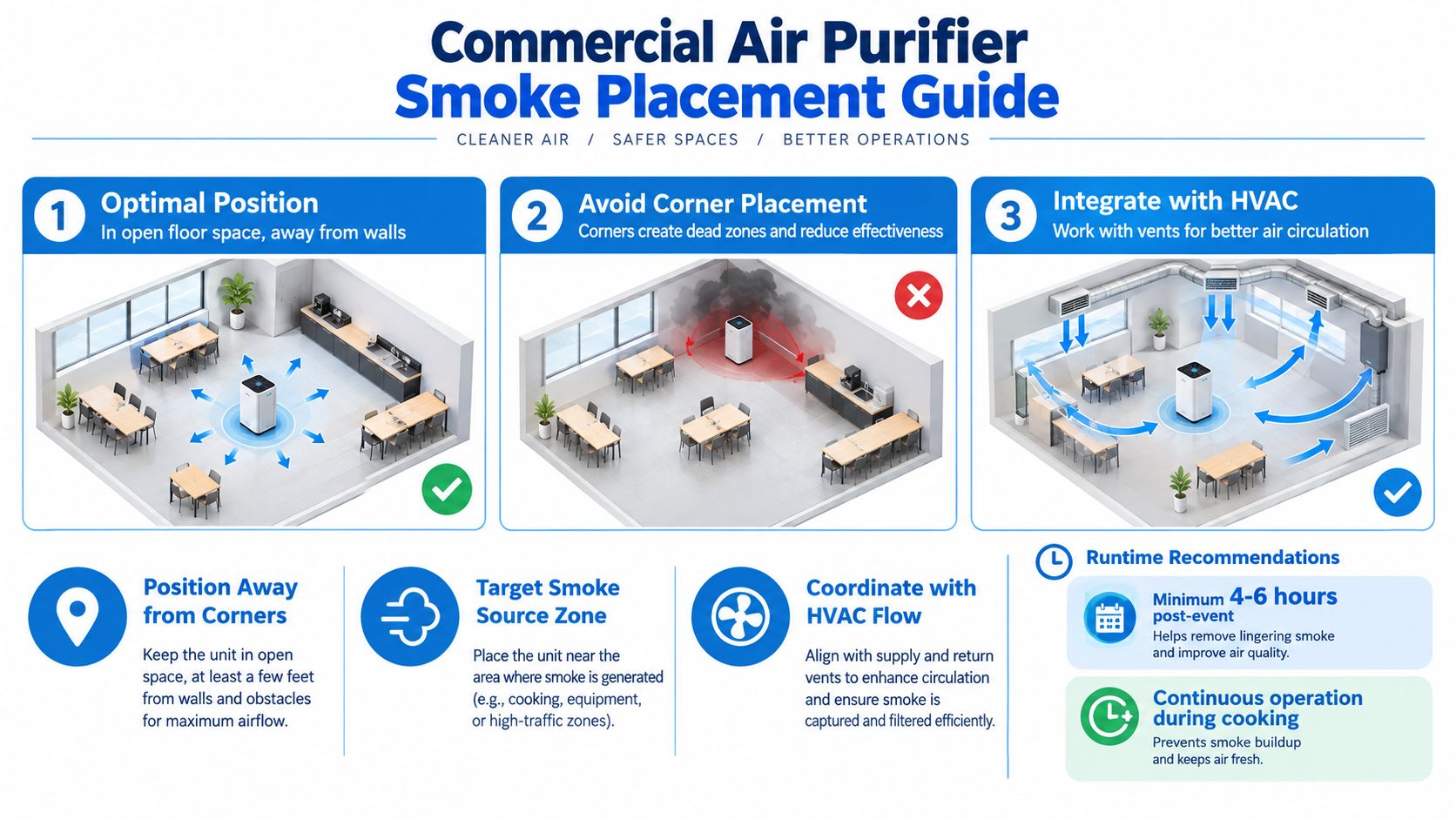
Set runtime around the event
Run equipment continuously during active smoke production. Use a low-speed baseline when the venue is occupied and a higher setting when cooking, patio traffic, or an infiltration event increases the load. A PM2.5 sensor can trigger a boost mode, while a differential pressure gauge can show when a loaded filter is restricting airflow.
Don't shut everything off when the visible haze disappears. The EPA's wildfire filtration research reports that a DIY air cleaner reduced PM2.5 by about 56% after 90 minutes in a larger room and about 99% within 60 minutes in a smaller room during a wildfire smoke event. Those results demonstrate why runtime and room size matter, but they aren't a universal promise for every commercial layout or smoke source. Continue filtration after the source ends, and verify the result with indoor measurements.
Coordinate with the HVAC system
Ask the HVAC contractor to evaluate MERV 13 or higher filtration during smoke events, provided the equipment can handle the added pressure drop. EPA guidance for schools and commercial buildings supports this approach. Adjust outdoor-air dampers and recirculation deliberately. More outdoor air can improve freshness and carbon dioxide control, but during wildfire smoke it can also bring more particles indoors.
Zone control matters in multi-room venues. Keep cleaner-air rooms slightly protected from contaminated corridors, avoid forcing smoke through transfer paths, and coordinate supply and return airflow. For broader building reliability work, facility teams can also find HVAC system reliability tips before making damper or filter changes.
Real Venues, Real Setups
A restaurant, salon, and gym can all need commercial smoke control, but they shouldn't receive the same equipment plan. The source, ceiling height, occupancy pattern, and HVAC layout determine the setup.
Restaurant with patio drift and cooking aerosols
Consider a 120-seat dining room with a partial kitchen and a patio door near the bar. The first control layer is source capture at the kitchen, followed by rooftop-unit filtration and portable units positioned between the patio entry and the occupied dining area. The portable units should support the room's calculated CADR without blocking circulation or creating a trip hazard.
Staff need a simple event routine. Keep the patio door closed when practical, run the portable units before peak service, increase fan speed when smoke drifts inside, and record complaints alongside PM2.5 readings. MERV filtration helps the HVAC system, but it doesn't replace kitchen exhaust or local source control.
Salon with chemical vapors
A salon has a smaller footprint, but treatments can create a persistent gas-phase load. Put ceiling-mounted or high units where they can circulate air without blowing directly across clients, and prioritize a meaningful activated-carbon stage alongside particle filtration. Smoke from a nearby entrance may be intermittent, while treatment vapors remain present throughout the day, so carbon maintenance becomes central to the operating plan.
Gym with high ceilings and CO2 pressure
A gym's open floor, high ceiling, and changing occupancy make distribution harder. Use overhead directional units or several distributed cleaners, then coordinate demand-controlled ventilation with indoor carbon-dioxide monitoring. Run filtration continuously at low speed and increase it during busy periods or smoke infiltration.
| Venue | Typical Unit Count | Target ACH | HVAC Change |
|---|---|---|---|
| Restaurant | Multiple distributed units | Calculate from room volume and source load | MERV filtration, kitchen exhaust review, patio-door control |
| Salon | Distributed or ceiling-mounted units | Size for treatment and smoke load | Carbon-focused filtration, ventilation review |
| Gym | Multiple directional or overhead units | Size for occupancy and high ceiling | Demand-controlled ventilation, MERV filtration, CO2 monitoring |
These are setup patterns, not purchase quantities. The correct unit count comes from total required smoke CADR, room geometry, and whether HVAC filtration carries part of the cleaning load.
Mistakes Buyers Make and Ozone Safety Warnings
More units don't automatically solve smoke. If every machine sits in a corner, shares the same blocked intake path, or moves air against an overloaded return system, the building can contain several purifiers and still have a smoky occupied zone.
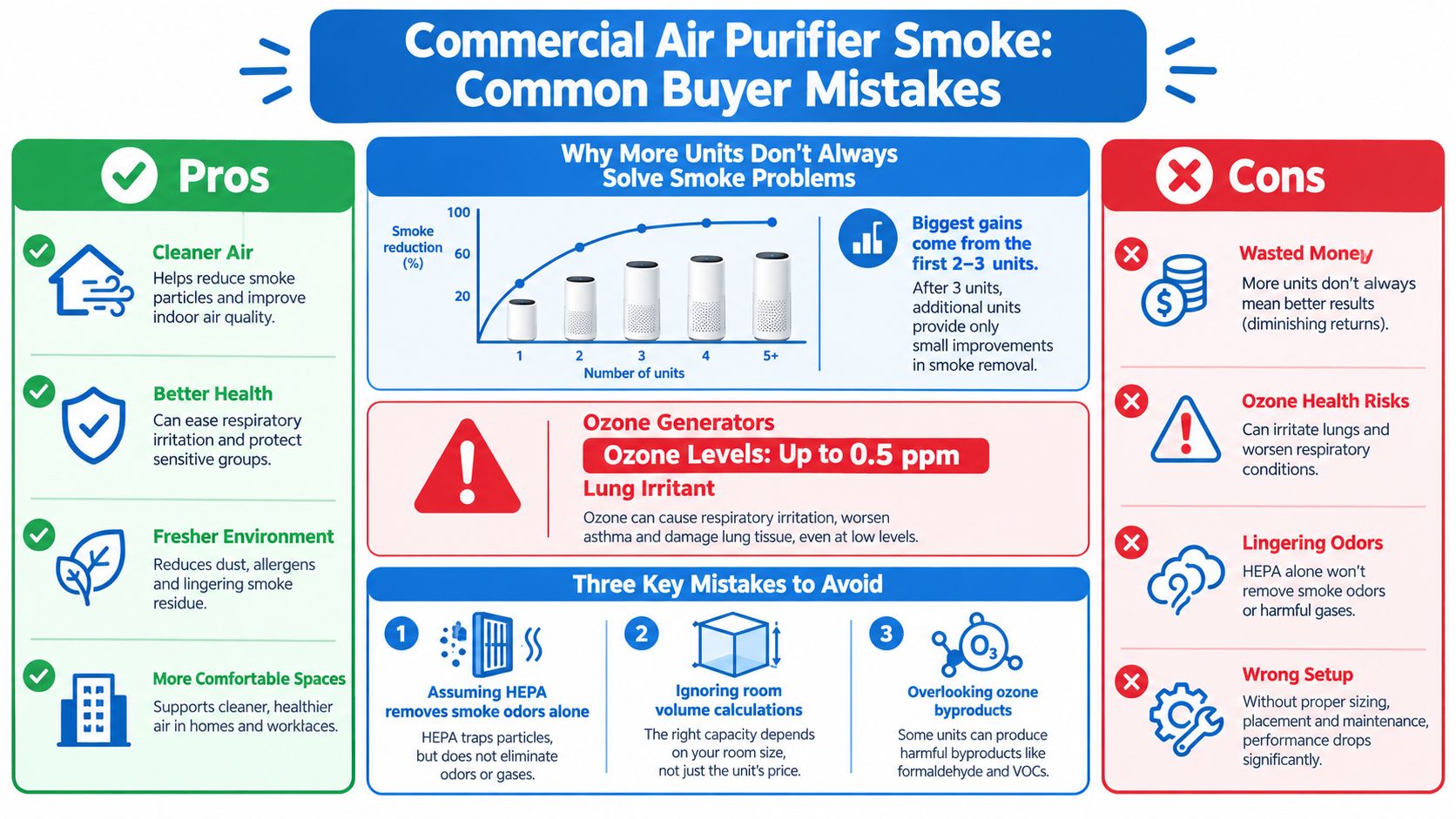
The three errors I see most often
Buying by room-size label. A label rarely tells you the smoke CADR needed for a high ceiling, constant occupancy, or continuous infiltration. Calculate the room volume and total CADR first.
Assuming HEPA removes the smell. HEPA targets particles. Odor control needs activated carbon or another appropriate gas-phase stage, and the carbon must have enough mass to handle the load.
Treating ozone as purification. Intentional ozone generators aren't appropriate for occupied interiors. Ozone is a lung irritant, and a machine that masks odor by adding a reactive gas has failed the basic safety test. In California, check CARB requirements before buying or operating an electronic air cleaner.
Over-sealing a room creates another problem. A purifier running in recirculation mode doesn't remove carbon dioxide generated by occupants. If the building cuts outdoor air too aggressively during a long smoke event, people may report drowsiness, stuffiness, or discomfort even while particle readings improve. Health Canada's guidance reinforces the need to manage CO2, humidity, and PM2.5 together, rather than optimizing one measurement in isolation.
Operational warning: Clean air isn't the same as comfortable air. During a multi-day event, pair PM2.5 control with deliberate ventilation and CO2 monitoring.
Over-pressurization can also cause trouble when portable equipment overwhelms the return-air path. Doors may become difficult to operate, smoke can leak from adjacent spaces, and HVAC equipment may short cycle. Distributed units usually provide better coverage than one oversized machine, but they still need to fit the building's airflow balance.
Facilities evaluating product categories can review commercial ozone-generator options, but intentional ozone generation should be excluded from occupied smoke-control plans. Choose removal technologies, verify emissions certifications, and ask for test documentation before installation.
Maintenance Schedules and Compliance Basics
Smoke loads turn maintenance into a performance issue. A dirty pre-filter restricts airflow, loaded carbon loses odor-control capacity, and an overloaded HEPA filter can reduce the very CADR you paid for.
During heavy smoke events, inspect and vacuum or replace pre-filters weekly. Check carbon stages monthly for odor breakthrough and loading. Replace HEPA media according to pressure-drop readings and observed performance, not an arbitrary calendar date. The suggested service window may extend from 12 to 24 months, but recurring wildfire exposure, tobacco smoke, and cooking aerosols can shorten it.
| Filter or Check | Replacement Interval | Compliance or Trigger |
|---|---|---|
| Pre-filter | Weekly inspection during heavy smoke | Visible loading, restricted intake, or reduced airflow |
| Activated carbon | Monthly odor check | Odor breakthrough or saturated media |
| HEPA filter | Pressure-drop based, often 12 to 24 months | Rising pressure drop, reduced CADR, or visible discharge-side haze |
| PM2.5 monitoring | During and after smoke events | Persistent indoor elevation or occupant complaints |
| Fan and electrical inspection | According to equipment schedule | Rising fan amperage, unusual noise, or unstable operation |
Document filter changes, smoke-event hours, pressure readings, sensor results, and occupant complaints. Those records help explain maintenance decisions during insurance, health-department, or workplace reviews.
Compliance checks before installation
Verify CARB certification for devices sold or operated in California, review the applicable UL 867 safety listing for electronic air cleaners, and check local rules for cigar lounges, hookah venues, casinos, and other smoking-related occupancies. OSHA and local workplace requirements still matter even when a venue's customers accept smoke as part of the experience.
A commercial HVAC vendor can combine filter service, pressure-drop checks, damper review, and sensor verification. For broader workplace procedures, Amax Fire and Safety management offers a useful reference point for organizing health and safety documentation.
A Decision Framework for Your Space
Use this sequence before requesting quotes.
Measure the room. Record floor area, ceiling height, room volume, occupancy, smoke sources, doors, and outdoor-air paths. Set the target ACH from the actual smoke load, not from a product brochure.
Calculate total smoke CADR. Use room volume and the formula above. For tobacco smoke, compare the result with the EPA's area-based CADR guidance. Then divide the requirement across units that can circulate air through the occupied zone.
Decide whether HVAC must participate. If the system can handle it, evaluate MERV 13 or higher filters, return-air improvements, damper settings, dedicated exhaust, and zone control. A portable unit may be enough for a small, isolated room with intermittent smoke. It usually won't solve smoke entering through multiple doors, shared corridors, or outdoor-air intakes.
Choose the filtration stack. Make HEPA-class particle filtration and substantial activated carbon the baseline. Consider RCI or bipolar ionization only as secondary technologies after verifying the application, emissions data, and certification. Exclude intentional ozone generation from occupied spaces.
Budget for operation. Include replacement filters, sensor checks, pressure monitoring, electricity, staff procedures, and HVAC service for the next operating cycle. Pilot a vendor with particle and CO2 monitoring before committing to a long contract.
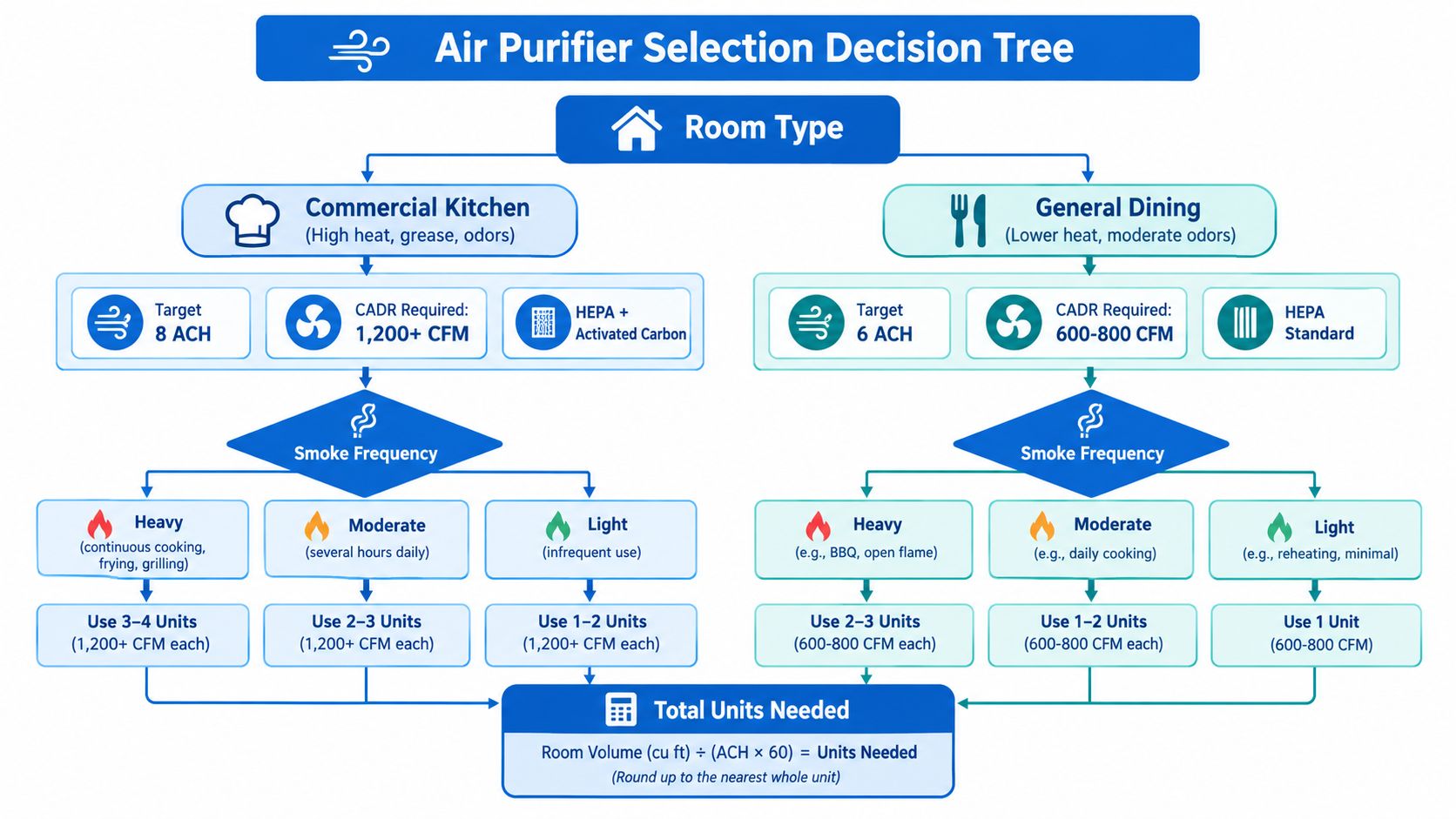
The decision is rarely “portable purifier or HVAC.” The durable answer is usually source control, balanced ventilation, correctly sized smoke CADR, particle filtration, carbon for odor, and a maintenance plan. That combination protects comfort during long events without trading smoke exposure for stale, over-sealed air.
EcoQuest Purifiers offers indoor air-quality products, replacement parts, repair services, and HVAC-integrated options across technologies including HEPA, charcoal filtration, UV, RCI, and bipolar ionization. Review EcoQuest Purifiers with your room measurements, smoke source, CADR target, and HVAC constraints, then choose equipment that fits the building rather than relying on a generic room-size claim.