
Commercial Air Purifier HEPA Selection Guide
You're responsible for a busy office, clinic, restaurant, or gym, and people are complaining about stale air, dust, odors, or recurring respiratory irritation. The obvious response is to buy a commercial air purifier labeled HEPA. The difficult part is choosing a system that actually cleans the air your occupants breathe, rather than a unit that merely moves air through an impressive-looking filter.
For a commercial installation, the practical questions are these: What airflow does the room need? How many air changes per hour will the equipment deliver? Will the filter remain sealed under load? What will replacement filters, electricity, and servicing cost over the system's life? Filter grade matters, but room ventilation math and operating discipline matter just as much.
| Decision factor | What to verify | Why it matters |
|---|---|---|
| HEPA specification | Stated capture efficiency and applicable standard | Confirms what the filter has actually been tested to remove |
| Airflow | CADR or delivered airflow under installed conditions | Determines how quickly the room receives cleaned air |
| Room performance | ACH based on room volume, occupancy, and use | Converts equipment output into a meaningful target |
| Air path | Filter seal, housing integrity, and bypass control | Prevents untreated air from passing around the filter |
| Maintenance | Pre-filter cleaning, HEPA replacement, access, and labor | Determines ongoing performance and total cost |
| Integration | HVAC compatibility, controls, noise, and placement | Ensures the purifier works in the occupied space |
Table of Contents
- Why Commercial Spaces Demand Certified HEPA Filtration
- Decoding Filter Grades and Certification Standards
- Calculating Room Size and Air Change Requirements
- Evaluating HEPA Against Alternative Purification Technologies
- Matching Purification Systems to Specific Business Use Cases
- Analyzing Long-Term Maintenance and Operational Costs
- Finalizing Your Commercial Air Quality Investment
Why Commercial Spaces Demand Certified HEPA Filtration
A facilities manager sees the pattern quickly. Staff report dust near supply grilles, patients notice stale air in a clinic waiting room, and restaurant odors persist even while the exhaust system runs. The business places portable purifiers along the walls, yet complaints continue.
The usual failure is not a lack of fan movement. It is insufficient measured clean-air delivery. A fan can redistribute contaminated air without removing fine particles. Commercial rooms also face variable occupancy, open doors, irregular layouts, and activities that produce aerosols, dust, smoke, or odors. A residential purifier chosen from a “maximum coverage” label does not account for those conditions.
HEPA earned its place in serious particulate-control work because it was developed for environments where airborne contamination required strict control. The technology originated during the Manhattan Project in the early 1940s, was declassified and commercialized in the 1950s, and supported broader high-containment and clean-air applications by the 1960s, as described by Britannica's history of HEPA systems. Modern U.S. specifications center on removing 99.97% of particles at 0.3 micrometers, a benchmark that established HEPA as a common choice for hospitals, laboratories, offices, and public buildings.
Moving air is not the same as cleaning air
Commercial specifications must separate three functions:
- Ventilation introduces outdoor air and removes indoor air.
- Filtration captures particles that pass through filter media.
- Air cleaning measures the removal capacity delivered by a purifier or HVAC system.
A HEPA unit improves particulate control, but it cannot correct a defective exhaust system, blocked outdoor-air intake, or poorly balanced HVAC design. In a restaurant, it may reduce airborne particles and some odors, yet source capture at cooking equipment remains the primary control.
Define those requirements in the building brief before selecting equipment. If you are planning your office build, specify air distribution, purifier locations, service access, electrical capacity, noise limits, and filter-replacement routes before walls and ceilings make changes costly.
Why certified particulate control remains the default
HEPA remains a major filtration technology in commercial air purification. One estimate places HEPA systems at 68.1% of the overall air purifier market in 2025, while a separate commercial-segment estimate places HEPA at 34.8% of global revenues in 2025 and projects a 9.6% CAGR through 2034, according to Mordor Intelligence's air purifier market report. The figures measure different market bases. They indicate demand, not a substitute for engineering verification.
Start a commercial specification with mechanical filtration and delivered airflow. Calculate room volume, target ACH, and CADR under installed conditions. Then assess pressure drop, filter loading, replacement intervals, electricity, labor, and access. A high-grade filter still fails operationally if the unit is undersized, poorly sealed, or expensive to maintain.
Review commercial air purifier options only after defining the room's contaminants, occupancy, noise tolerance, service plan, and airflow requirement. The equipment must deliver clean air where occupants are, not merely display an impressive filter label.
Decoding Filter Grades and Certification Standards
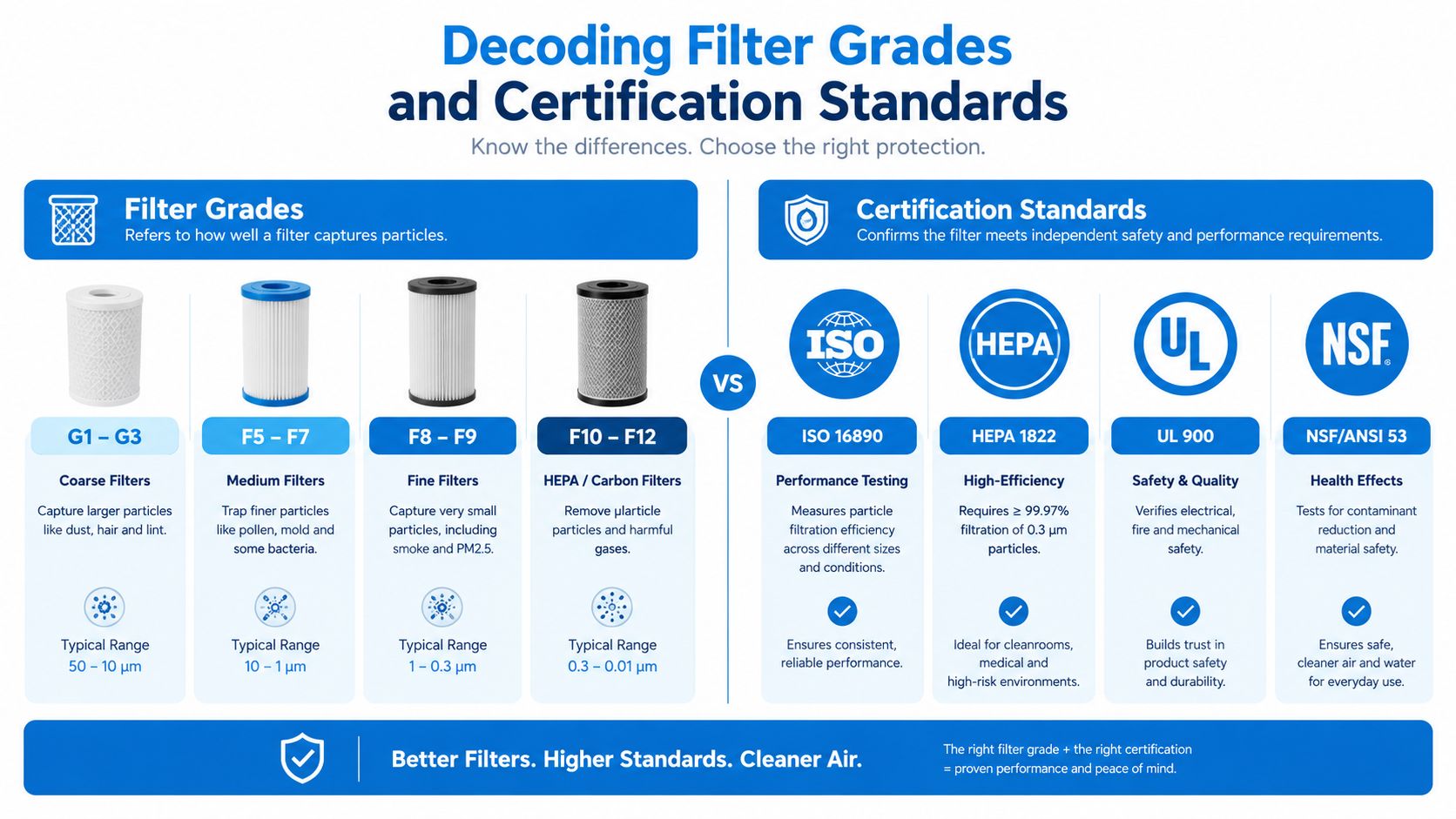
A filter grade does not tell you how much clean air a commercial room receives. True HEPA, H13, H14, and medical-grade describe different claims, so require separate evidence for each. “Medical-grade” is often a marketing label unless the supplier names the governing standard, test method, and product-level documentation.
True HEPA is the 99.97%-at-0.3-micron benchmark covered earlier. H13 and H14 classifications go further under EN 1822 or ISO 29463, with greater emphasis on testing the filter and complete assembly. Review the standard and test conditions, not just the grade printed on the cabinet. Confirm whether the stated efficiency applies to the filter media, the housing, or the complete operating unit. That distinction affects delivered performance and, ultimately, the ACH your room receives.
The filter grade is only one part of the result
A highly efficient filter can underperform if air bypasses the media or fan pressure reduces airflow. Check these failure points:
- Gasket compression: A damaged or uneven gasket lets air pass around the media.
- Housing joints: Poorly sealed access panels leak untreated air.
- Frame distortion: A filter that sits out of square leaves gaps.
- Installation damage: Torn media or rough handling can compromise the filter before startup.
- Fan and cabinet mismatch: Excessive pressure can distort seals or cut delivered airflow.
For higher-risk rooms, require individual leak testing, not only a generic filter certificate. Dental offices, laboratories, and clinical areas need a sealed air path, a defined test method, and commissioning evidence for the installed unit. The supplier should explain how it checks the filter, frame, housing, and final assembly.
What to request from a vendor
Request the exact standard, test conditions, pressure drop, rated airflow, and replacement filter identification. Ask whether the claimed efficiency applies at the unit's operating airflow or only under a laboratory condition that differs from the installed fan setting. Require the supplier to state the resulting CADR, because a restrictive filter can increase fan demand while reducing the clean-air output used in your room calculation.
H13 or H14 equipment fits applications with tighter contamination-control requirements or lower risk tolerance. It also brings greater fan demand, noise, energy use, and filter-replacement cost. In a general office, verified True HEPA with good sealing and adequate CADR can deliver better operating value than a higher grade that the ventilation design cannot use effectively.
A product such as Fresh Air Double Plus combines ozone generation, germicidal UV light, charcoal, HEPA, and ionization according to its catalog description. Evaluate each operating mode, the intended occupancy conditions, and the documentation for particulate and ozone-related performance. Treat the technologies as separate functions, not interchangeable proof of room-level air cleaning.
Procurement rule: Buy documented performance from the complete air-cleaning assembly, then verify its CADR, sealing, pressure drop, and maintenance cost. Do not buy the largest filter grade printed on the carton.
Calculating Room Size and Air Change Requirements
“Covers up to” is a sales phrase, not a commissioning result. Commercial sizing starts with room volume, then converts required air changes into a required airflow.
Use this process:
- Measure the room length, width, and average ceiling height.
- Multiply those dimensions to calculate volume.
- Choose a target ACH based on occupancy and risk.
- Convert ACH into required airflow.
- Divide the requirement across units while accounting for actual operating settings and pressure losses.
The core formula is:
Required airflow in cubic feet per hour = room volume in cubic feet × target ACH
To convert that result into cubic feet per minute:
Required CADR in CFM = room volume × target ACH ÷ 60
For a rectangular room, the calculation is straightforward. A space with more occupants, higher aerosol generation, or higher contamination risk needs a stronger target than a lightly occupied storage area. Don't use the manufacturer's maximum room area unless the stated assumptions match your ceiling height, occupancy, doors, HVAC operation, and fan setting.
Target ACH by commercial environment
| Environment Type | Target ACH | Primary IAQ Goal |
|---|---|---|
| General office | 2 to 4 ACH | Reduce accumulated particulate matter in occupied work areas |
| Classroom | Minimum 2 ACH | Establish a baseline clean-air target alongside ventilation |
| Clinic waiting area | Set from occupancy and risk assessment | Reduce exposure in a continuously occupied shared space |
| Higher-risk hospital-type room | Up to 15 ACH may be required | Support stringent contamination-control objectives |
The classroom minimum and hospital-type target are cited in ISO-Aire's guidance on clean-air technology and HEPA filtration. They shouldn't be copied blindly into every room. The correct target depends on the activity, source control, existing ventilation, and applicable facility requirements.
Use delivered CADR, not theoretical fan airflow
CADR must reflect air passing through the filter at the selected operating point. A powerful fan running through a loaded high-efficiency filter may deliver much less airflow than the headline figure suggests. If the specification lists only free-air CFM, ask for airflow with the intended filter installed.
For an open-plan office, multiple distributed units usually outperform one oversized device placed at a remote corner. Distribution reduces dead zones and gives occupants a more consistent clean-air supply. In a multi-room clinic, calculate each enclosed room separately, then confirm that doors, transfer grilles, and HVAC pressure relationships won't undermine the design.
An HVAC-integrated option such as Induct 5000 should be evaluated as part of the duct system, with attention to airflow, access, controls, and compatibility. A filterless unit such as Living Air Classic XL-15 Air Purifier uses ionization and activated oxygen technology according to its catalog description, so it should not be treated as a substitute for a calculated HEPA CADR when the specification requires mechanical particulate removal.
Evaluating HEPA Against Alternative Purification Technologies
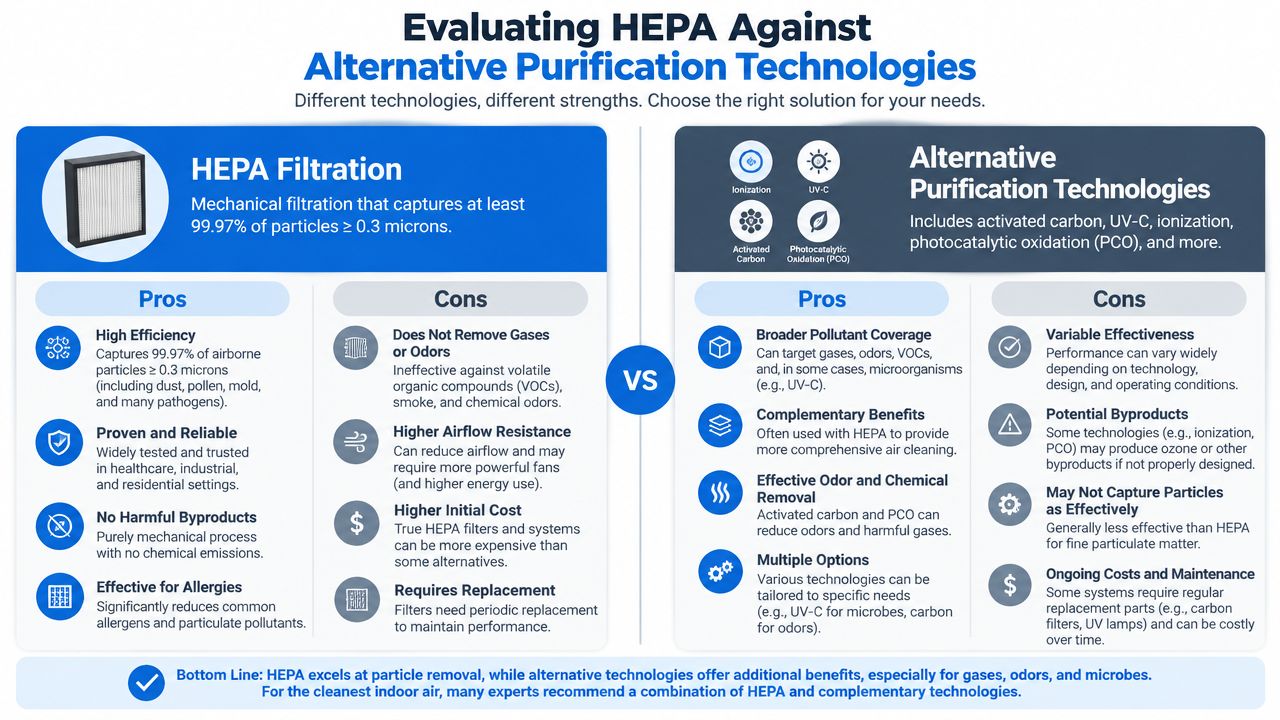
HEPA is excellent at capturing particles that pass through its media. It isn't a universal treatment for gases, VOCs, or every odor source. Facilities often get better results by assigning each technology a defined job instead of buying a mixed-technology unit and assuming every stage has equal value.
Match the technology to the contaminant
| Technology | Strongest role | Main limitation |
|---|---|---|
| HEPA | Fine particulate capture | Doesn't remove gases unless paired with another stage |
| Activated carbon | Odors and some gaseous contaminants | Capacity depends on carbon mass, contaminant, and contact time |
| UV-C | Inactivation within a properly designed irradiation zone | Performance depends on dose, exposure time, lamp condition, and airflow |
| Bipolar ionization | Particle interaction and agglomeration in some system designs | Requires careful evaluation of byproducts and installed performance |
| Photocatalytic oxidation | Treatment of selected airborne contaminants in a designed reactor | Needs validated performance for the specific contaminant and configuration |
| Active oxygen or ozone | Specialized odor and treatment applications | Occupied-space use requires strict control and appropriate operating conditions |
The air cleaning technology overview for facility operations is useful background when comparing these categories. The key engineering principle is simpler than the product terminology: remove the contaminant at its source, ventilate where possible, then use filtration or treatment for what remains.
A waiting room with airborne particulate concerns should prioritize verified HEPA airflow and proper distribution. A commercial kitchen needs source capture and exhaust first, then may use carbon or other odor controls for residual smells. A gym needs high air movement and manageable noise, but the equipment still has to deliver measurable clean air rather than merely circulate warm, humid air.
Don't let secondary technology hide weak airflow
UV-C, ionization, and oxidation stages can be useful additions, but they don't make an undersized purifier adequate. If the room requires a defined particulate-removal target, specify HEPA CADR first. Evaluate secondary stages for their intended contaminant, test evidence, byproducts, maintenance needs, and compatibility with occupied operation.
Watch the video below for a visual comparison of purification approaches.
Ozone deserves particular caution. A system designed for controlled treatment in an unoccupied area is not the same as a purifier intended to operate continuously around employees or customers. Require clear operating instructions and documented suitability for the occupancy conditions. Review commercial ozone and air purification equipment as a separate category, not as an automatic replacement for mechanical HEPA filtration.
Matching Purification Systems to Specific Business Use Cases
The right commercial air purifier hepa configuration depends on what happens in the room. A clinic, restaurant, gym, and office can occupy the same floor area yet need very different equipment profiles.
Healthcare and clinical spaces
Start with verified particulate performance, sealed housings, documented commissioning, and a maintenance process that staff can follow without entering restricted areas unnecessarily. Waiting rooms need distributed airflow that doesn't blast directly at seated patients. Treatment rooms may require a different target, lower noise, and stricter control of filter access.
Don't rely on the phrase “medical-grade.” Request the applicable standard, individual leak-test information, delivered airflow, alarm functions, and records showing when filters were changed. Coordinate the purifier with existing HVAC pressure relationships and infection-control requirements. A portable unit may support a room, but it doesn't replace the clinical engineering review required for higher-risk spaces.
Offices and schools
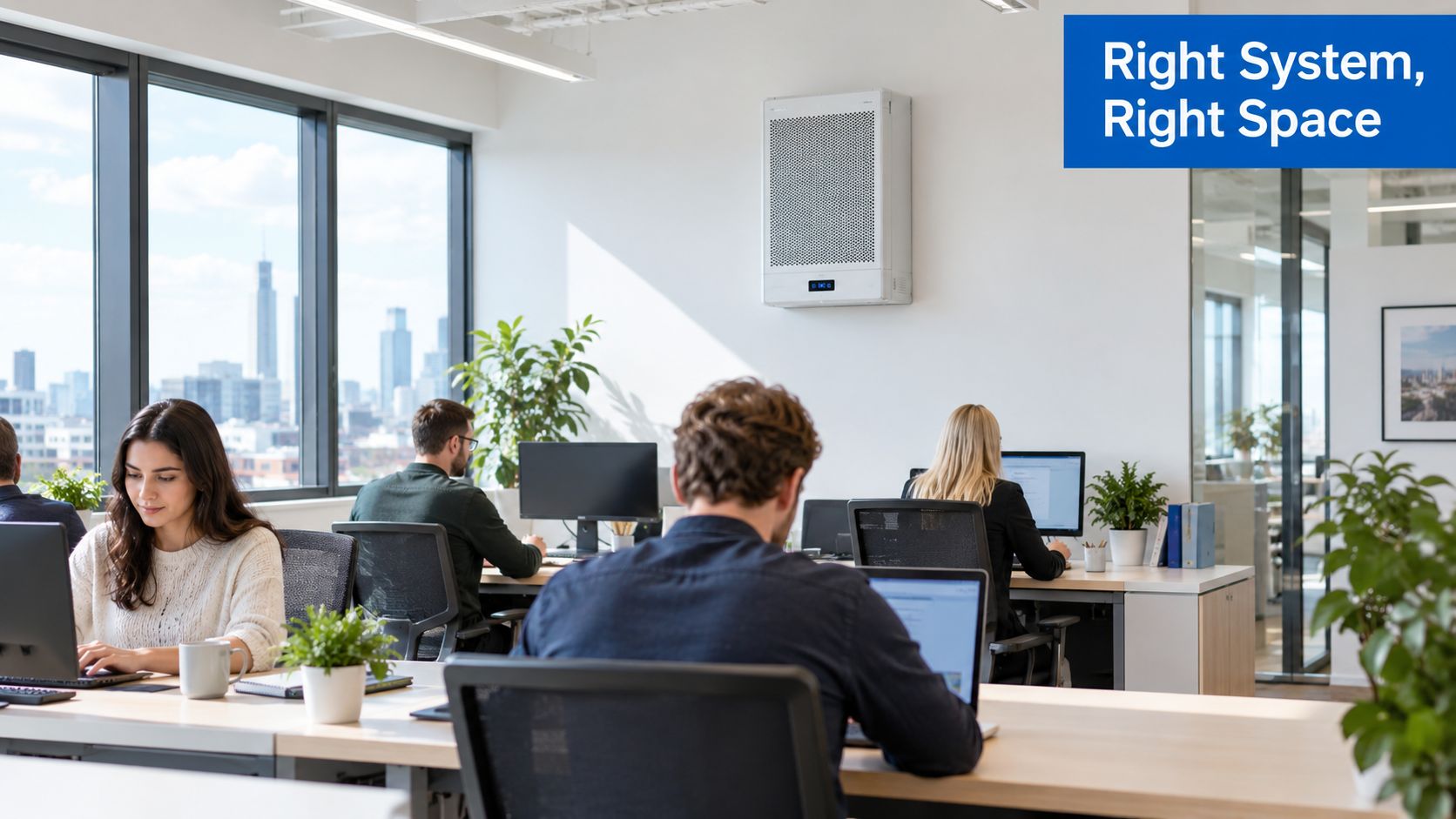
Offices prioritize predictable airflow, low noise, unobstructed circulation, and simple controls. Place units where they can draw and discharge air across the occupied zone, not behind cabinets or inside cramped corners. Open-plan spaces often need several smaller clean-air sources because partitions, furniture, and meeting rooms interrupt circulation.
Schools need tamper-resistant controls, accessible but secure filters, and a service plan that works around term schedules. A unit that achieves its target only at an intrusive fan setting will be turned down by occupants, so specify the performance level at the noise setting people will tolerate.
Hospitality and food service
Restaurants have two separate problems: airborne particles and odors. Exhaust and source capture remain the first line of defense. A purifier can help with residual airborne contamination, but a HEPA filter isn't an odor-control system by itself.
Choose a compact, serviceable unit for dining areas, with carbon or another validated odor-control stage where appropriate. Keep discharge away from tables, food-preparation zones, and doors that create short-circuit airflow. In hotels, guestrooms and public corridors also require attention to sound, appearance, filter access, and the risk of moving odors between spaces.
Gyms and high-occupancy venues
Gyms need high clean-air delivery, reliable operation, and controls that staff can understand. Sweat, humidity, dust, and constant movement increase the importance of durable housings and straightforward pre-filter service. Place units to avoid blowing directly across exercise stations while still creating useful room mixing.
Across every use case, connect the purifier to the building's HVAC strategy. Standalone HEPA units are flexible, while duct-integrated systems can serve multiple zones but require more careful engineering and maintenance access. The equipment profile should follow the room's risk, not the vendor's broadest coverage claim.
Analyzing Long-Term Maintenance and Operational Costs
The purchase order is only the beginning. A commercial purifier creates recurring costs for filters, electricity, labor, access, storage, downtime, and disposal. If procurement ignores those costs, the facility may lower fan speeds, delay replacements, or stop servicing units when the budget tightens.
Filter replacement is a performance expense
Pre-filters protect the more expensive final filter and help preserve airflow. If staff neglect them, pressure rises, CADR falls, fan energy increases, and the motor works harder. A loaded HEPA filter can still look intact while the system delivers less useful clean air.
Get these details in writing:
- Filter availability: Identify the exact replacement part and ordering route.
- Service interval: Ask what inspection or replacement schedule applies under your dust and occupancy conditions.
- Access time: Confirm whether one technician can safely reach the filter without moving heavy furniture or shutting down a work area.
- Disposal process: Determine how used filters must be handled in healthcare, laboratory, or contaminated settings.
- Pressure monitoring: Require an indicator or measurement method that shows when airflow resistance is affecting performance.
Calculate total cost of ownership
Build a simple annual operating model for every proposed system. Include filter purchases, scheduled labor, electricity at the intended fan setting, corrective maintenance, and the cost of taking a room or unit offline. Then compare systems by delivered clean air, not by purchase price or theoretical coverage.
High-MERV and HEPA systems can demand more fan power because finer media creates greater resistance. That doesn't make them a poor choice. It means the fan, filter area, controls, and cabinet must be selected as a matched assembly. A large filter surface can reduce resistance, while variable-speed control can help the facility balance noise, energy, and required ACH.
Budget test: If the maintenance team can't explain how the unit will be inspected and serviced, the specification isn't complete.
Track operating performance after installation. Record fan setting, pressure or alarm status, filter changes, room use, and complaints. Those records reveal whether the purifier is delivering the intended clean-air rate and help justify future replacement budgets.
Finalizing Your Commercial Air Quality Investment
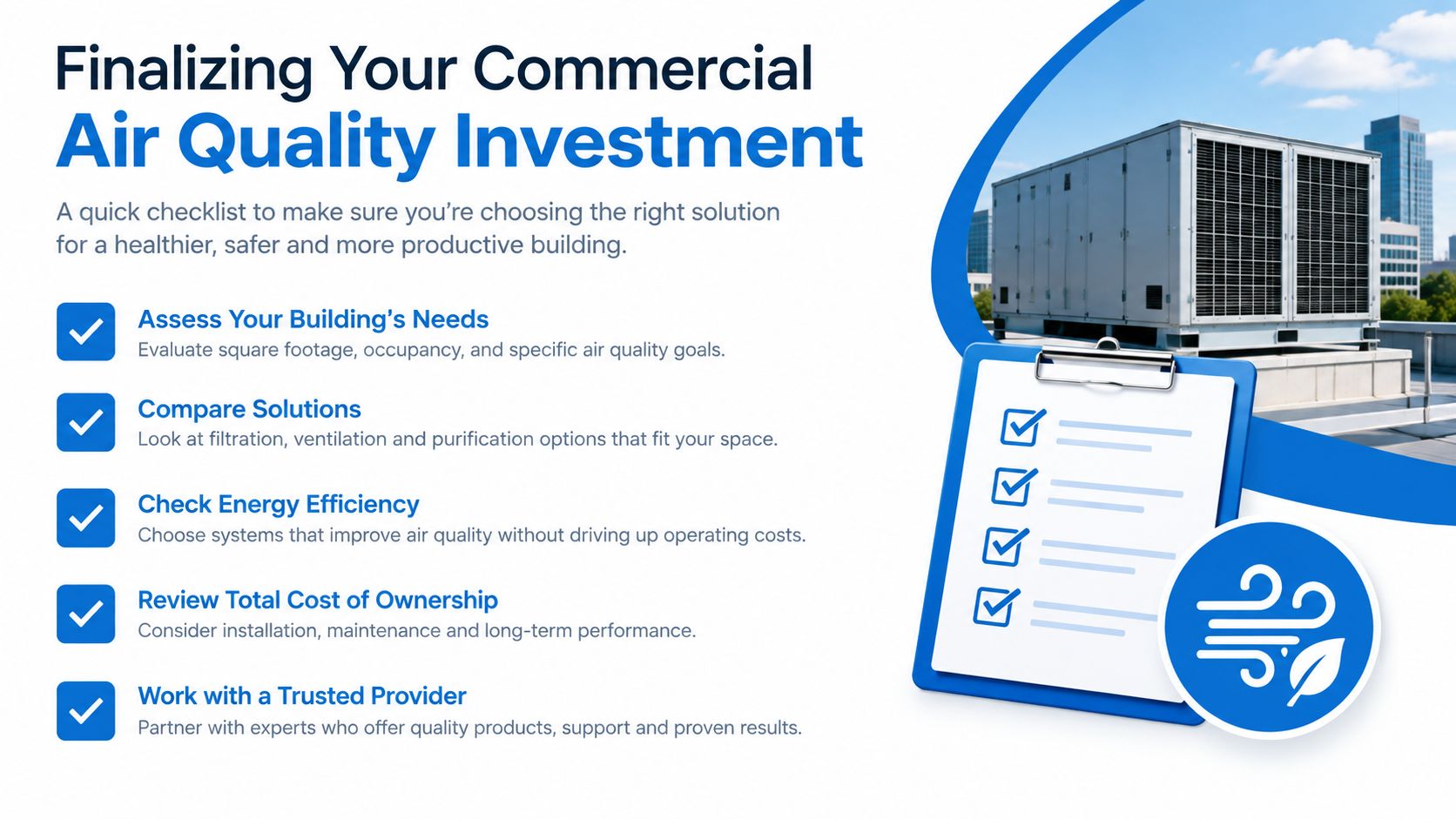
Choose the system with a commissioning checklist, not a brochure. The right commercial air purifier hepa purchase should prove three things: the filter is what the vendor says it is, the installed equipment delivers the required airflow, and the business can afford to maintain it.
Questions to put in the proposal
Ask vendors to provide:
- Filter evidence: Which standard applies, what was tested, and does the documentation cover the complete assembly?
- Delivered airflow: What CADR or airflow does the unit produce with the specified filter installed?
- Room calculation: Which room dimensions, ceiling height, occupancy, and target ACH support the recommendation?
- Bypass protection: How does the housing seal, and how is leakage checked after installation?
- Operating cost: What filters, labor, energy, and service access will the facility need?
- Warranty and support: Who handles repairs, what parts remain available, and how quickly can the unit return to service?
- Controls and noise: At what fan setting does the equipment meet the target, and what will occupants hear?
- Integration: Will the purifier work alongside existing HVAC, exhaust, pressure relationships, and controls?
Reject proposals that provide only a room-area claim or a filter-grade slogan. A credible vendor can show the calculation, identify assumptions, and explain what changes when filters load or the fan runs below maximum speed.
Roll out in measured phases
For a large facility, start with representative rooms rather than purchasing a fleet without verification. Commission the first installation, measure delivered airflow, check sound and placement, review filter access, and collect occupant feedback. Then adjust the specification before expanding to other zones.
Use HEPA as the particulate-control foundation where the risk and room target justify it. Add carbon for validated odor or gas-control needs. Consider UV-C, ionization, photocatalytic oxidation, or active oxygen only when the technology has a defined role, documented operating conditions, and a maintenance plan.
The strongest investment is rarely the unit with the most features. It's the system that delivers the required clean air at an acceptable noise level, stays sealed, and remains affordable to operate. Ask for evidence, calculate ACH, price the maintenance, and make the vendor defend every assumption.
EcoQuest Purifiers offers indoor air quality products, replacement parts, repair services, and commercial-oriented purification options that include HEPA, charcoal, UV, ionization, photocatalysis, and ozone technologies. Review the available configurations and support resources at EcoQuest Purifiers, then match any product choice to your room calculations, occupancy requirements, and maintenance plan.