
Car Air Purifier with UV Light: How It Works and What to Buy
A morning commute can make a car feel like a sealed box. You're sitting in traffic, the cabin is set to recirculate, yesterday's takeaway smell is still trapped in the upholstery, and the air feels heavy even though the windows are closed. A compact purifier may seem like an obvious fix, but a model advertised as a car air purifier with UV light deserves closer inspection than a bright lamp and a confident product label.
UV-C can inactivate microorganisms, but only when the air receives enough light at the right intensity for long enough. Airflow, filtration, enclosure design, ozone control, and maintenance matter at least as much as the presence of a UV lamp. This guide uses that dose-and-airflow reality to help you decide whether UV is worth paying for, or whether HEPA and activated carbon better match your daily driving.
Table of Contents
- What Drivers Actually Want From a Car Air Purifier
- How UV-C Light Cleans Air Inside a Car
- UV Light vs HEPA and Carbon for Cabin Air
- When UV Helps and When It's Overkill
- Ozone and Byproduct Safety in the Cabin
- Power and Installation Options for Every Vehicle
- Maintenance That Keeps UV Units Effective
- Choosing the Right Car Air Purifier With UV Light
What Drivers Actually Want From a Car Air Purifier
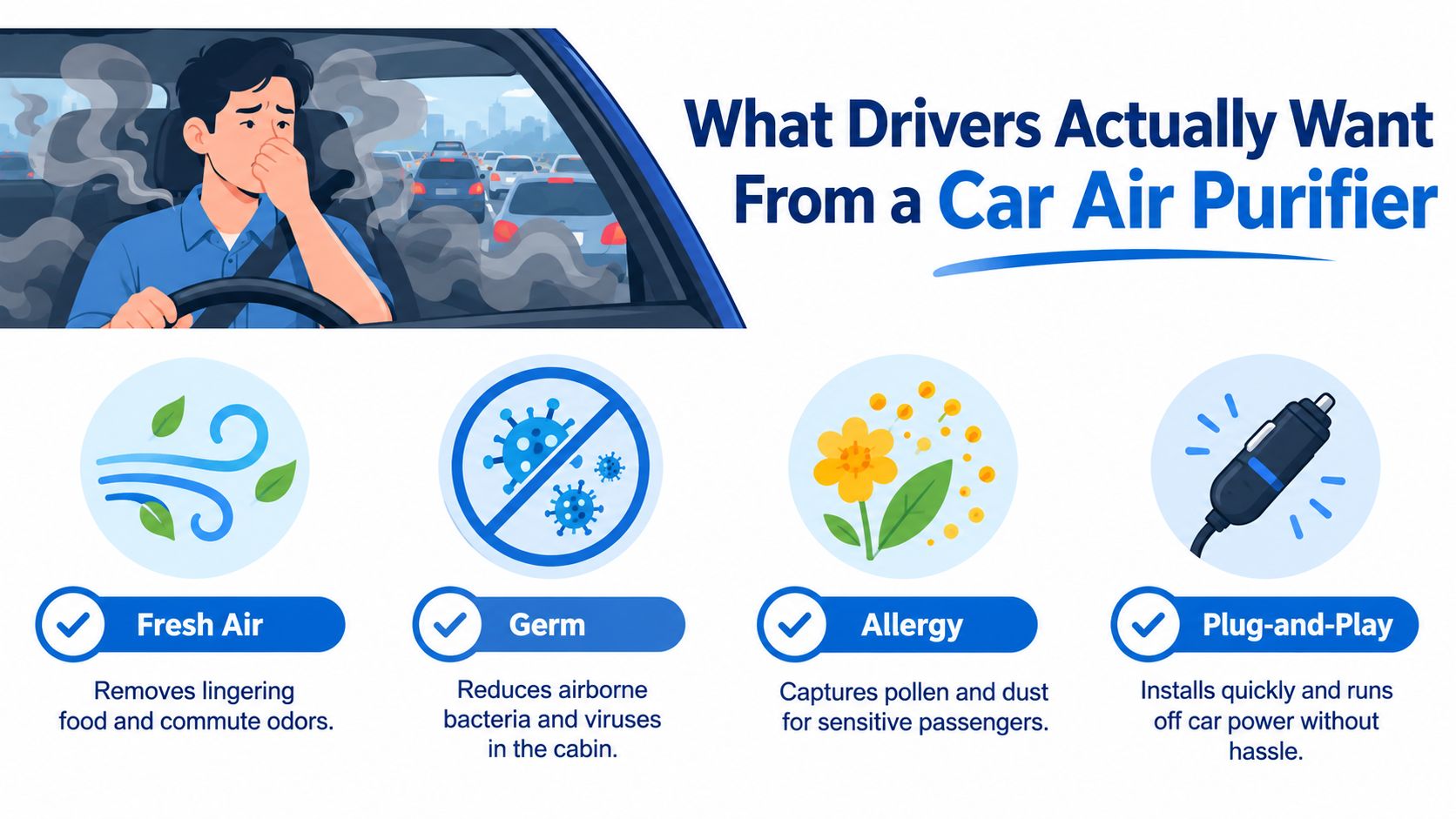
Most drivers aren't shopping for abstract “air quality technology.” They want the cabin to smell less like food, feel less dusty, and become more comfortable for passengers with allergies. A parent may be thinking about pollen and pet dander, while a rideshare driver may care more about smoke, stale air, and the steady turnover of passengers throughout the day.
The same device may be asked to handle several different jobs:
- Particles: Capture road dust, pollen, smoke particles, and other airborne debris.
- Odors and gases: Reduce food smells, tobacco residue, exhaust-related odors, and some volatile compounds.
- Microbial load: Inactivate some airborne bacteria, viruses, or other microorganisms when the design delivers a meaningful UV dose.
- Convenience: Run from vehicle power, stay quiet enough for conversation, and avoid blocking controls or visibility.
The difficult part is that these jobs require different technologies. A mechanical filter can capture particles without waiting for them to receive a light dose. Activated carbon can hold some odor molecules and gases through surface adsorption. UV-C acts on microorganisms only when contaminated air passes through the irradiated zone, and it doesn't remove dust or absorb odors by itself.
The market reflects growing interest in in-cabin purification. The global automotive air purifier market was estimated at USD 2.12 billion in 2025 and is projected to reach USD 3.78 billion by 2031, with a projected 10.11% compound annual growth rate from 2026 to 2031, according to Mordor Intelligence's automotive air purifier market report. The report also identifies UV-LED units as its fastest-rising technology category, but market growth doesn't prove that every consumer UV device delivers useful disinfection.
The practical question isn't “Does this purifier contain UV?” It's “How much of my cabin air passes through a properly engineered UV zone?”
That question becomes especially important in a moving vehicle. The cabin is small, but the air can circulate quickly, leak around occupants and vents, or bypass a poorly sealed portable unit. A thoughtful purchase starts by separating what you want removed from how the purifier removes it.
How UV-C Light Cleans Air Inside a Car
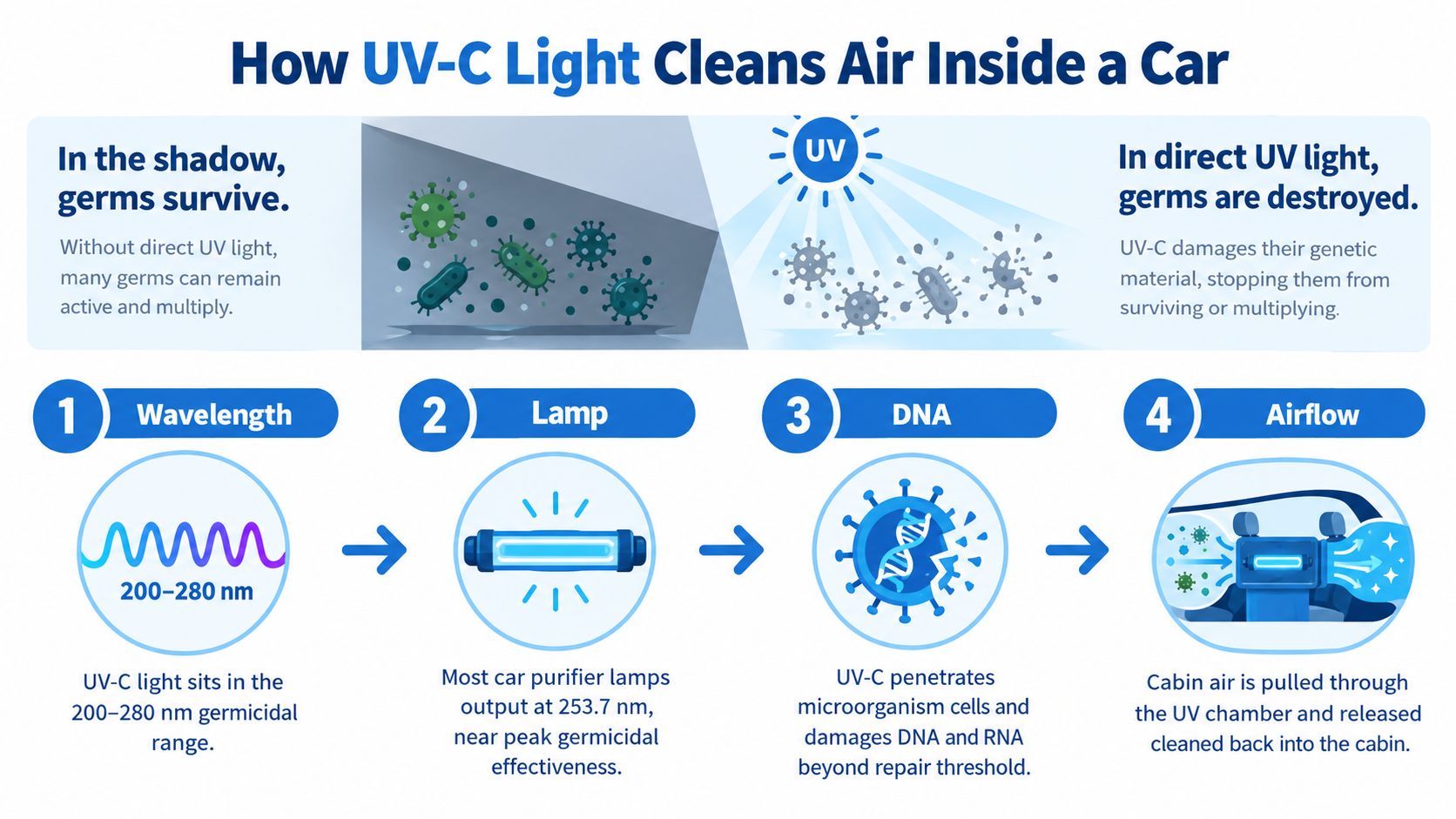
UV-C works more like direct sunlight than like a filter. A microorganism exposed to sufficient germicidal light can suffer damage to its genetic material, which prevents it from reproducing normally. A microorganism hidden behind a surface, inside a shadow, or moving through the chamber too quickly may receive too little exposure to be meaningfully affected.
The key term is dose. In simple terms, dose depends on light intensity multiplied by exposure time. A powerful lamp can still perform poorly if air rushes past it. A slower air path can improve exposure, but it also reduces the amount of cabin air processed during a given period. Good designs balance irradiance, residence time, turbulence, reflective surfaces, and airflow volume inside a sealed chamber.
Why the lamp alone isn't enough
A purifier can place a UV-C lamp inside a duct, but the lamp only affects air that enters that duct. The rest of the cabin remains outside the irradiated zone until the fan draws it in. Even then, a single pass may be too brief, especially if the unit uses a strong fan and a short chamber.
One technical evaluation describes the challenge directly. It notes that microbial UV-C inactivation may require at least 15 seconds of direct exposure at roughly 10 mJ/cm², while air in a vehicle can pass a lamp in under 0.3 seconds, making the delivered dose negligible in many consumer units. Those figures come from AutomotoFlux's technical evaluation of car air purifiers, and they illustrate why a UV feature shouldn't be judged by lamp wattage alone.
A well-designed purifier may address this problem by using:
- A narrow, enclosed chamber that keeps air close to the lamp.
- Baffles or reflective materials that reduce shaded areas.
- Controlled airflow that increases residence time.
- Recirculation that sends air through the chamber repeatedly.
- A filter stage that removes particles and can reduce re-aerosolization.
A vehicle HVAC system can provide a more engineered path than a loose cabin accessory. A 2023 systematic review found that UV-C can be integrated into vehicle cabin air systems, while also emphasizing that performance depends strongly on airflow, temperature, and UV dose. The review reports that optimized systems using filters can achieve high particle and germ removal rates and reduce the risk of particles becoming airborne again, as discussed in the systematic review of ultraviolet germicidal irradiation in HVAC systems.
The EcoTravel Voyager Portable Car Air Purifier is described as purifying air from roadway exhaust gases, unpleasant odors, and other contaminants that enter the vehicle, while also providing protection against viruses and bacteria from the air-conditioning system.
The useful takeaway is simple: UV-C doesn't disinfect a whole cabin merely by being switched on. It disinfects, or attempts to disinfect, the air that passes through its irradiated zone and receives a sufficient dose. For a portable unit, that may represent only part of the cabin air during each circulation cycle.
UV Light vs HEPA and Carbon for Cabin Air
UV-C, HEPA, and activated carbon solve different problems. Comparing them by “purification strength” is misleading because each technology interacts with a different pollutant.
HEPA-style mechanical filtration captures airborne particles as air moves through a dense filter. It doesn't need a microorganism to remain in a light chamber for a specified period. If a particle reaches the filter and the filter is intact, capture depends mainly on filter design, airflow, sealing, and the amount of air processed.
Activated carbon works through adsorption. Its porous surface can hold many odor molecules and some gases, although its performance depends on the type and quantity of carbon, the contaminant concentration, humidity, and contact with the media. Carbon won't replace a particle filter.
UV-C can inactivate microorganisms, but it doesn't capture road dust, remove pollen, or absorb food odors. Its result depends on the delivered dose, not just on the lamp's existence.
| Pollutant | UV-C Light | HEPA Filter | Activated Carbon |
|---|---|---|---|
| Particulate matter | Doesn't remove dust or smoke particles by itself. It may affect some microorganisms attached to particles only if they enter the irradiated zone. | Captures airborne particles as they pass through the filter. | Has limited value for particle capture unless paired with a mechanical filter. |
| Gases and VOCs | Doesn't generally remove gases. UV plus a catalyst can create additional chemical reactions that require careful byproduct control. | Doesn't target gases or ordinary odors. | Adsorbs many odor molecules and some gases, though capacity varies by design and use. |
| Microbes | Can inactivate microorganisms that receive sufficient irradiance for sufficient time. | Captures microorganisms carried in the airflow, but capture isn't the same as inactivation. | Doesn't provide primary microbial control. |
The dose problem makes UV particularly sensitive to device geometry. A purifier with a modest fan and a sealed chamber may give each parcel of air more exposure, while a high-airflow product may move more cabin air but expose each parcel for less time. Without a published irradiance rating, chamber dimensions, airflow specification, or test method, shoppers can't reliably translate a UV claim into cabin performance.
For particles, prioritize airflow through a capable filter. For odors, inspect the carbon stage. Treat UV as an additional microbial-control layer, not as a replacement for either one.
The strongest combination is usually a properly sealed particle filter, an appropriate carbon stage, and an enclosed UV chamber with documented operating conditions. A purifier that advertises UV but has little filter area, weak airflow, or no safety information may offer less practical value than a simpler HEPA-plus-carbon unit.
When UV Helps and When It's Overkill
UV is often oversold for ordinary solo commuting. Consider a driver who travels alone, has no pets, rarely eats in the car, and already replaces the vehicle's HVAC filter. For that person, the main concerns may be pollen, road dust, smoke particles, and occasional odors. Mechanical filtration and activated carbon address those needs more directly than a UV lamp with a short exposure path.
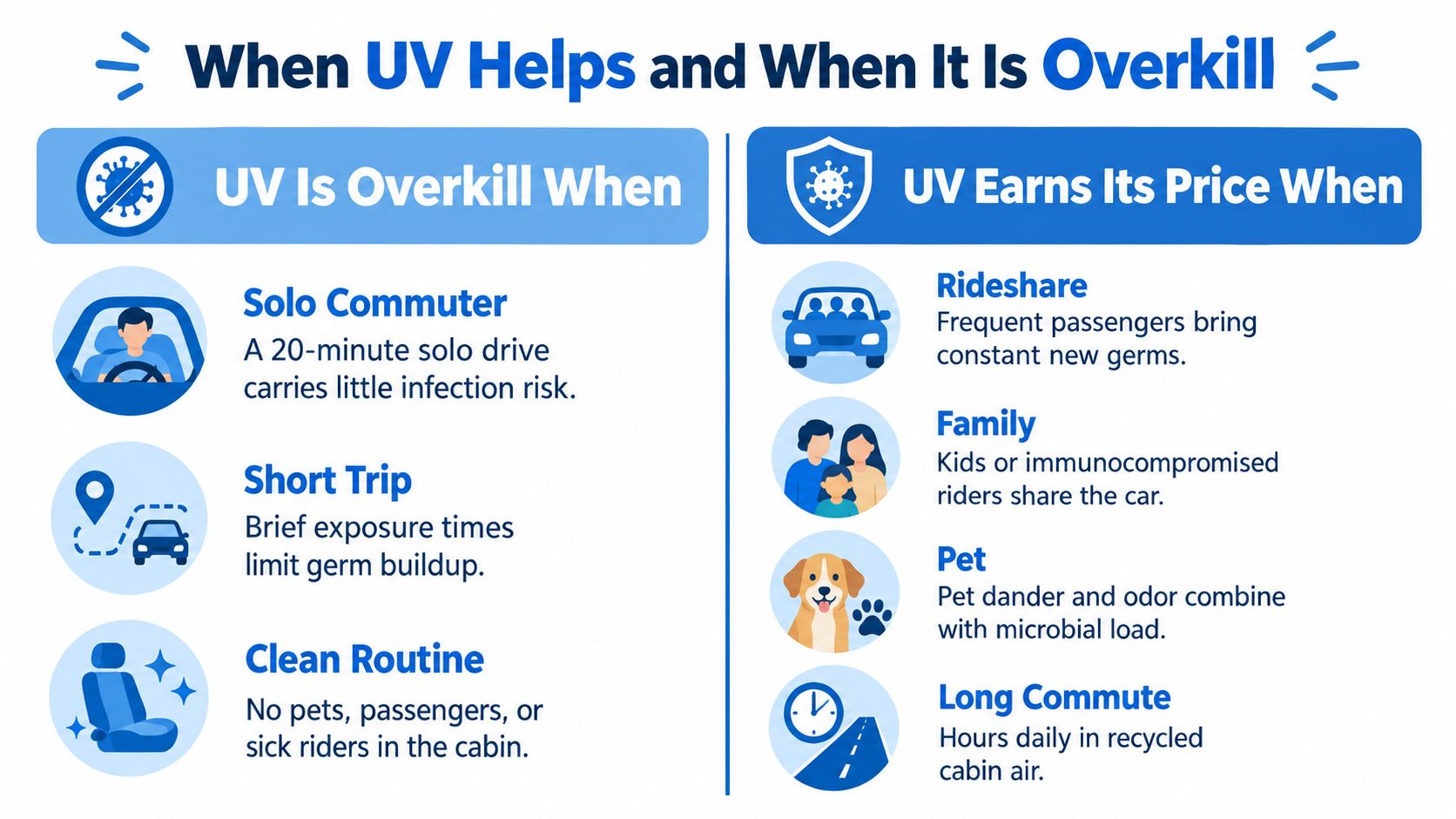
The case for UV becomes stronger when the cabin is a shared, repeatedly occupied environment. A rideshare driver may carry many passengers in succession, while a taxi may operate in dense traffic with frequent recirculation. Families transporting a medically vulnerable passenger may also prefer an added microbial-control stage, provided the device has credible dose and safety documentation.
Situations where the premium may make sense
- High passenger turnover: Frequent occupants introduce new particles and microorganisms into the cabin, so repeated air processing becomes more relevant.
- Long periods of recirculation: A sealed cabin with limited fresh-air exchange gives a purifier more opportunity to process the same air repeatedly, although the UV chamber still needs to deliver a meaningful dose.
- Sensitive household use: Families may value an enclosed, low-emission UV stage as a supplement to filtration when children or medically vulnerable riders share the vehicle.
- Engineered HVAC integration: A factory or professionally integrated chamber can control airflow and exposure more effectively than a loosely positioned portable lamp.
Situations where it adds little
A short trip with one occupant doesn't automatically create a strong use case for UV. Neither does a cabin where the primary problems are settled dust, pollen, pet hair, food odor, or exhaust fumes. In those situations, the purifier's filter area, sealing, carbon quantity, and usable airflow deserve more attention.
The automotive market is moving toward integrated systems rather than treating UV as an isolated accessory. The same market report identifies passenger cars as 65.02% of 2025 revenue, OEM sales as 62.62%, and HVAC-integrated factory systems as 57.74%, according to Mordor Intelligence's market breakdown. These figures indicate where manufacturers are placing investment, not that every factory system or aftermarket device performs equally.
Choose UV for a defined exposure profile, not because the product page uses the word “sterilize.” For many drivers, HEPA plus activated carbon is the practical foundation, and UV earns its place only when shared-cabin microbial control matters enough to justify the added complexity.
Ozone and Byproduct Safety in the Cabin
A car is a small enclosed space. If a purifier adds ozone or another irritating compound, concentration can rise faster than it would in a large room. Safety therefore depends on the entire air path, not just on whether the device includes a UV lamp. The lamp, catalyst, fan speed, seals, and cabin materials all influence what occupants breathe.
UV-C systems designed to avoid ozone generally use lamps or LEDs that do not emit the ozone-producing portion of the spectrum. A label that says “UV light” without identifying the output range leaves an important question unanswered. Wattage describes electrical input, not ozone performance, and it cannot confirm that a device delivers a useful UV dose through its airflow.
A sealed UV chamber also matters. Air must pass through the treatment zone while the light remains shielded from eyes and skin. If the fan moves air faster than the chamber can expose it, the purifier may process cabin air without delivering enough UV dose to produce the claimed effect. Ask for airflow information, chamber design details, and testing that reflects the intended operating mode.
What to inspect before installation
Look for a sealed lamp housing, a clear safety specification, and an automatic shutoff when a cover or service panel opens. Independent low-emission verification is more useful than broad wording such as “natural purification.” CARB-aligned documentation, EPA-related compliance information where applicable, and a specific zero-ozone test statement can help distinguish a tested design from a vague product claim.
Photocatalytic oxidation requires extra scrutiny because it intentionally triggers chemical reactions. Depending on the catalyst and materials, those reactions can produce unwanted byproducts such as formaldehyde or ozone. The Philips GoPure Style car air purifier information discusses ozone concerns linked with ionizers and traditional UVC mercury-lamp designs, while describing modern UV-LED systems as zero-ozone alternatives.
| Metric or concern | Limit or specification | What to check on the unit |
|---|---|---|
| Ozone generation | Verified low-emission or zero-ozone operation for occupied use. | Request a test method or certification. |
| Direct UV exposure | UV-C remains inside a sealed treatment path. | Check the closed chamber and service-panel shutoff. |
| Photocatalytic byproducts | UV and a catalyst can create secondary compounds if poorly engineered. | Identify the catalyst and request byproduct testing. |
| Odor or irritation | Burning smells, eye irritation, or throat discomfort indicate a problem. | Stop the unit, ventilate the vehicle, and contact the manufacturer. |
Odor control may need no active chemical process. For stale food or upholstery smells, compare the purifier with simpler car air fresheners from Evo Dyne Products. Fragrance changes or masks odor, while filtration targets airborne particles.
Do not use an ozone generator in an occupied vehicle. For unoccupied treatment, review the car and home ozone generator information separately from everyday cabin purification.
Power and Installation Options for Every Vehicle
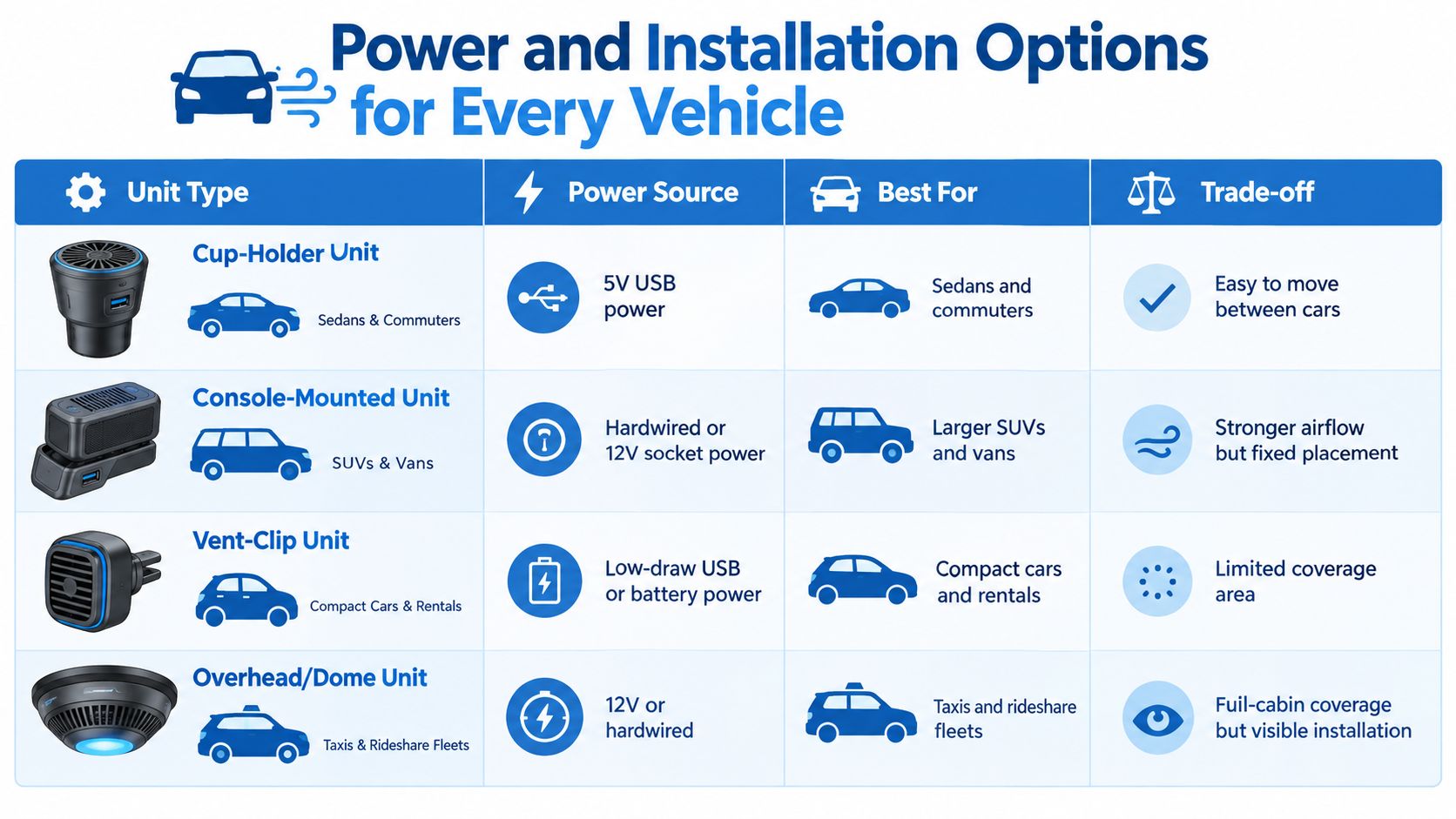
The best mounting style depends on how often you drive, who rides with you, and how much cabin airflow the device needs. A small USB unit may be convenient for a personal car, while a rideshare vehicle may benefit from a more stable 12V installation that can run whenever the ignition is on.
Four common formats
| Format | Practical fit | Main compromise |
|---|---|---|
| Cup-holder unit | Portable commuters who want simple USB power and easy relocation between vehicles. | It can occupy a cup holder and may sit low in the cabin. |
| Vent-clip unit | Rental cars, compact vehicles, and users who want a small footprint. | Placement can be unstable, and airflow through the unit may be limited or uneven. |
| 12V socket unit | Drivers who need stronger fan operation or frequent air processing. | It occupies a power socket and may leave cables across the console. |
| Hardwired 12V unit | Fleets, taxis, and owners seeking automatic operation with a tidy installation. | It requires correct fusing, cable routing, and often professional installation. |
A vent clip isn't automatically better because it sits near an HVAC vent. The purifier still needs a controlled path through its filter and UV chamber. A unit positioned in a strong stream may move air quickly, but quick movement can reduce UV residence time unless the chamber was designed around that flow.
Power also affects heat, noise, and usability. A high fan setting may process more air, but occupants may switch the purifier off if it becomes distracting. A lower setting can be more comfortable and may give air longer contact with the treatment chamber. The right choice depends on the manufacturer's airflow and electrical specifications, not on the largest power figure.
Before buying, check four details:
- Outlet capacity: Confirm that the purifier won't overload the socket or compete with a dash camera, phone charger, or heated accessory.
- Fuse protection: A hardwired installation should use an appropriately fused circuit rather than an improvised connection.
- Cable routing: Keep cables away from pedals, steering mechanisms, airbags, and sliding seats.
- Ignition behavior: Confirm whether the unit starts and stops with the vehicle, or remains powered after parking.
Electrical accessories can also affect overall vehicle use, especially when climate control is running. For broader context on how air-conditioning use relates to fuel demand, consult this guide to AC and gas consumption. The purifier's own draw may be modest, but installation should still respect the vehicle's electrical system.
Maintenance That Keeps UV Units Effective
A UV purifier can fail gradually, without an obvious warning. The fan may continue running while a dusty lamp produces less useful irradiance, or a clogged pre-filter may reduce airflow through the chamber. In both cases, the device can sound operational while delivering a weaker treatment dose.
Start with the pre-filter. It catches larger debris before that material reaches the finer filter and UV chamber. Inspect it regularly, remove accumulated dust according to the manual, and don't reinstall a washable filter until it's completely dry. A restricted intake reduces the volume of air the purifier can process and may change the intended airflow pattern.
The parts that need attention
The lamp or LED module needs inspection for dust, damage, and signs of aging. Ultraviolet output can decline before the lamp visibly fails, so follow the manufacturer's replacement indicator or rated service information. Don't touch a lamp surface unless the service instructions permit it, and never operate an exposed UV source where occupants can see or reach it.
HEPA and carbon filters have different failure modes. A loaded particle filter increases resistance and lowers airflow. Carbon can become saturated, after which odor control weakens even if the fan still operates normally. Returning odors, reduced airflow, or a persistent change in operating noise are useful prompts to check the filter rather than increasing fan speed.
Photocatalyst surfaces also require model-specific care. Dust can cover the active surface, while cleaning chemicals or cabin residues can alter the reactions taking place there. Don't spray fragrance, disinfectant, or household cleaner into a purifier unless the manufacturer specifically approves it.
A clean lamp with weak airflow still delivers a poor cabin result. A strong fan with a contaminated lamp or exhausted filter has the same problem from the other direction.
Keep a simple service record in the vehicle or on your phone. Note when you clean the pre-filter, replace the main filter, inspect the lamp, and notice a change in odor or fan behavior. The correct interval depends on dust, smoke, pet use, driving frequency, and the unit's own instructions, so a calendar reminder should support the manual rather than replace it.
For replacement components, confirm the exact model before ordering RCI cells and UV lamps. A replacement part that fits physically may still have the wrong electrical, optical, or catalytic specification.
Choosing the Right Car Air Purifier With UV Light
You are comparing two compact purifiers for the same commute. One advertises a bright UV lamp. The other publishes airflow, filter details, and chamber conditions. The second product gives you more useful evidence, because UV performance depends on dose and contact time, not visible brightness.
Start with the pollutant you want to reduce. HEPA or equivalent filtration addresses particles such as dust and pollen. Activated carbon helps with odors and some gases. UV can add a microbial-control stage, but only when air passes through the treatment chamber at a suitable speed and receives enough exposure.
A credible specification should identify the UV-C output range, describe the enclosed chamber, and provide irradiance, dose, airflow, or test conditions where possible. Treat a lamp color, a vague “sterilization” claim, or a wattage figure without airflow information as incomplete evidence. A technical design that explains how air moves through the unit is easier to assess than one that depends on appearance.
| User profile | UV priority | Key features | Trade-off to accept |
|---|---|---|---|
| Daily solo commuter | Low to moderate | HEPA or equivalent filtration, activated carbon, quiet operation, accessible filters | UV may add cost without addressing the main cabin complaints. |
| Rideshare or taxi driver | Moderate to high | Enclosed UV chamber, documented dose or irradiance, tolerable airflow, automatic ignition operation | More maintenance, noise, and installation complexity may be necessary. |
| Allergy-sensitive driver | Low to moderate | Effective particle filter, sealed housing, good pre-filter, replacement-filter access | UV does not replace particle capture for pollen or dust. |
| Long-distance traveler | Moderate | Carbon for odors, particle filtration, dependable power, low-emission certification, comfortable controls | A portable unit may process only part of the cabin air on each pass. |
| Family vehicle with frequent passengers | Moderate | Filter combination, enclosed UV, clear safety documentation, simple maintenance alerts | The microbial benefit depends on repeated operation and actual airflow through the chamber. |
Match the purifier to the cabin and its fan performance. Look for a published clean-air delivery figure or another meaningful airflow measure. A unit may contain a technically sound UV chamber yet treat too little cabin air per pass to make the feature worthwhile.
Safety checks should cover zero-ozone verification, sealed UV construction, service shutoff, and clear information about any photocatalytic stage. Confirm that the electrical specification matches the vehicle socket or hardwired circuit. Check that filters and lamps can be replaced without improvised wiring or exposed UV components.
Factory integration shows that vehicle manufacturers are exploring this technology. Mordor Intelligence forecasts UV-LED technology growth at an 11.94% CAGR from 2026 through 2031 and describes a June 2026 Hyundai Motor and Kia Plasma Care UVC concept using Far-UVC light in the 200 to 230 nm range, as reported in the automotive air purifier market analysis. Such developments are interesting, but a forecast or concept does not prove the performance of the particular purifier in your cabin.
For a compact option, review the Smart Car Air Purifier alongside other products. Compare its documented filtration, airflow, safety, power, and service requirements with your driving pattern.
Use a simple rule: choose HEPA plus activated carbon for particles and odors, then add UV when shared-cabin exposure or frequent passenger turnover justifies the premium. If a listing cannot explain its airflow path, UV dose, ozone performance, and service requirements, the UV label alone is weak evidence.
EcoQuest Purifiers offers portable car units, replacement parts, UV components, and other indoor air-quality products. Visit EcoQuest Purifiers to compare options against your cabin, safety requirements, and maintenance routine.