
Best HVAC Air Filter for Home with Pets
The most common advice for pet owners is to buy the highest MERV filter available. That sounds sensible, but it can be wrong for the HVAC system. A filter that catches more fine particles also creates more resistance, and an older furnace or undersized return can struggle when the filter is too restrictive.
The best HVAC air filter for a home with pets is the one that captures airborne dander while staying within the system's airflow limits. For many homes, that means starting around MERV 11, considering MERV 13 only after checking compatibility, and treating maintenance as part of the filtration strategy rather than an afterthought.
| Filter choice | Pet-particle performance | Airflow concern | Practical fit |
|---|---|---|---|
| MERV 8 | Removes animal dander and larger particles | Lower resistance than denser options | Basic dust and equipment protection |
| MERV 11 | Stronger capture of fine dander | Moderate resistance | A practical starting point for many pet homes |
| MERV 13 | Better fine-particle filtration | May restrict airflow substantially in some systems | Allergy-focused use when the HVAC system supports it |
| True HEPA | Very high particle capture | Usually incompatible with a standard one-inch residential slot | Standalone or specially designed systems |
Table of Contents
- The Highest MERV Rating Is Not Always the Best Choice
- Understanding MERV Ratings and Pet Dander Capture
- Comparing Filter Media Types for Pet Households
- Checking Your HVAC System for Filter Compatibility
- Maintenance Schedules and the True Cost of Ownership
- Solving the Pet Odor Problem Beyond the HVAC Filter
- Situational Recommendations for Every Pet Household
The Highest MERV Rating Is Not Always the Best Choice
A high MERV rating doesn't automatically make a filter the right choice. The filter sits in the return-air path, so every increase in density affects how hard the blower must work to move air through the system. If the filter loads with fur, dust, and dander, that resistance increases further.
The risk isn't theoretical. Excessive restriction can reduce airflow across the evaporator coil, contribute to coil icing during cooling, and make the blower operate under unnecessary strain. It can also produce uneven temperatures, weak airflow at registers, and repeated comfort complaints. A filter that looks impressive on its packaging can therefore create a poor result if the furnace or air handler wasn't designed for it.
Practical rule: Choose the highest-efficiency filter your HVAC system can move air through safely, not the highest rating you can fit into the slot.
Why airflow matters more than the package claim
Pet owners often judge a filter by what it catches when they remove it. Visible fur is easy to notice, but the more important target is microscopic allergen material that can remain airborne after floors and furniture look clean. A filter that captures more dander but causes the system to circulate less air may not deliver the expected whole-home benefit.
EPA filtration guidance supports using filters rated at least MERV 8 for animal dander and larger particles, while also warning that higher-rated filters should be used only when the HVAC system can handle the allowable static pressure. The EPA filtration guidance makes system compatibility part of the decision, not a footnote.
That distinction changes the buying process. First identify the filter size and system limitations. Then choose the rating that meets the household's needs without creating a restriction problem.
When another air-cleaning device makes sense
An HVAC filter only works when the central system is running, and it primarily addresses particles. If a homeowner wants a separate approach without modifying the ductwork, the Living Air Classic XL-15 Air Purifier is described as a filterless air purifier using ionization and activated oxygen technology to help reduce airborne particles, odors, and stale indoor air.
That kind of device is a supplement, not permission to install an unsuitable furnace filter. The central filter still needs to protect the equipment and manage recirculated dander without choking airflow.
Understanding MERV Ratings and Pet Dander Capture
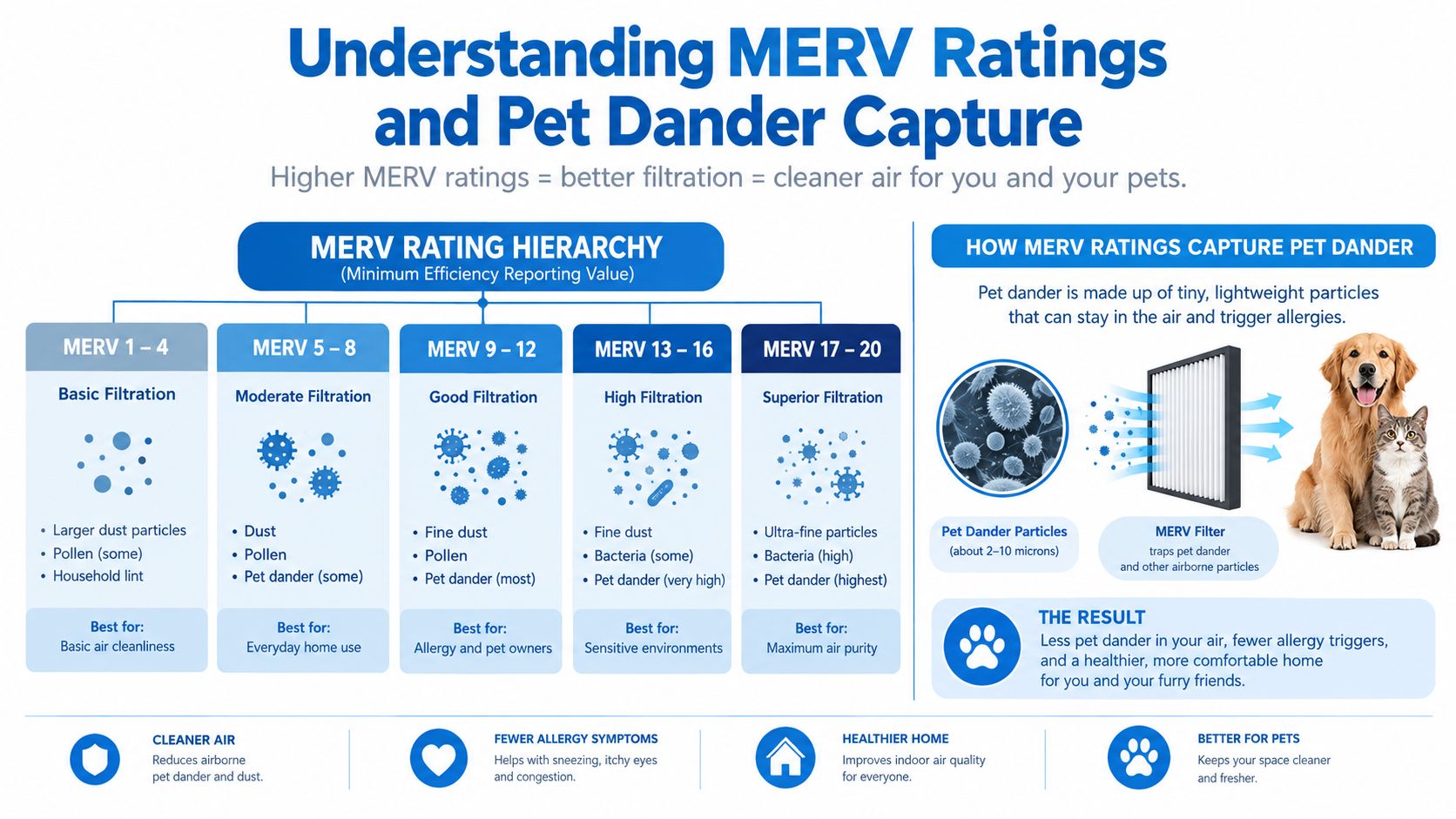
MERV, or Minimum Efficiency Reporting Value, measures how effectively a filter captures particles within specified size ranges. In a pet home, separate visible hair from airborne allergen particles. Hair is relatively large and easy for many filters to catch. Dander and allergen-bearing material are smaller, lighter, and can remain suspended in indoor air after floors and furniture appear clean.
MERV 8 can remove animal dander and larger particles, while allergy-focused households may benefit from a higher rating. A medical review of indoor filtration and allergens identifies MERV 12 and higher as an effective range for reducing cat allergens. It also reports that filters with more than 70% removal efficiency for Fel d 1 can cut allergen concentrations by more than 50%.
Why MERV 11 is often the sensible starting point
MERV 11 is a practical middle ground for many homes. Independent HVAC guidance describes it as capturing at least 85% of particles in the 3 to 10 micron range and at least 65% of particles in the 1 to 3 micron range, according to this MERV 8 versus MERV 11 comparison. Those ranges cover more than coarse dust and visible shedding, including smaller airborne material.
MERV 13 captures finer particles, which may help where allergies or asthma are a major concern. Higher capture, however, can increase airflow resistance. If the filter loads quickly with hair and dust, the restriction rises further. The correct rating is the highest level your system can maintain without starving the blower of airflow.
Use this guide to choose the right air filter rating while comparing capture performance with equipment limits and replacement habits.
What research found in homes with pets
A 2022 home-air-filtration study found that filtration reduced median cat allergen, Fel d 1, by 76.6%, and dog allergen, Can f 1, by 89.3%, in homes where pets were present. The results appear in the home-air-filtration study on cat and dog allergens.
The study also measured a median Can f 1 level of 219.0 pg/m³ in one comparison group of homes with dogs, compared with 22.8 pg/m³ in homes without dogs. In the intervention comparison, the figures were 19.7 versus 2.6 pg/m³. The practical lesson is clear: a filter must address microscopic allergen particles, not only the hair visible on its surface.
For a separate room-based option, review the HEPA filter and replacement screen selection. True HEPA filtration generally belongs in equipment designed for it, rather than an ordinary furnace slot.
Comparing Filter Media Types for Pet Households
The MERV label isn't the whole filter. Two filters with similar ratings can behave differently because pleat depth, media area, frame quality, and surface loading all affect airflow and service life. Pet homes put unusual demands on that construction because loose hair can collect quickly while fine dander continues moving through the return stream.
| Filter type | Dander capture | Airflow impact | Best use case |
|---|---|---|---|
| Fiberglass | Low for fine dander | Usually low | Basic equipment protection and coarse debris |
| Pleated | Moderate to high, depending on rating | Moderate, influenced by density and size | General residential pet filtration |
| Electrostatic | Varies by design and rating | Varies | Systems where the stated performance and airflow fit are verified |
| True HEPA | Very high particle capture | High in ordinary HVAC applications | Standalone purifiers or HVAC systems designed for HEPA |
Fiberglass is cheap, but it solves a narrower problem
Flat fiberglass panels are primarily equipment-protection filters. They can catch larger debris before it reaches the blower and coil, but they aren't a strong choice when the household's main concern is fine pet dander. A homeowner may see hair on the filter and assume the air is being cleaned effectively, even while smaller allergen particles pass through.
That doesn't make fiberglass useless. It makes it limited. If the system has a restrictive rack or a blower that already struggles, a lower-resistance filter may be necessary until an HVAC professional corrects the underlying airflow problem.
Pleated media gives the filter more working area
Pleated filters fold the media into a larger effective surface within the same face dimensions. That added area can distribute the load from hair and dust more effectively than a flat panel. A properly fitted pleated filter in the appropriate MERV range is usually the most practical central-air choice for a pet household.
Electrostatic designs can improve particle attraction, but the label alone isn't enough to predict the result. Check the stated MERV rating, physical thickness, and pressure characteristics. Some washable products also create a maintenance trap. If the media isn't cleaned and dried properly, its performance and airflow can deteriorate.
Why true HEPA belongs in the right equipment
True HEPA media is much denser than the filter commonly installed in a residential return slot. Putting it into a one-inch compartment without a system designed for the pressure drop can sharply reduce airflow. A standalone HEPA purifier in a bedroom or pet-frequented room is often more practical than forcing HEPA media into the central system.
Odor requires a separate consideration. Particle media can catch some odor-carrying dust, but it isn't the same as gas-phase adsorption. If smell is the dominant complaint, look for a carbon component or use a dedicated odor-control device alongside the central filter.
Checking Your HVAC System for Filter Compatibility
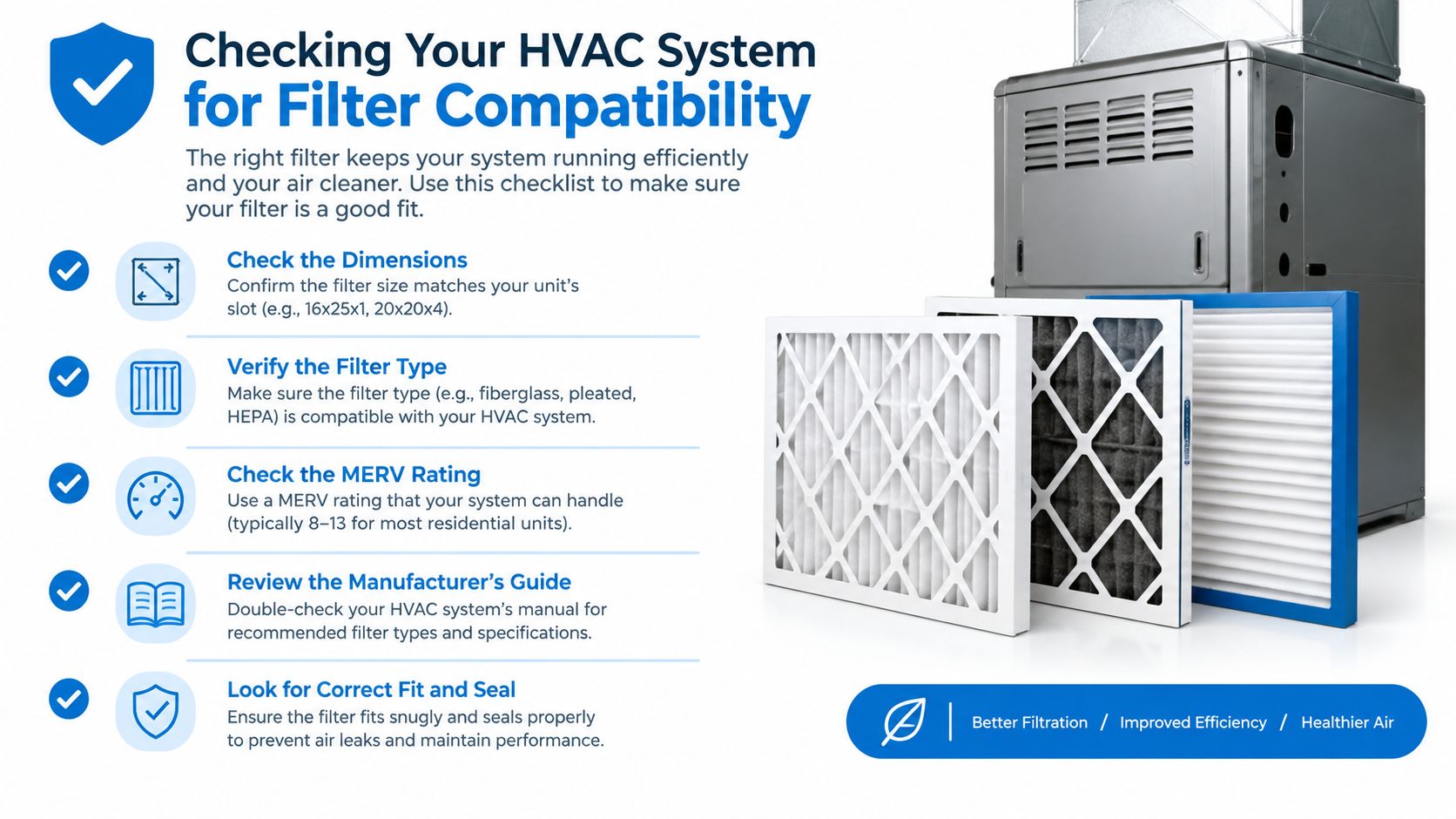
The highest MERV rating can be the wrong choice if the HVAC system cannot move air through it. Before changing from MERV 8 to MERV 11 or 13, inspect the filter slot, return-air path, blower, ductwork, and total system resistance. Pet households need particle capture without starving the equipment of airflow.
Start with the physical filter slot
Record the dimensions. Read the nominal size on the old filter, then confirm that the replacement fits snugly. A gap around the frame lets pet dander bypass the media.
Measure the depth. A one-inch slot has less media area than a deeper cabinet. A dense filter in that shallow space can restrict airflow more quickly. Do not force a thicker filter into a rack that was not built for it.
Inspect the airflow arrow. Point the arrow toward the furnace or air handler. Reversing the filter can change how dust loads the media and how the frame sits in the rack.
Check the return path. Whistling grilles, collapsed flexible duct, heavy dust at registers, or weak supply airflow can signal an existing restriction. Correct that condition before increasing filter resistance.
Identify what the blower can handle
Older systems often use PSC blower motors, while newer equipment may use ECM motors that adjust speed more actively. Motor type does not settle the question. The cabinet, coil, ductwork, filter rack, and return path all contribute to total resistance.
An HVAC technician can measure external static pressure instead of judging compatibility by noise alone. That measurement shows whether a denser filter leaves the blower and coil enough airflow to operate properly.
A clean one-inch MERV 13 filter can create about 0.25 in. w.g. of resistance, compared with about 0.12 in. w.g. for MERV 8. Treat those figures as a practical warning about configuration, not a universal pass or fail. A filter that works when clean may become restrictive as hair and dust accumulate.
Test after installation
After installing a new filter, check supply airflow and system operation. Weaker airflow, unusually long run times, new return whistling, or an icing coil during cooling indicates that the setup needs attention. Inspect the filter early after the change, especially if the home has heavy shedding.
If performance changes noticeably, have the airflow measured rather than assuming a higher rating is automatically better. For replacement screens and related components, review HVAC filter and screen options while following the central system manufacturer's requirements.
Maintenance Schedules and the True Cost of Ownership
A filter's rating is only part of its real performance. Pet hair and dust load the upstream surface, while fine dander fills the media deeper inside. As the filter loads, resistance rises, so a filter that worked acceptably when clean may become a restriction problem later.
The right schedule depends on the number of animals, shedding behavior, home layout, filter thickness, and how often the HVAC system runs. Rather than relying on a calendar rule designed for a different household, inspect the filter regularly and respond to its condition.
Build a condition-based routine
- Check the filter visually. Look for a mat of fur, darkened pleats, or dust packed against the return-air side.
- Check airflow. Notice whether rooms feel less comfortable or registers deliver less air than usual.
- Check after shedding changes. A coat blowout, adoption of another pet, renovation, or extended heating and cooling use can shorten the interval.
- Keep a spare on hand. Delaying replacement because the correct size isn't available leaves the system operating with a loaded filter.
A deeper filter can provide more media area, but it still needs to fit the cabinet and meet the manufacturer's specifications. Thickness isn't a substitute for a compatible rack.
Reduce the load before it reaches the return
Grooming, vacuuming, and cleaning pet bedding reduce the amount of loose material available to enter the HVAC return. A pre-filter at a return grille may help with larger hair, but it must be checked often and shouldn't block the grille. Never cover a return with a material that hasn't been designed for that use.
Maintenance reality: A filter that looks clean from the front can still be loaded on the return-air side, where pet hair and dust arrive first.
Track the date, filter rating, and condition when you remove each filter. That simple record shows whether a rating upgrade is causing faster loading or whether the system needs a deeper media cabinet. It also lets you compare ownership cost objectively, based on replacement frequency and comfort, rather than purchase price alone.
Solving the Pet Odor Problem Beyond the HVAC Filter
A central HVAC filter is mainly a particle-control device. It can capture dander, hair, and dust, but a higher MERV rating alone won't remove every litter-box smell, wet-dog odor, or volatile compound circulating through a room. Odor molecules behave differently from the particles the filter was designed to trap.
That distinction prevents a common waste of money. Homeowners sometimes keep upgrading particle filters after the dander problem improves, expecting the next rating to solve odor. The result can be more airflow restriction without a proportional improvement in smell.
Match the tool to the pollutant
Activated carbon is useful for gas-phase odor control because it adsorbs certain odor compounds rather than relying only on mechanical particle capture. Carbon-treated filter media can provide some supplemental control, although the amount and quality of carbon vary widely between products.
Standalone room purifiers make sense where odors and allergens are concentrated, such as near a litter area or in a room where pets sleep. A carbon option such as bamboo charcoal odor-control bags can be considered as a supplemental measure, but it shouldn't replace ventilation, cleaning, or a properly maintained HVAC filter.
Treat the source first
Odor control works better when the source is managed directly. Clean litter areas, wash pet bedding, dry wet coats, remove soiled materials promptly, and address moisture in carpets or upholstery. If an odor persists despite cleaning, investigate the surface or building condition rather than asking the furnace filter to solve it.
The EcoQuest catalog includes air-quality products spanning room and whole-house approaches, but homeowners should choose technology according to the pollutant and follow the equipment's operating guidance. Active technologies, including ionization or oxidation-based products, require careful attention to the manufacturer's instructions and indoor-use requirements.
A balanced strategy uses the central filter for airborne particles, source control for persistent smells, and a room purifier where a household's exposure is highest.
Situational Recommendations for Every Pet Household
The right choice changes with the system and the people in the home. A modern air handler with a compatible filter cabinet may tolerate a denser filter than an older furnace with a shallow one-inch slot. The household's allergy burden also matters, but it doesn't override airflow limits.

One pet in a newer home
Start with a well-sealed MERV 11 pleated filter if the system accepts it. Confirm the printed size, install it in the correct airflow direction, and inspect it regularly during periods of heavy shedding. If the home has a deeper filter cabinet, use the manufacturer-approved depth rather than assuming a one-inch replacement is interchangeable.
Multiple pets and an older furnace
Don't jump straight to MERV 13. Begin by checking the return grille, filter rack, blower condition, and static pressure. A properly fitted MERV 11 may be the safer working choice if a denser filter causes weak airflow, while grooming and frequent inspection reduce the load reaching the return.
If the older system already shows signs of restriction, have a technician diagnose that first. A deeper media cabinet or return-air correction may be more useful than repeatedly buying increasingly dense one-inch filters.
Severe allergy concerns
MERV 13 can be appropriate when the system supports it, especially when the priority is finer airborne-particle capture. Confirm compatibility before installation, then combine central filtration with source control and a standalone purifier in rooms where the affected person spends substantial time.
The practical answer isn't a universal rating. It's a matched plan: MERV 11 for a balanced starting point, MERV 13 when the system and health needs justify it, and maintenance that keeps the filter from becoming a new airflow problem.
EcoQuest Purifiers offers indoor air-quality products, replacement parts, and repair support for room and whole-house purification needs, including options that address particles and odors alongside your HVAC filter. Review the available solutions at EcoQuest Purifiers, then choose supplemental equipment that fits your home, pollutant concerns, and maintenance routine.