
Best Air Purifier for Smoke Large Rooms in 2026
A 1,200-square-foot room is not "covered" because a box says so. Under the U.S. Environmental Protection Agency wildfire-smoke guidance, that floor area needs a minimum tobacco-smoke CADR of approximately 800 cubic feet per minute when the ceiling is about 8 feet. The same guidance treats Clean Air Delivery Rate (CADR) as the selection metric, not the marketing room size, and its 8-foot chart lists minimums of 65 cfm at 100 square feet, 130 at 200, 195 at 300, 260 at 400, 325 at 500, and 390 at 600.
Smoke is two jobs. Fine particles, including PM2.5, have to be captured. Residual gases and odor have to be adsorbed. A unit can look successful at one job and fail the other, and some add-on technologies add ozone while they work. Buy in this order: match smoke CADR to the floor area, confirm mechanical particle filtration, judge carbon by how much of it you can replace, then refuse ozone wherever people stay.
Table of Contents
- Smoke CADR Targets for Large Rooms
- Particles Gases and Technology Choice
- Placement Airflow and Continuous Runtime
- Homes Offices and Commercial Smoke Rooms
- Filter Carbon and Ownership Costs
- Choose a Large Room Smoke Setup
Smoke CADR Targets for Large Rooms
Start with floor area. The EPA rule is a tobacco-smoke CADR of at least two-thirds of the square footage at an 8-foot ceiling. A home air-cleaner guide from the EPA makes the buying math explicit: a 600-square-foot room needs at least 400 cfm, and a 1,000-square-foot room needs at least about 667 cfm. That guide singles out tobacco-smoke CADR because smoke is the smallest particle class in common CADR testing. A strong pollen or dust number does not prove smoke performance. Do not substitute those ratings.
Measure length times width, pick the row, and carry that cfm into every model you compare.
Minimum smoke CADR by floor area
| Floor area | Two-thirds smoke CADR | EPA chart minimum | When to go higher |
|---|---|---|---|
| 100 sq ft | 67 cfm | 65 cfm | Standard 8-ft ceiling |
| 200 sq ft | 133 cfm | 130 cfm | Standard 8-ft ceiling |
| 300 sq ft | 200 cfm | 195 cfm | Standard 8-ft ceiling |
| 400 sq ft | 267 cfm | 260 cfm | Add capacity for 10-ft ceilings |
| 500 sq ft | 333 cfm | 325 cfm | Continuous smoke or leakage |
| 600 sq ft | 400 cfm | 390 cfm | Prefer the 400 cfm two-thirds target |
| 1,000 sq ft | 667 cfm | Use 667 cfm; chart stops at 600 | Often two units rather than one maxed-out unit |
| 1,200 sq ft | 800 cfm | Use 800 cfm; chart stops at 600 | Open plan or higher ceilings need still more |
The chart floors sit just under the two-thirds targets. At 600 square feet, buy the 400 cfm target, not the 390 cfm chart floor. At 100, 200, and 500 square feet, two-thirds is about 67, 133, and 333 cfm. Past 600 square feet the published chart stops, so stay on 667 and 800 cfm.
Ceilings, leaks, and a second unit
A 10-foot ceiling holds more air than the 8-foot assumption, so step up a row instead of rounding down. Leaky open plans and rooms that keep generating smoke belong on a higher row too. Higher ceilings need more capacity because there is more air to clean, and in a very large or open plan several correctly sized units move filtered air better than one small machine pinned at its limit.
Practical rule: If you will not run the published high-speed smoke CADR, you did not buy that CADR.
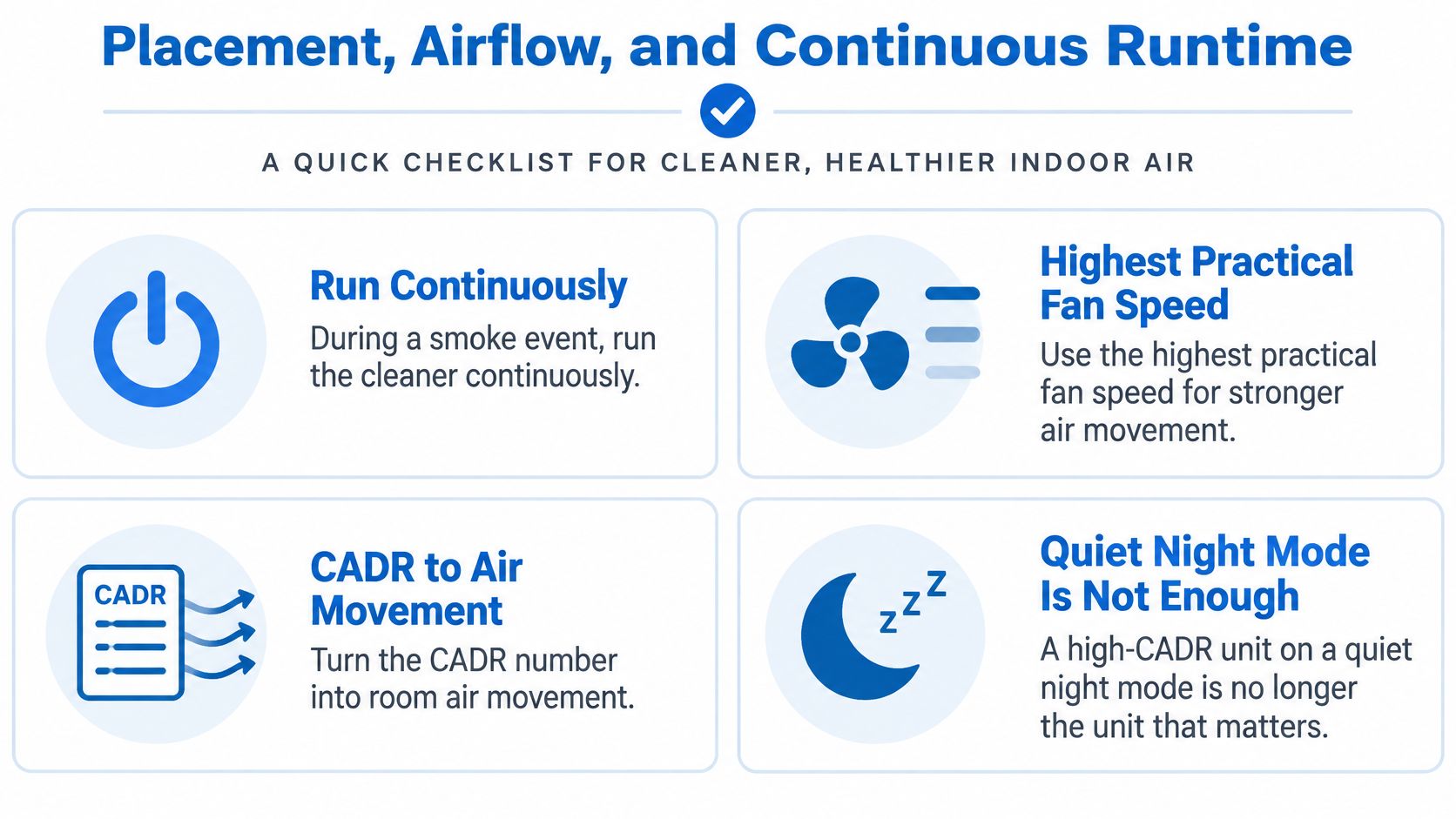
Pair the cfm with a high-efficiency particle filter, commonly HEPA, and plan continuous runtime at the highest practical fan speed while smoke is present. That is the unit you are sizing, not the quiet overnight setting.
Particles Gases and Technology Choice
Particle removal has a ceiling, not a guarantee. The Weld County indoor air-cleaner guidance reports that portable air cleaners with high-efficiency filters can reduce indoor particle concentrations by as much as 85 percent. Actual results depend on the purifier's size, the area treated, filter efficiency, operating time, and fan speed. Treat 85 percent as the top of a well-matched setup, not as a promise on the carton.
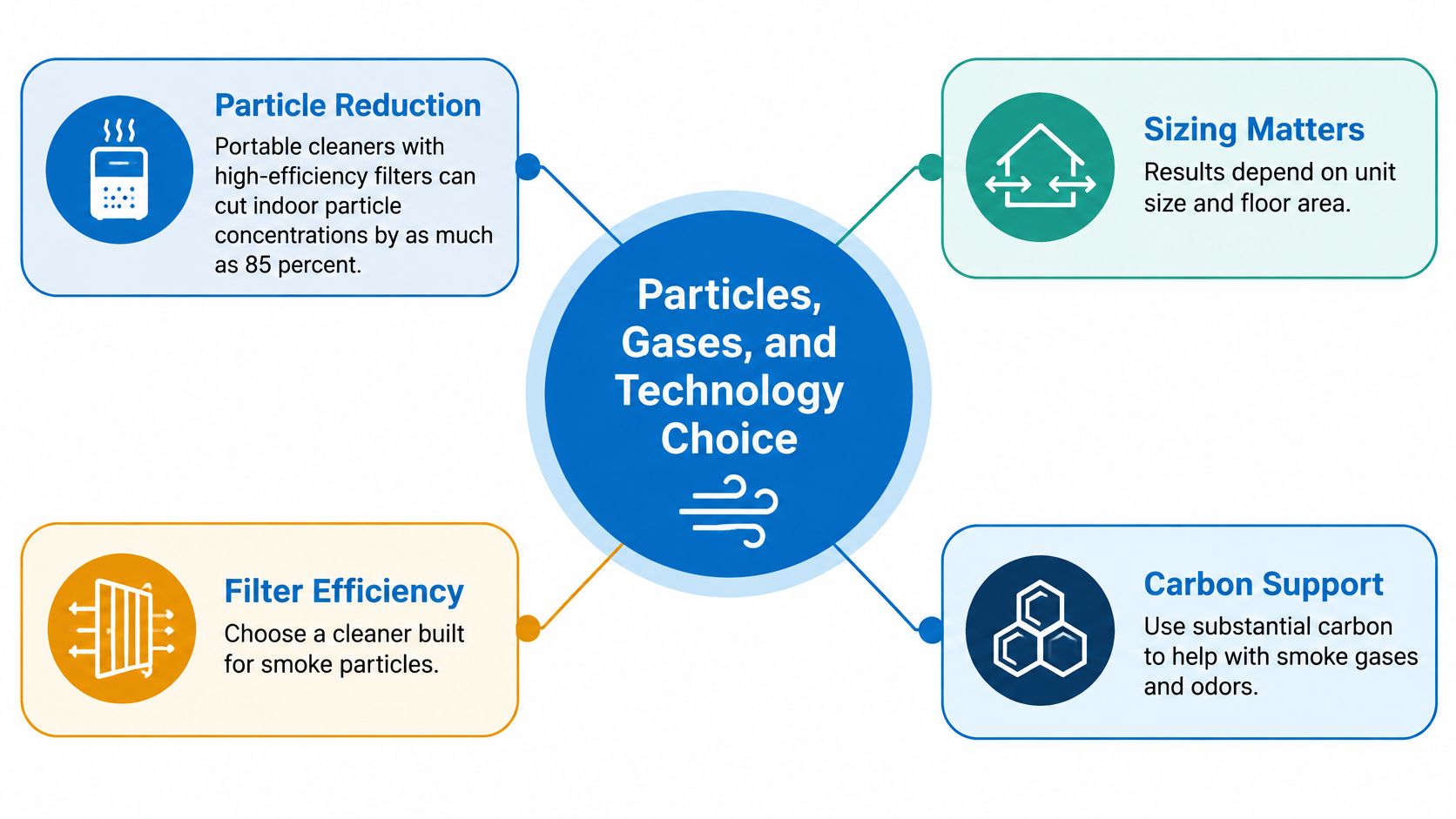
That same guidance separates the second job. CADR is built for inhalable particles, not odors or gases, and activated carbon is what those pollutants need. A room can stop smelling and still hold fine particles. A room can show low particles and still smell. Losing the odor does not prove combustion pollutants are gone.
What each technology fails at
HEPA is the particle path for fine smoke and PM2.5. Filter efficiency is not room performance. CADR already combines airflow with removal, so a dense filter on a weak fan still cleans a large room slowly. Carbon handles some gases and odors, and the result tracks carbon mass and bed design, not a thin odor pad or a marketing label. Carbon does little for fine particles by itself.
EPA indoor filtration guidance is blunt about the rest. Mechanical air cleaners and high-efficiency filters trap smoke particles. Electronic cleaners are not recommended for smoke when performance is unclear. Photocatalytic oxidation, hydroxyl generators, and UV stages are not designed to remove smoke particles, and they may produce ozone or other pollutants. California regulators advise against indoor ozone generators and require portable cleaners sold in California to meet a 0.050 ppm ozone-emission limit. Some ozone generators can push indoor ozone past health standards. Choose devices that produce little or no ozone. Ozone is itself a harmful air pollutant.
Smoke technologies by what they remove
| Technology | Smoke particles | Odors and gases | Occupied-space caution |
|---|---|---|---|
| HEPA mechanical filter | Primary path for PM2.5; 99.97% at 0.3 µm is efficiency, not CADR | None by itself | Low ozone if no ionizer is added |
| Activated carbon | Little particle removal | Depends on carbon mass and bed design, not the label | Generally appropriate when it does not add ozone |
| HEPA plus substantial carbon | Best occupied-room match when smoke CADR fits the room | Practical odor path if carbon is thick and replaceable | Prefer verified low or zero ozone |
| Ionization or bipolar ionization | Not a proven substitute for HEPA smoke CADR | Weak for gases | May produce ozone; skip if performance is unclear |
| RCI, photocatalysis, UV, or hydroxyl | Not designed to remove smoke particles | Variable; by-products possible | Ozone or other pollutants possible |
| Ozone or active-oxygen generators | Not a particle filter | Smell can fade while particles remain | Avoid in occupied rooms; CARB limit is 0.050 ppm for portable cleaners sold in California |
The buying order is short. Match the cfm from the sizing table. Confirm a real particle filter, the kind sold as a HEPA air purifier, not an electronic substitute. Judge carbon mass and how soon you will replace it. Then verify low or zero ozone. For a family, an office, or a commercial room, smoke CADR and filter replacement come first. Carbon capacity and ozone emissions come next, only for the odor job.
A clean smell is not a clean particle count. Do not let odor fade talk you into an ozone cycle.
Placement Airflow and Continuous Runtime
CADR only becomes room air if the fan is moving that air. During a smoke event, run the cleaner continuously on the highest practical fan speed. A high-CADR unit left on a quiet night mode is no longer the unit you sized.
Put the inlet where air can reach it
Leave several feet of clearance. Pull the unit off curtains, sofa backs, and dead corners. Do not shove the inlet against a wall. In a large or L-shaped room, two units whose smoke CADRs add up to the target mix better than one unit fighting a single stagnant zone. Keep doors to the treated zone mostly closed so the rated airflow is not diluted across the whole floor.
If wildfire smoke is leaking in, cut outdoor air intake and seal the obvious gaps first. The purifier should work on a smaller indoor volume, not on the entire outdoors. A ceiling fan can help mixing only when it does not blow smoke from an untreated area into a cleaner one.
What not to run while people are present
The ENERGY STAR room air cleaner specification defines HEPA as at least 99.97% removal of 0.3-micrometer particles under the applicable test. That rating still is not room performance. CADR folds airflow together with particle removal, so a highly efficient filter with weak airflow cleans a large room slowly. Activated carbon can reduce some smoke odors and gases, but only in proportion to the quantity and design of the carbon, not the label.
Skip ozone and active-oxygen modes in any occupied space. EPA warns that ozone-generating cleaners can cause coughing, breathing difficulty, and lung damage. Homes, offices, healthcare rooms, and childcare rooms should get a high-smoke-CADR HEPA unit, substantial replaceable carbon, and verified low or zero ozone.
Before smoke arrives, check four things: cfm matched to the room, inlets clear, fan set to high, and both the carbon and the HEPA installed. Nobody should share that room with an ozone cycle.
Homes Offices and Commercial Smoke Rooms
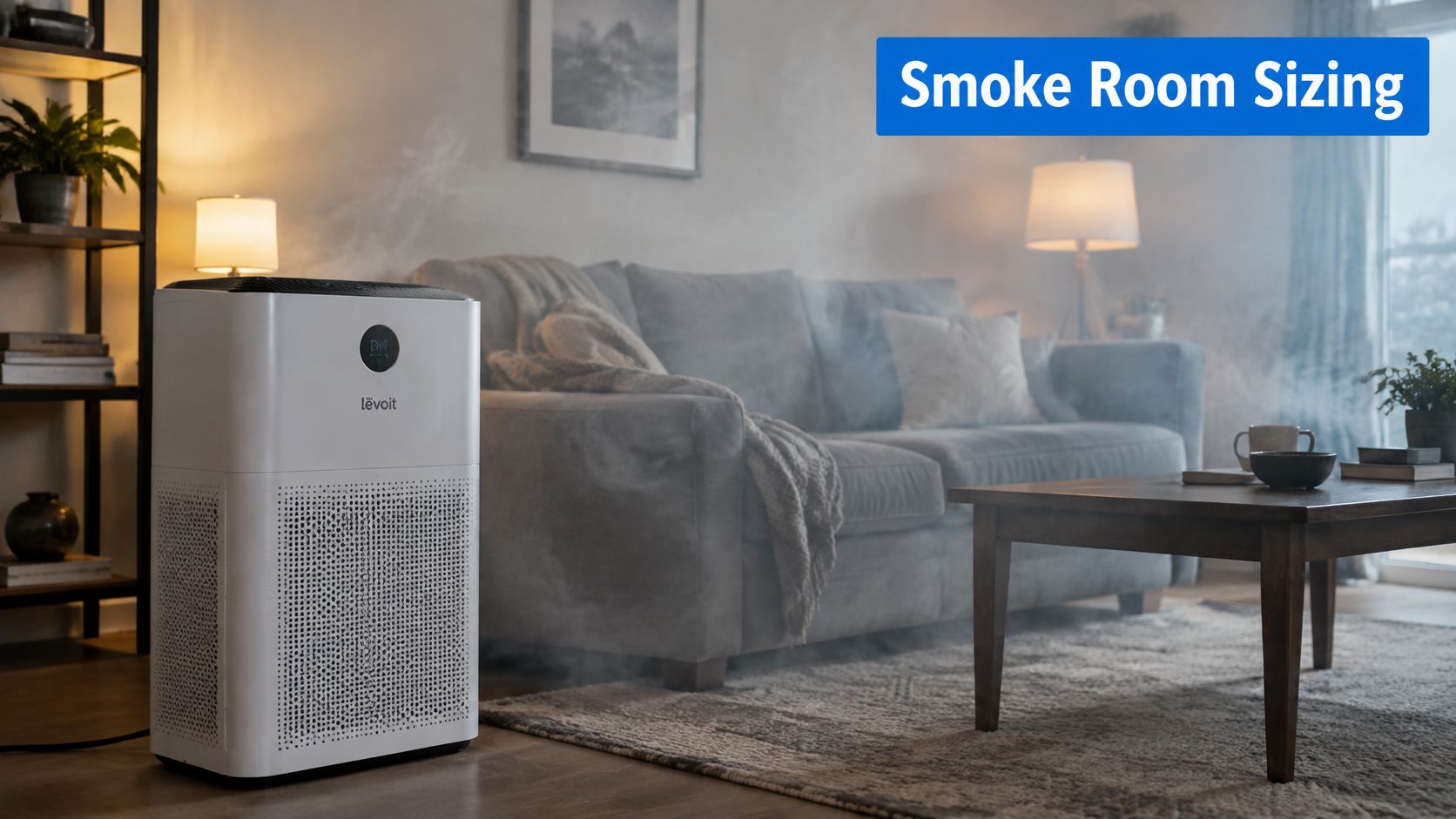
Apply the sizing table to the room you occupy, then apply one occupancy test. If anyone remains in the room, do not run an ozone-producing mode.
A home living room is the straightforward case. The Washington State Department of Health stated in 2025 that a 400-square-foot room with an 8-foot ceiling requires an approximate smoke CADR of 267 CFM. Run a HEPA unit with a real carbon bed while people are home. Night mode is for after the smoke event, not during it.
An open-plan living area at 600 square feet sits on the 400 cfm row. Two smaller units, neither stuck in a corner, usually mix better than one cabinet trying to reach the far sofa. Keep the zone doors mostly shut so you are not cleaning the hallway for free.
Work floors and odor businesses
An office or coworking floor near 1,000 square feet needs the 667 cfm class of capacity, spread so workstations are not all downstream of a single outlet. Run it through the workday. A lunch-hour burst does not catch a day of infiltration. Look at commercial air equipment only after the cfm and the occupied-room rule are settled.
A restaurant corner, salon, or gym with ongoing odor is a different load. Size particle CADR first, then size carbon for a constant gas load and replace that carbon sooner than a living-room schedule. Smell returning mid-shift means the bed is spent, even if the particle filter still looks acceptable.
Healthcare, daycare, and eldercare rooms do not get a technology experiment. Occupants often cannot leave. Mechanical HEPA plus substantial carbon, with verified low ozone, is the occupied-room match. The filterless Living Air Classic XL-15 Air Purifier uses ionization and activated oxygen for particles, odors, and stale air in homes and offices. That is not a published tobacco-smoke CADR, and activated oxygen does not belong in a room patients, children, or staff must stay in.
Spaces you can empty
A garage or similar space can be cleared of people. Ventilate with outdoor air until the smoke is gone, and keep people out until the air is clear. Do not use ozone or active-oxygen treatment as the way to make a space safe to re-enter. Fading odor is not an all-clear.
This short walk-through shows why placement and fan speed decide whether a correctly sized unit ever delivers its rating.
Filter Carbon and Ownership Costs
A large-room rating is a new-filter rating. A loaded HEPA filter and a saturated carbon bed both cut delivery rate, so a unit that met 400 or 800 cfm on day one will not hold that rate once the media is packed. Compare ownership by lost airflow and replacement interval, not by a low shelf price.
Particle filters are typically changed on an hour count or after heavy smoke events. Wildfire weeks and daily tobacco use shorten that interval. Carbon is less obvious. It exhausts by adsorbing gases while it still looks clean, so odor return is the replacement signal, not a color chart. Thick beds cost more up front and last longer under a steady odor load than a thin coated pad. When the design includes a prefilter, that is the frequent low-cost swap, and it keeps hair and lint off the HEPA.
Filterless ionization or ozone-style units skip filter invoices. They do not skip the particle problem. Any RCI cell, UV lamp, or ozone plate is still a consumable with its own replacement cycle. If genuine replacement media is unavailable, reject the large-room claim no matter how the coverage is advertised. Budget the HEPA filters and screens you will buy before you treat a cheap purchase price as a saving.
Odor that keeps coming back is often the source, not a weak fragrance layer. Restore Heroes on why odor source removal beats masking is the right frame for tobacco residue, smoke-stained materials, and rooms where the purifier is fighting a surface that keeps off-gassing.
Ask for smoke CADR at the fan speed you will run, plus the filter and carbon interval under smoke, before you call a low price a bargain.
Choose a Large Room Smoke Setup
For any room people stay in, the verdict is mechanical. You want HEPA plus substantial replaceable carbon, sized to tobacco-smoke CADR, with no ozone mode. Ionization, RCI, photocatalysis, UV, hydroxyl, and active oxygen are not the particle solution, and they are the wrong primary machine for a large smoky room.
- Measure length, width, and ceiling height. Take the matching smoke CADR row. Raise the target for ceilings above 8 feet, open plans, leaks, or smoke that is still being produced.
- Shortlist mechanical HEPA units that publish tobacco-smoke CADR at the fan speed you will run. Ignore a room-size claim that hides the test speed. Add substantial replaceable activated carbon if odor or gases matter.
- Reject ionization, RCI, photocatalysis, UV, or hydroxyl as the particle fix. Reject every ozone or active-oxygen mode wherever people, patients, children, or staff remain.
- Use two units when one cannot reach the target cfm without sitting in a corner that never mixes. Add the two smoke CADRs. Do not add the marketing square footages.
A filterless ionization or activated-oxygen device already in the house is a supplemental odor device to check for ozone, not the smoke CADR for a large room. For buyers who want help matching a room to replacement filters or carbon, EcoQuest Purifiers can talk through occupied-room HEPA-and-carbon options versus equipment meant for unoccupied spaces. That conversation is optional. It is not a required purchase.
Write down square footage, ceiling height, and whether people stay in the room. Then match a low-ozone HEPA-plus-carbon setup to that cfm. That is the best air purifier for smoke large rooms: the setup that hits the smoke CADR you measured, on the speed you will leave running.
EcoQuest Purifiers carries single-room and commercial air equipment, HEPA and charcoal filtration, and replacement media for homes, offices, and occupied workplaces that need smoke particles and odors handled as separate jobs. If you already know your square footage and whether people remain in the room, use that cfm target to compare a low-ozone HEPA-and-carbon setup against anything that relies on ozone. Visit EcoQuest Purifiers to match filters, carbon, and room units to the space you run.