
Air Purifier Dog Hair: What It Catches and What It Misses
An air purifier captures airborne dander and allergen particles, not the visible hair already sitting on floors and furniture. Filtration in a controlled study of 22 bedrooms cut airborne dog allergen Can f 1 by a median 89.3%.
The advice you hear most often treats one machine as the whole fix. Buy a purifier, people say, and the dog hair problem is handled. Or vacuum until the rug looks bare and call it done. Both shortcuts miss how this mess behaves. Visible strands are heavy. They drop onto rugs, sofas, and beds long before a fan can drag them across a room. What keeps symptoms going is the protein riding on skin flakes and fine dust, plus the particles that stay in the breathing zone after the tufts are gone.
A floor can look tidy and still set off sneezing. Walking, a dog jumping onto a cushion, or making the bed lifts settled material back into the air. Hair pickup, surface cleaning, and air capture each solve a different piece. Treat them as one system, and the one-gadget plan stops looking like a plan.
Table of Contents
- Whether an Air Purifier Removes Dog Hair at All
- Why Dog Allergens Outlast the Hair
- Filter Stages That Catch Dog Hair and Dander
- Where to Place a Purifier in a Home With Dogs
- Maintenance Schedule for Pet-Hair Filters
- Cleaning Habits That Work Alongside a Purifier
- Sizing a Purifier for Your Dog's Room
- Choose a Purifier Built for a Home With Dogs
Whether an Air Purifier Removes Dog Hair at All
| Problem | Air purifier handles it? | What handles the rest |
|---|---|---|
| Loose hair on floors | No | Vacuum with HEPA filter and regular grooming |
| Hair on sofas and bedding | No | Washable covers, lint roller and laundering |
| Airborne dander and fine allergen | Yes, with a HEPA filter | Keep the purifier operating in the room |
| Allergen settled in carpet | Partly | HEPA vacuuming and damp wiping |
| Pet odor in the air | Partly, with activated carbon | Washing bedding and enzyme cleaner |
| Hair stuck in HVAC returns | No | Filter change and duct service |
The difference is easy to miss: a room can be free of visible strands while fine particles remain suspended or settle into carpet and upholstery. A purifier works on particles that pass through its filter. It does not pull settled hair or dust off surfaces.
A controlled study of 22 bedrooms found that filtration reduced airborne dog allergen Can f 1 by a median 89.3%. In the study, particle removal efficiencies ranged from 67% to 92.4% across measured size fractions. Repeated airflow through a high-efficiency filter captures suspended particles, though some dander settles before it reaches the unit.
Walking across a room or a dog jumping onto furniture can stir settled material back into the air. Place the purifier near the dog's main resting spot to capture some of that resuspended dust. For dog hair already on furniture or floors, use the appropriate surface-cleaning method in the table.
Why Dog Allergens Outlast the Hair
Dog hair is easy to spot. The allergen that can trigger symptoms is not. Canis familiaris allergen 1 (Can f 1) is associated with dander, skin flakes, saliva, and dust on hair and household surfaces. Removing loose hair from a rug leaves those other sources behind.
A nationally representative U.S. survey of 831 homes detected Can f 1 in 100% of homes with available measurements, although only 49.1% of households reported that a dog or cat had lived there during the previous six months. The survey found that 98.0% of homes with an indoor dog exceeded a Can f 1 sensitization threshold. 36.2% of homes without an indoor dog also exceeded that threshold, according to the survey results.
Allergen can travel beyond the pet's home. It may cling to clothing and furnishings, move through shared buildings, and accumulate in settled dust. A sweater worn around a dog can carry allergen into a car, even when no hair is visible on the seat.
Fine particles you never see
In a comparison of homes with and without dogs, about 20% of the airborne allergen load in dog homes was attached to particles smaller than 5 micrometers. Low levels also appeared in some homes without a current dog. Walking, sitting on upholstery, vacuuming, and handling bedding can stir settled particles back into the air.
A bare-looking floor does not show whether fine allergen remains in dust or upholstery. For people with allergies or asthma, that distinction matters: symptoms can persist after a pet leaves because allergen remains in the home. Cleaning removes settled material; ventilation and an air purifier can help address particles in the air.
A sealed air purifier for allergy relief can support that routine, but it does not remove allergen already settled on surfaces. This walkthrough explains how fine particles can remain in room air:
Filter Stages That Catch Dog Hair and Dander
Air hits the stages in order. Visible hair, airborne dander, and allergen already on the floor are three different loads, and each stage only handles one of them. A lab percentage on the box is not a cleaner room.
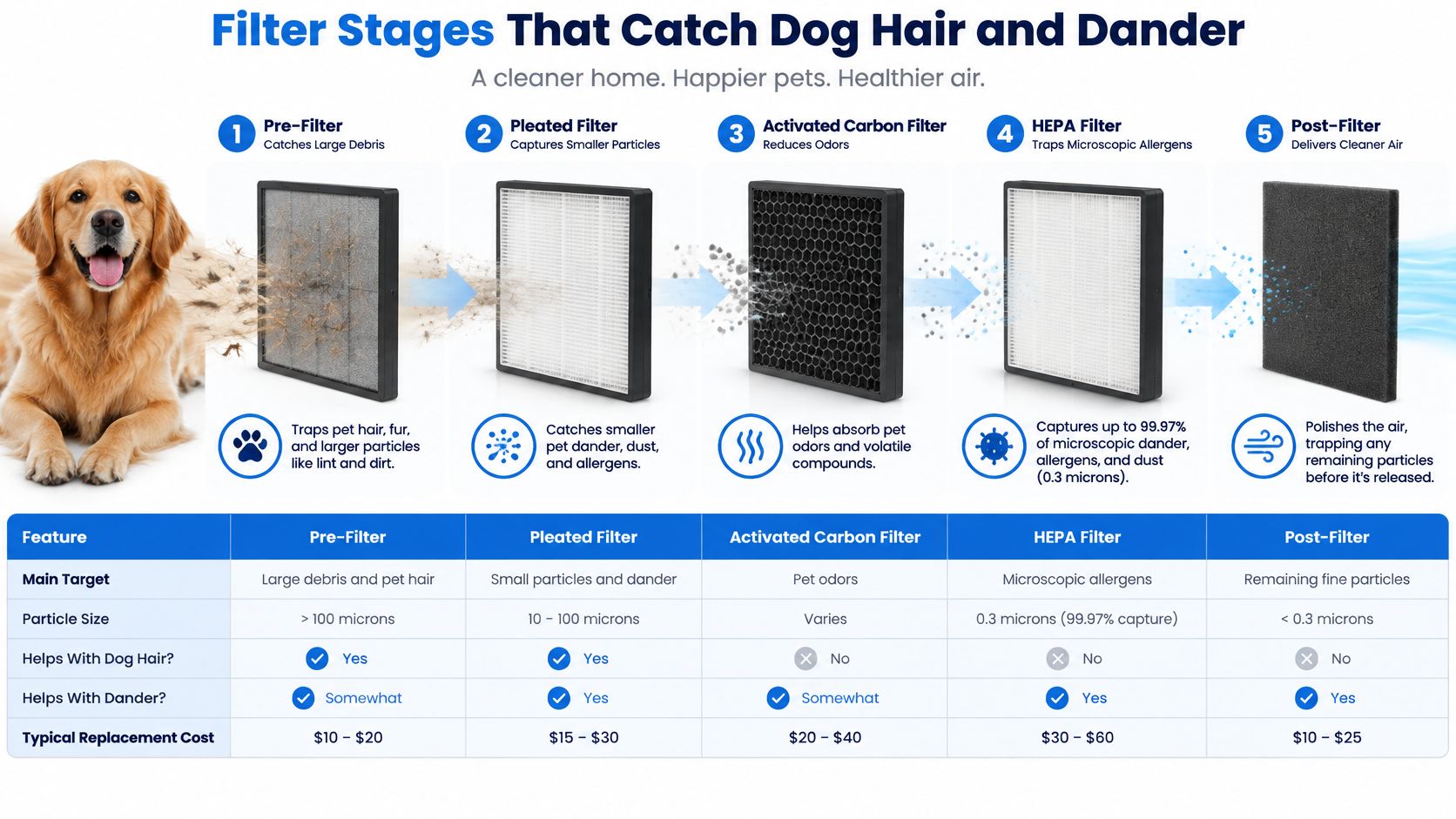
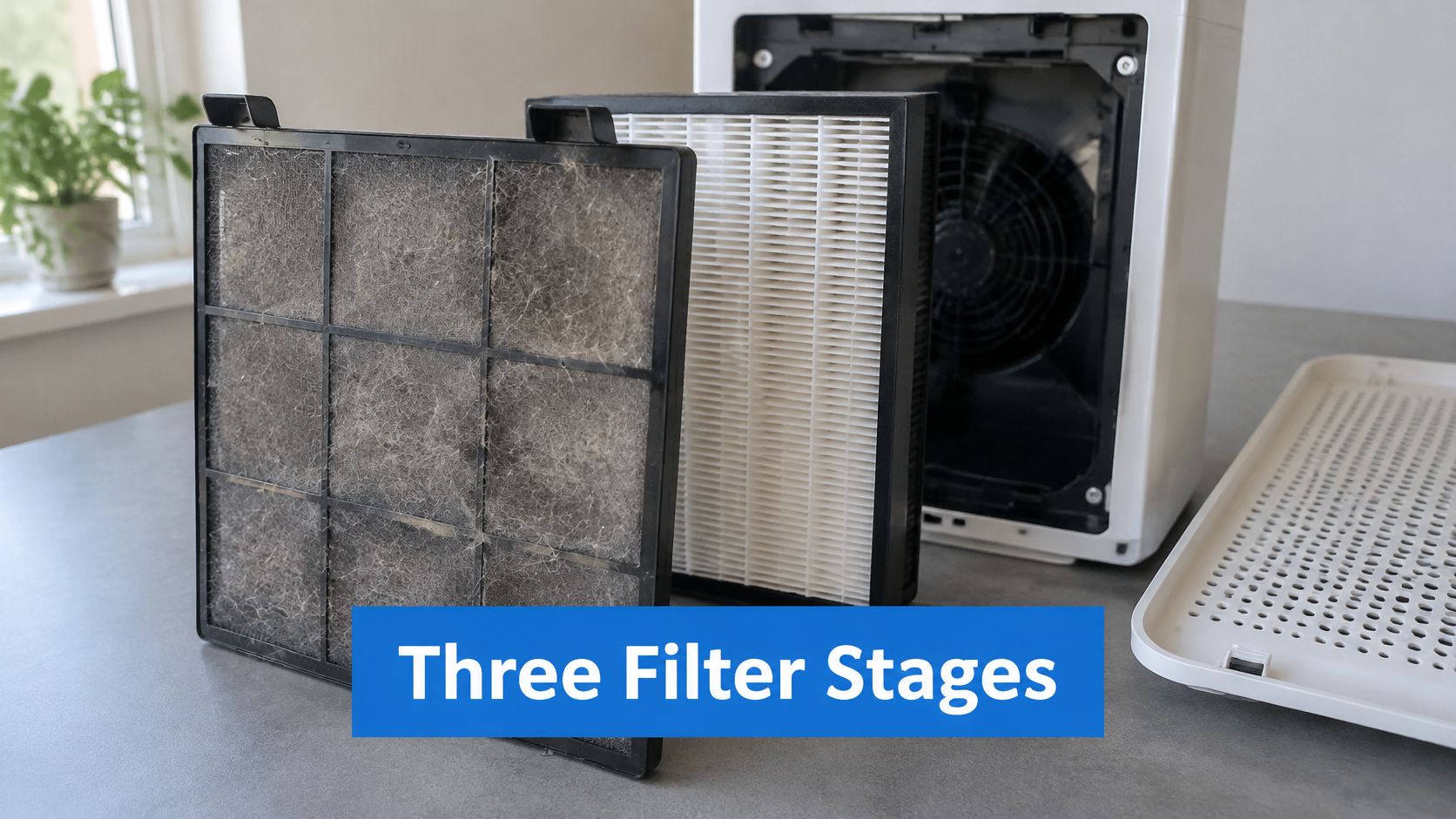
Coarse pre-filter. This mesh takes visible hair, lint, and large fur before they reach the fine media. The protein on fine dust sails through. Heavy loading raises resistance and cuts airflow, so the rest of the machine moves less air even if the inner filter is still new. In a heavy-shedding home, inspect it weekly.
HEPA filter. A genuine HEPA filter is rated to remove at least 99.97% of 0.3-micron particles, and EPA guidance on air cleaners treats animal dander as a particle class mechanical filters can capture while warning that rapid settling limits complete removal from indoor spaces. Room-level results depend on clean-air delivery, run time, filter loading, leakage around the frame, and whether the hair ever became airborne. A HEPA air purifier with a sealed housing forces air through the media instead of around it. Bypass leaves that slice of dander in the breathing zone.
Activated carbon. Carbon targets odors and some gases. It does not collect bulk hair, and it is a weak stand-in for dander capture. Keep it for wet-dog smell once the mechanical stages are already doing the particle work.
Ionizer or ozone stage. These may clump some particles or cut smell. They also can add ozone, which is an irritant. Mechanical capture still has to do the particle work. For allergy-driven buying, I would put a sealed filter first and treat ozone as a separate trade-off for odor.
| Stage | Captures | Misses | Upkeep |
|---|---|---|---|
| Coarse pre-filter | Visible hair, lint and large fur | Fine dust and dander | Rinse or vacuum weekly in heavy shedding |
| HEPA filter | Fine dust and dander particles | Hair already settled on surfaces | Replace on manufacturer interval or when airflow drops |
| Activated carbon | Odors and gases | Bulk hair and most dander | Replace on manufacturer interval |
| Ionizer or ozone stage | Some particles clumped or neutralized | Replaces no filter; adds ozone | Check published ozone level; choose mechanical filtration first |
Settled hair on floors, sofas, and beds is still a surface job. Pair the machine with a HEPA vacuum and damp cleaning. A filtration result measures airborne allergen, not the hair on the floor.
Where to Place a Purifier in a Home With Dogs
Place the purifier high and where air can move freely. Set it as close to the ceiling as possible, or at least five feet from the floor, next to an incoming air vent. Keep the intake and exhaust clear. Behind a sofa or beneath a bed skirt, the unit mainly filters the air trapped around its housing.
Match the room to the exposure
A clinical study found airborne Can f 1 levels were higher when a dog was in the sampled room. In the same clinical study of HEPA cleaning, cleaning cut airborne allergen by about 75% with the dog present and about 90% when the dog was elsewhere.
- Living room: Place the unit near the dog's usual resting spot, where activity can stir settled material into the air.
- Allergic person's bedroom: Run a unit there during sleep, when exposure continues for hours in a closed room.
- Open plan: Position one larger unit between the dog's area and the main walkway, with clear space around its intake.
- Small room: Put a compact unit near the door if that doorway is the room's only connection to the rest of the home.
A bedroom unit serves the sleeping area; a living-room unit serves the dog's active zone. One machine may not circulate air effectively through both. Run it continuously in the room where people and the dog spend the most time. If a single unit cannot serve a separate room, consider a second one. Choose a fan setting you can tolerate at night, since a switched-off purifier provides no filtration.
Maintenance Schedule for Pet-Hair Filters
A clogged pre-filter is the failure most owners miss. Hair mats on the mesh, resistance climbs, and the fine filter loads faster than the manual assumed. Rinsing that mesh protects the expensive stage.
| Task | How Often | Sign It Is Due |
|---|---|---|
| Rinse or vacuum pre-filter | Weekly in heavy-shedding homes | Visible hair mat on the mesh |
| Vacuum intake grille and vents | Weekly | Hair and dust around the air inlet |
| Wipe housing and exterior | Monthly | Dust on the casing and controls |
| Check airflow and indicator | Monthly | Weaker airflow at the outlet |
| Replace HEPA filter | Per manufacturer's interval | Airflow loss or filter indicator alert |
| Replace activated carbon or ozone plates | Per manufacturer's interval | Odor returns after cleaning |
Act on the signs, not the calendar alone
Swap the HEPA filter sooner than the printed interval if outlet airflow drops or a stale smell returns after you have already cleaned the pre-filter. Waiting for a filter to look black wastes weeks of weak delivery. Carbon and ozone plates follow the same logic: if odor is back after a thorough surface clean, the odor stage is spent.
Keep a one-line log. Date each pre-filter rinse and each HEPA swap on a note stuck to the housing or in your phone. The next change is then a date you already know, not a guess when symptoms flare.
Most air purifiers are covered by a one-, two-, or three-year warranty, which does not include replacement parts such as filters, screens, PCO cells and UV bulbs. Before you buy, read which consumables are excluded and budget for replacement filters and screens from the start. A cheap machine with unavailable filters is an expensive paperweight by month six.
Cleaning Habits That Work Alongside a Purifier
A floor that looks hair-free can still set off symptoms. Visible undercoat is only the part you can see. Settled allergen stays in fabric, and grooming throws a fresh cloud the purifier has to catch once loose hair is already out of the room.
Work the room in this order so the fan is not the first tool on a loaded carpet.
- Vacuum floors and upholstery with a HEPA vacuum first. The bag or canister holds loose hair and dust instead of blowing them back. Raise the purifier to high only after that pass.
- Damp-wipe hard floors, baseboards, and furniture legs. A dry duster moves allergen from one surface to another. A slightly damp cloth holds it.
- Wash pet beds, throws, and bedding weekly, and use washable sofa covers. Saliva and dander stay in fabric for days after the floor looks clear.
- Brush the dog outdoors or in one grooming spot. Loose undercoat comes off before it travels through the house. Run the purifier on high during and after that session, because grooming is when the airborne load spikes.
- Bag the brushed hair and wash the towel or mat from that session the same day. Otherwise the undercoat you just removed walks back in on fabric.
A 2024 systematic review in the Journal of Asthma and Allergy reported that HEPA filtration reduced allergen concentrations by approximately 65% to 90%. That range describes air capture after the room is already cleaned. A 2023 Dyson Global Dust Study, cited by TechRadar, found that as many as 50% of pet owners allow their pets to sleep on their beds, which is why weekly bedding washes matter in those homes.
For the wipe-down, it helps to compare natural products for pet homes so the cleaner on floors and upholstery is not itself a problem for the animal. Clean surfaces first, then leave the purifier running so it catches what walking and sitting release afterward.
Sizing a Purifier for Your Dog's Room
Measure the room before you compare features. A coverage claim printed for a whole floor will disappoint in the one room the dog uses.
- Get the floor area. Multiply length by width for square footage. If the ceiling is well above a standard eight feet, note that extra volume, because the same floor area holds more air.
- Read the clean air delivery rate. CADR describes how much filtered air the unit delivers. It is more useful than a marketing coverage number alone.
- Match CADR to the room. A workable rule of thumb for allergen control is a CADR of at least two-thirds of the room's square footage. A 300 square foot living room needs a CADR around 200 or higher.
- Size up for heavy shedding. A loaded pre-filter lowers airflow. A unit rated only just above the room will underperform once hair mats the intake.
- Size each room on its own. An open plan may need one larger unit between the dog's zone and the walkway. An allergic person's bedroom can often use a compact unit sized to that room alone.
Confirm CADR and room size on the spec sheet before you argue about carbon, apps, or noise. Airflow that is too small for the space makes every later feature irrelevant.
Choose a Purifier Built for a Home With Dogs
A purifier can reduce airborne particles and odors, but it will not pick hair off the floor or remove allergens already settled on furniture. Choose for the room and the household's main concern, then keep up with filter cleaning.
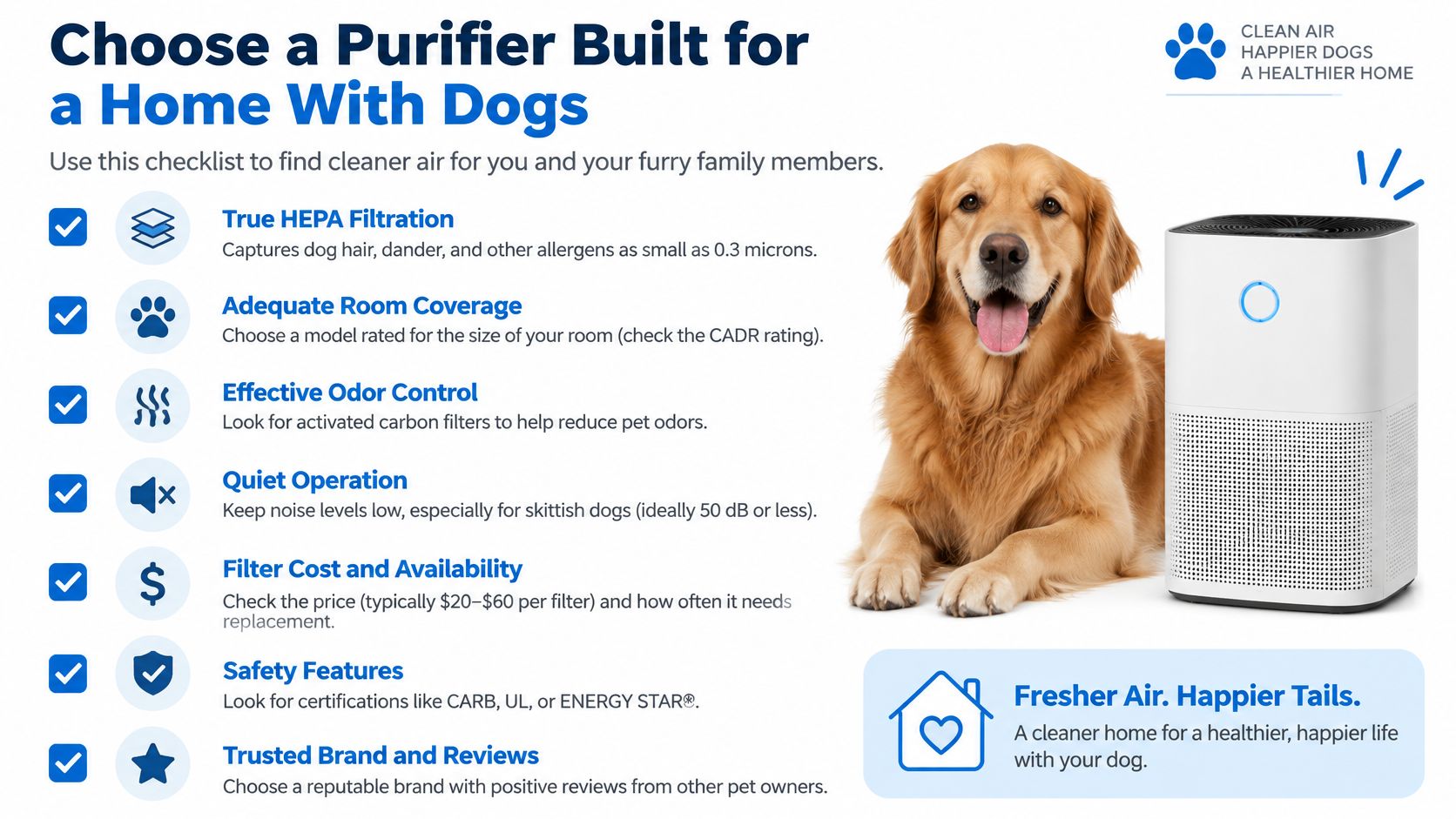
For homes with shedding dogs, compare these features:
- A HEPA filter and a good seal. A sealed filter path helps keep particles from bypassing the filter.
- A pre-filter that is easy to clean or replace. It catches larger debris, including hair, before it reaches finer filtration.
- Room coverage that fits the space. A whole-house claim does not show whether a unit suits a particular bedroom.
- A clear explanation of ozone use. Ozone can help neutralize lingering odors, but it does not replace particle filtration for airborne dander.
- Filter costs and warranty terms. Replacement parts such as filters, screens, PCO cells and UV bulbs are not covered by EcoQuest's purifier warranties.
Verdict by household
For heavy shedding and allergy concerns, prioritize a HEPA filter with a pre-filter that you can maintain. Odor control is a separate need: charcoal filtration can address odors, while ozone is used to neutralize lingering smells. Neither stage removes hair already settled around the room.
The Breeze 2 includes charcoal and standard HEPA filtration, plus two ozone plates, on top of the Fresh Air Purifier's technology. The portable, quiet Breeze AT covers up to 1,500 sq. ft. and has UV and ozone technology, along with a washable pre-filter. For a smaller area, the Air Ionizer Purifier EcoSpace is a plug-in model priced at $159.99. It covers up to 500 ft² with ions and ozone.
Choose according to the room and the problem you want to address. A purifier can treat air moving through it; vacuuming and surface cleaning still handle hair and settled allergens.
EcoQuest Purifiers sells room, portable, whole-house and other air purifiers, along with replacement parts. Compare the room coverage, filtration and upkeep needs of the available models before choosing one for a home with dogs. Visit EcoQuest Purifiers to review its purifiers and replacement parts.